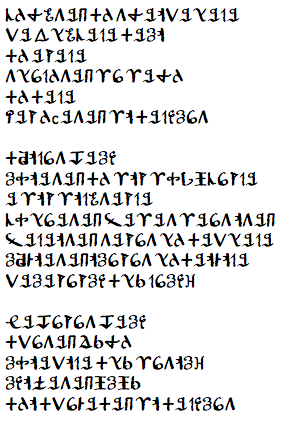
Naming conventions in Rílin: names of people

I have been thinking a lot lately about names. In a language, names have a variety of ways they may manifest. Some are derived from older words in the language, some are identical to contemporaneous words, and some need certain morphology to indicate that they are, in fact, names, and not just regular words.

Rílin Given Names

In my various conlangs, I’ve taken different approaches to naming people. In Rílin, for example, there are specific name morphemes that mark a word as a person’s name. Some of these are gender specific, and some are gender neutral. Some have roots are traceable to either Rílin or Old Rílin words, but some do not have even discernable meaning. Below are some examples.

Feminine Names

Some feminine name suffixes include: -tót, -í, -u, -in/-ín, -ló

The following names are all derived from contemporary Rílin words, which become names with a suffix. (You can click on each name to hear it spoken.)

Bishéín [ˈbɪʃein] – from bishé ‘bright’
Esuí [ˈɛsui] – from esu ‘griffin’
Fylûlatót [fyˈlʌlatot] – from fylûla ‘bird’
Ítshaló [iˈtʃalo] – from ítsha ‘luck’
Kisin [ˈkɪsɪn] – from kis ‘honeybee’ or maybe kis ‘slender’
Mímin [ˈmimin] – from mím ‘cute, little’
Nesú [ˈnɛsu] – from nes ‘graceful’

 -tót-in/-ín-ló
bishé ‘bright’   Bishéín 
esu ‘griffin’ Esuí   
fylûla ‘bird’Fylûlatót    
ítsha ‘luck’    Ítshaló
mím ‘cute, little’   Mímín 
kis ‘honeybee’   Kisin 
nes ‘graceful’  Nesú  
Various Rílin word roots paired with naming suffixes can create names. These names are specifically feminine names.

Not all Rílin names have clear or discernible meanings. They may still include some of the typical suffixes, but when detached from the rest of the word, that series of sounds does not necessarily make up a Rílin word.

Änsu [ˈænsu]
Äshtín [ˈæʃtin]
Alaí [ˈalai]
Bûlaísí [bʌˈlaisi]
Nímu [‘nimu]
Silin [ˈsɪlɪn]
Tsilu [ˈtsɪlu]
Tsheló [ˈtʃɛlo]

Masculine Names

Some suffixes are masculine, such as -n, -ó, -a, -ret.

Awun [ˈawun] – from awu ‘upright’
Bynóret [ˈbynoɾɛt] – from bynó ‘morning’
Daghóra [daˈɣoɾa] – from daghóra ‘sacrifice’
Evekaret [ɛˈvɛkaɾɛt] – from eveka ‘streak, brook’
Fífaía -[fiˈfaja] – from fífaí ‘advantage, benefit’
Gómó [ˈgomo] – from góm ‘thought, mind, know’
Kér̂a [ˈkeʂa] – from u ‘step forward, put (oneself) forward’

 Some names may use naming suffixes but have indeterminate root meanings.
Ekhéla [ɛkˈhela]
Feneret [ˈfɛnɛɾɛt]
Gíŕan [ˈgiʐan]
Kedûn [ˈkɛdʌn]
Pirór̂nó [pɪˈɾoʂno]
Shíburet [ˈʃibuɾɛt]
Óŕina [oˈʐɪna]

Gender Neutral Names


Other name suffixes are gender neutral, such as -ja, -bí, and -tos. These could be used for a person of any gender. Some of these names are very old and no longer have clear roots.

Béíntos [ˈbeintɔs] – unknown root
Ískesébí [iskɛˈsebi] – from ískesé ‘high, tall’
Jenja [ˈjɛnja] – probably from jen ‘day’
Kótos [ˈkotɔs] – maybe from ‘intention, meaning’

Other names may not include a suffix at all. Most of these names can be used regardless of gender.

Amlim [ˈamlɪm]
Köle [ˈkølɛ]
Ŕetsŭ [ˈʐɛtsɯ]
Nemne [ˈnɛmnɛ]
Valhén [ˈvaɬen]

Rílin Family Names

Rílin family names come after given names. Names are inherited by children from their parents. Female children inherit their mother’s name, and male children their father’s name (typically, although there are exceptions to this). Therefore, they are somewhat matronymic and patroymic in function, although they also act as family names since there is no other inherited name for most Rílin people.

For example, Silin, a middle-aged Rílin woman, would have her mother’s last name, Bízunla. Her husband, Nósh, would have his father’s name, Ínómí. Their son would take his father’s name too. Family names often concern personal traits, origins, trades, and skills. Bízunla comes from bízun ‘alarm, alert’, with a possible agentive suffix -la. So the original meaning might have been “one who warns or foretells”. Ínómí looks like the word ínó ‘color’ plus a genitive suffix –, so might mean “with color, of color”. This could either have originally referred to a personal trait (some color of the body–hair, eyes, skin, or even clothing) or it could have referred to a colorful place of origin, like a green forest or floral garden, etc.

These are just a few points concerning Rílin naming conventions. In the future, I will write a bit about Rílin nicknames as well as expand on naming conventions of other cultures across Aeniith. Thanks for reading!
Some Lexember examples: new words in conlangs

December is the month that conlangers of all kinds participate in something called Lexember. We create a new word (in the lexicon) for our conlang(s) every day of the month. I’ve been participating and sharing words largely through tumblr (user: aeniith) and twitter (@MintakaGlow). Here are a few from the first days so far.


Rílin

Dec 1:

íha [ˈiha], [v tr/intr] : [1] forgive, pardon; accept, understand; [2] know, acknowledge, recognize; [3] bring attention to, point out, remark on; [4] notice, realize

Etymology: Possibly from iŵ- [iɸ] ‘take in, accept’ and ja ‘know’

Example:

íhazim kasa tañ lönenet naba ŵedínla
íha      -z        -im kasa       tañ        lön -en-et     naba                  ŵedí -n-la
forgive-pst.prf-1s already dist woman-pl-abs whatever wrongdoing-pl-instr
“I have already forgiven those women for any wrongdoing’

Karkin

Dec 2:

vkāmēgh [vkɑːˈmeːɣ] [v tr/intr] (ki-verb class) : [1] break out of, escape from within; [2] break down a wall or other barrier; [3] (fig) destroy a boundary, flout a rule, defy expectations

Etymology: From vkā ‘strike, hit’ and mēgh ‘run, run away’.

Example:

Psi  nux-ë     twë  qhrō    ki    vkāmēgh-ā  -yi         vuq     kuqhkë mi  ja   wëngi-ā   -pa   
dist girl-3s.p  who early part defy        -pst-3s.a    all       clan      gen part speak-pst-1s.a
“I spoke with that girl who had previously broken all the boundaries of her family clan.”

Rílin

Dec 3:

bióŝû [bɪˈoʃʌ] [v intr] : [1] walk precariously, walk on a slippery or icy surface; [2] be in a precarious or unsure state; [3] be in a risky state, ‘walk on thin ice’.

Etymology: From bió ‘slip, slide’ and [jó]ŝû ‘walk’.

Example:

Ŝy-ky  sé    zaín séfet   tû pre-t       pato        bióŝû -l -í
be-irr prox time now do care-abs because walk.slippery-prs.hab-2s.fam
‘Now is the time to take care because you are in a precious position’

Rílin

Dec 4:

móníhas [moˈnihas] [n, inan] : [1] portent, omen, sign; [2] hint, clue; [3] tell, revealing action.

Etymology: From móní ‘watch, guard’ and has ‘sign, signal’.

Example: Né      í-t     -íí          kuala              -n-et ómina-mí,    x-óly    -t      -aap      lí-et      
      if   look-npst-2s.fut constellation-pl-abs sky-gen  caus-solve-npst-3s.fut 2s-abs the

                 bí ǵom-et ka-ŝó      kalum-mí a       oma-mí.  
                 knot-abs two-adv world-gen and  soul-gen

“If you look into the constellations in the sky, it will let you untie the knot of both the world and the soul.”

Tosi

tūgh [tuːɣ] [n] : [1] face; [2] front; [3] cover, outside covering, skin; [4] sleeve, sock, outer layer (e.g. of a wrapping, of clothing); [5] protective layer, protection, assurance, aide, help, assistance, back-up, auxiliary force.

Etymology: From Old Tosi tūhuz- “face; scalp”

Example:

Tapi sur ja da chi tūgh i vis rīy.
imp angle vrblz 2s.fem gen face obj to sky
“Turn your face toward the sky”

Tosi

Dec 6:

gungar [ˈɡuŋɡar] [v, tr] : [1] chase, pursue; [2] hunt (e.g. animals); [3] fish, catch fish; [4] seek out, look for, search for.

Etymology: From gar ‘follow’, and gun-, an emphatic prefix (cf. gun ‘great, might’).

Example:
Na gangur na chi xeti gek i, gempe tapi ixari!
1s.f pursue 1s.f gen female.servant drunk obj please imp help
“I’m chasing after my drunken servant, please help me!”

Tosi

Dec 7:

hās [hɑːs] [v, tr] : [1] fill; [2] replenish; [3] add to, increase.

Etymology: From old Tosi hāh-, hāθ- ‘full, plentiful’

Example:
Tapi hās na chi kūn i ge na gō tiv gunāl.
imp fill 3s.f gen cup obj if 3sg.f be punct.fut empty
“Fill her cup if it is empty”


Translation practice in Rílin

I’ve been doing more practice translation for Rílin, to fill out any needed grammatical or lexical gaps. Here is a recent one, taken from here.

English: “That is the city of the Goyanim. They are a strange people. They light their cities at night, as if the stars weren’t sufficient for their needs. They fight and kill each other, not realising the greater danger beyond their small world. And they do not hunt each other with bows and arrows. No, they have strange devices that kill from far away without arrows. And take care near their strange iron horses they use to travel. They travel faster than any natural beast ought to, and ignore the strength of the bow and arrow. Best if you avoid their cities, my son.”

Rílin: “Tañ yẃäp Góyanimenmu. Be’a li apen. Xavéjalapen tañ yẃäpet bänkasla, do be hyzû bín kuan. Ŝílapen apenset a zansalapen. Be mílulapen bí gaŝ krur̂ûet dexe ẃy kalumla apenmu. Be siŝulapen apenset kótûñla a ítäla. La, lykylapen be’a mönet baes zansalapen róŝó ŝa ítänla. A toroky né lí mu be’a ǵasíaínla zar̂mí baet lykylapen níñgíle. Zaílapen psötar̂ó dexe gölhañ ŝutréla, dexe lhyntíla kótûñmí a ítämí. Ptatí histä tañ yẃäpenet, mävû.”

I imagine a Rílin father telling his son about a culture with more advanced technology (possibly Tosi?). I may do an interlinear gloss but for now, it stands as-is. More to come.

Greetings after a while!

It’s once again been a while. I’ve been busy with a lot of things–mostly my research and lots of international travel! I’ve been in six countries since May!

One of the things I was doing while traveling this summer was attending the Language Creation Conference (the 8th biannual) in Cambidge, UK. My husband Eric and I started off the conference with some musical performances of songs in several conlangs (Gotevian, Tosi, and Rílin). We’d written some Aeniithian music before but wrote several of the pieces for the conference specifically. Eric is a composer and musician, as well as a 3D graphics designer and synth expert, so we jointly designed musical instruments unique to Aeniith cultures. We also designed musical notation systems for each culture and the musical scales that they represent. We performed four songs, two of which can be heard/seen:, and Ŵatakap Bí Xabhét (Rílin), which has a video that can be seen here.

We also presented a poster that explains a bit about the unique instrument designs (and includes 3D models of them by Eric), musical notations, etc.

Conference-Poster

I am starting a mailing list since a lot of people wanted updates for lyrics, new songs, etc. So if that’s you too, email me at ransdell AT hawaii DOT edu, and I will add you!


Margaret

Rílin language: expression of sorrow and sympathy

Well, it’s been a while! I do want to get back in to posting things here, despite my busy workload. Maybe it’s even better for me to do so because of that workload.

Anyway.

In light the recent catastrophe in Paris, I have been thinking about how the Ríli form expressions of sorrow, sympathy, condolences, etc. Languages often have formalized/idiomized or set phrases for these kinds of expressions, so I thought it was important that Rílin did as well. Rílin culture emphasizes harmony, support, respect, and sensitivity to others’ emotions, so I wanted to make their phrases of sorrow and sympathy reflect some of those values too. All of the words and grammar used herein are extant parts of the Rílin language–I am configuring them in ways that seem appropriate.

Note: the variations on the way of saying ‘you’/’your’ are due to traditional Rílin’s (and Lunauli Rílin) way of distinguishing three levels of formality/familiarity for pronouns and persons (lí at the most familiar and zana at the most formal for ‘you sg.’).

Lilaíkim – ‘I am grieving/mourning/crying’ (this word lilaí also means to weep copiously)
lilaí-k-im
/lɪˈlaikɪm/
grieve-pres.prog-1sg

Lilaíkim líu/xyu/zanau – ‘I grieve with thee’
lilaí-k-im lí-u/xy-u/zana-u
/lɪˈlaikɪm ˈliu (ˈxyu) (ˈzanau)/
grieve-pres.prog 2sg-instr

R̂yla límu/xymu/zanamu imi – Lit., ‘I am in/with thy sorrow’
r̂y-la lí-mu/xy-mu zana-mu imi
/ˈʂyla limu (ˈxymu) (ˈzanamu)/
sorrow-instr 2sg-poss

Hestia(tíí)/(tyy)/(taa)ky – Lit. ‘may you recuperate/rest’
hestia-t-íí/t-yy/t-aa-ky
/hɛstɪaˈtiiky (hɛstɪatyyky)(hɛstɪataaky)/
rest-npst-2sg.fut-irr

Bítapky Démas/Ifinŝas líet/xyet/zanat – ‘May Déma/Ifinŝe embrace/aid thee’ (depending on which goddess you would like to reference)
bí-t-ap-ky Déma-s/Ifinŝe-as lí-et/xy-et/zana-et
/biˈtapky ˈdemas(ɪfɪnʃas) ˈliɛt (ˈxyɛt)(ˈzanat)/
embrace/aid-npst-3sg-irr Déma-erg/Ifinŝe-erg 2sg-abs

Rílin script

So you’ve all probably seen at least some of my numerous poems written in Rílin, along with their accompanying script. I wanted to explain how the alphabet for Rílin works.

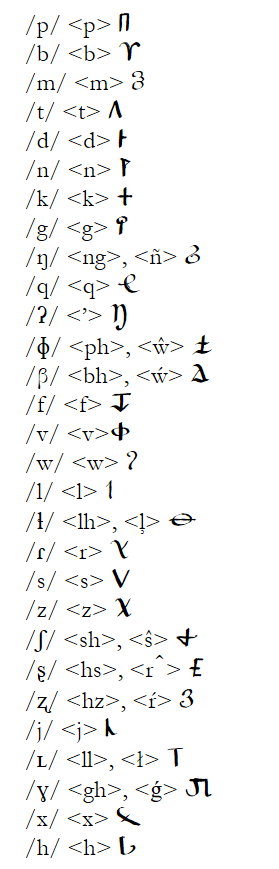
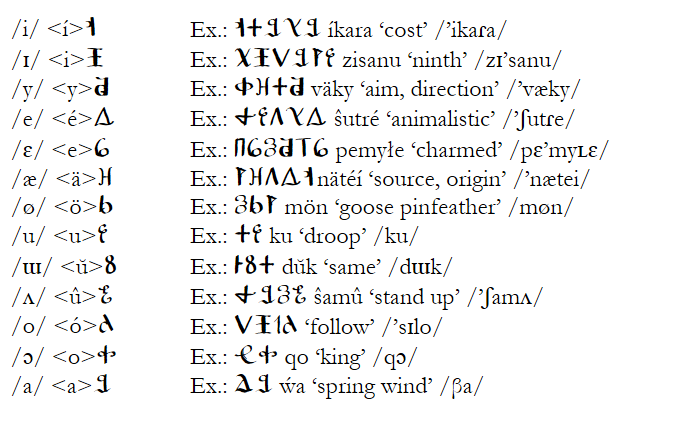
It is pretty simple conceptually. Rílin traditionally uses a phonetic alphabet, where each letter corresponds to a phoneme (distinguished sound) in the language. Rílin has a large phonemic inventory (29 consonants and 13 vowels), so there are as many letters in the alphabet.

In the below image, you can see the IPA symbol for each Rílin phoneme, followed by (in brackets) the Romanized representation (sometimes there are variants available for those times when it is not convenient or possible to use diacritic marks)

rilinletters
Consonants

vowels
Vowels


New maps

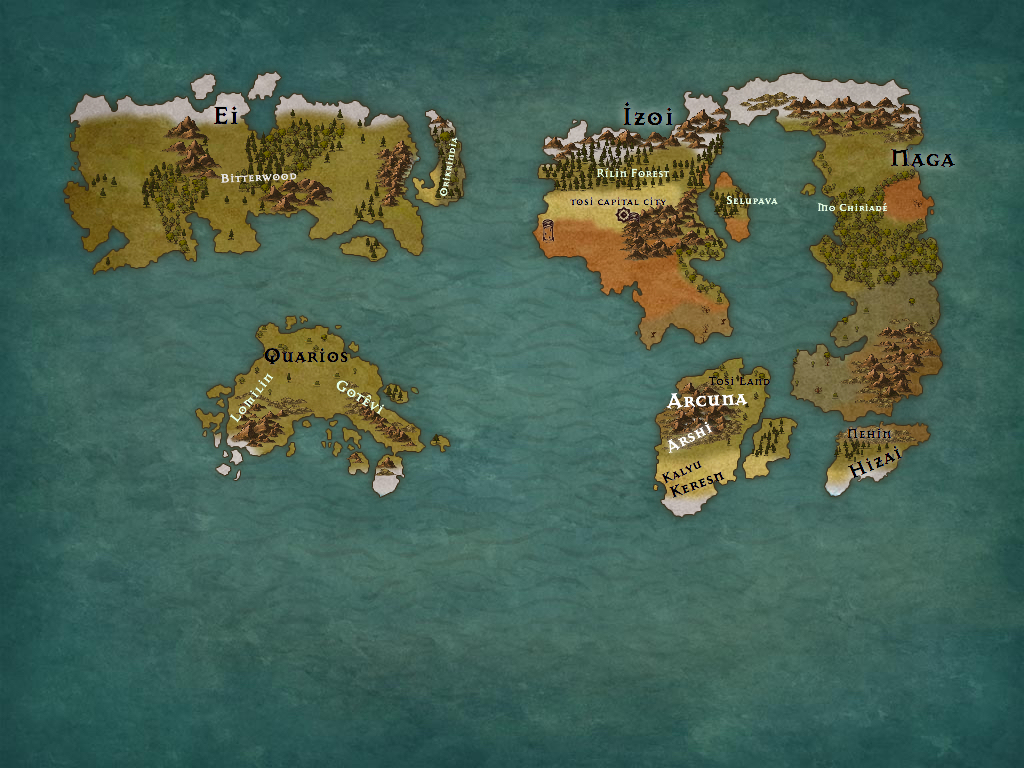
I’ve been updating my maps and geography of Aeniith and decided to try new styles. These are made with Inkarnate.


Regional Map of Izoi: See Full Version here: here 

izoimap_new.png

I added rivers, a few lakes, and more features. The fortress of Ad Simel Tī is where Dark Designs takes place. Zūr Chi Lār Na means Tower of Death in Tosi and basically is the watch tower for the western seas, in case any force tried to invade from Keta (which no wants to, but the Tosi are nothing if not paranoid). You can see the eastern island that is shared by the Selupa and the Karkin. The Karkin just get the shit end of the island that are plagued by sandstorms and have fewer resources. 😛

Then, in the Rílin forest, you can see the respective regions where the Ríli went after the Flight (post Tosi invasion), with some fleeing north and building underground cities (the Lunauli) and living in the cold mountainous area, and some (the Sunuli) choosing to stay south and fight the Tosi. There is a steppe between the forest and the desert that is a kind of no man’s land but of course the Tosi claim it.

That chasm south of the mountains is filled with a poisonous gas and the Tosi send their really hated enemies there. It also might be kind of sort of haunted.


Unfinished full map 

Still needs fresh water bodies, more placenames, etc. And there’s too much ocean at the bottom of the map, hehe. But, it’s a start. Full view here.


Map-8.jpg

Mintaka

Image of a Rílin woman: Silin

Commissioned art of a Rílin woman named Silin. Free Image Hosting at FunkyIMG.com (Please click the image to see the full size version! It looks squished when I insert it here.)

Silin is a scount with the Sunulí guerilla militia. She spies on the Tosi encampments and is an expert tracker of the woods. Her home settlement was destroyed in the initial Tosi attack on Rílin border towns, and Silin’s husband and young son were murdered. She wandered for a few years and fled to the northern coast of Elinís̆. It was here she met Tsilu, another Rílin woman who had fled the invasion, and they became friends, and eventually lovers.

I want to write stories about Silin, but I have three WIPs going right now that need to be dealt with first!

More places moodboards…

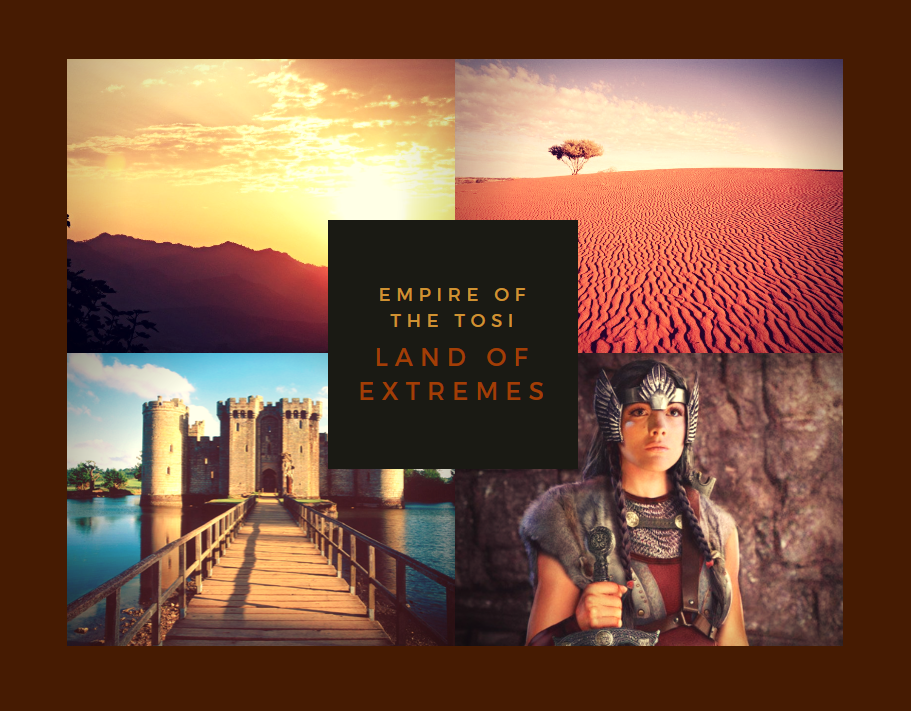
More moodboards for places in Aeniith. The Tosi Empire (mostly warm and arid, large, lots of military forts and castles and such, female-ruled society, imperialistic, etc), and the Rílin forests of northern Izoi (same continent mostly): cool, green, good for hiding, and actually toxic to most non-Ríli. The Tosi invaded them anyway for resources but the Ríli will eventually win this long war for their homeland, though not without great cost.


tosimoodboardrilinmoodboard