Naming conventions in Rílin: names of people

I have been thinking a lot lately about names. In a language, names have a variety of ways they may manifest. Some are derived from older words in the language, some are identical to contemporaneous words, and some need certain morphology to indicate that they are, in fact, names, and not just regular words.

Rílin Given Names

In my various conlangs, I’ve taken different approaches to naming people. In Rílin, for example, there are specific name morphemes that mark a word as a person’s name. Some of these are gender specific, and some are gender neutral. Some have roots are traceable to either Rílin or Old Rílin words, but some do not have even discernable meaning. Below are some examples.

Feminine Names

Some feminine name suffixes include: -tót, -í, -u, -in/-ín, -ló

The following names are all derived from contemporary Rílin words, which become names with a suffix. (You can click on each name to hear it spoken.)

Bishéín [ˈbɪʃein] – from bishé ‘bright’
Esuí [ˈɛsui] – from esu ‘griffin’
Fylûlatót [fyˈlʌlatot] – from fylûla ‘bird’
Ítshaló [iˈtʃalo] – from ítsha ‘luck’
Kisin [ˈkɪsɪn] – from kis ‘honeybee’ or maybe kis ‘slender’
Mímin [ˈmimin] – from mím ‘cute, little’
Nesú [ˈnɛsu] – from nes ‘graceful’

 -tót-in/-ín-ló
bishé ‘bright’   Bishéín 
esu ‘griffin’ Esuí   
fylûla ‘bird’Fylûlatót    
ítsha ‘luck’    Ítshaló
mím ‘cute, little’   Mímín 
kis ‘honeybee’   Kisin 
nes ‘graceful’  Nesú  
Various Rílin word roots paired with naming suffixes can create names. These names are specifically feminine names.

Not all Rílin names have clear or discernible meanings. They may still include some of the typical suffixes, but when detached from the rest of the word, that series of sounds does not necessarily make up a Rílin word.

Änsu [ˈænsu]
Äshtín [ˈæʃtin]
Alaí [ˈalai]
Bûlaísí [bʌˈlaisi]
Nímu [‘nimu]
Silin [ˈsɪlɪn]
Tsilu [ˈtsɪlu]
Tsheló [ˈtʃɛlo]

Masculine Names

Some suffixes are masculine, such as -n, -ó, -a, -ret.

Awun [ˈawun] – from awu ‘upright’
Bynóret [ˈbynoɾɛt] – from bynó ‘morning’
Daghóra [daˈɣoɾa] – from daghóra ‘sacrifice’
Evekaret [ɛˈvɛkaɾɛt] – from eveka ‘streak, brook’
Fífaía -[fiˈfaja] – from fífaí ‘advantage, benefit’
Gómó [ˈgomo] – from góm ‘thought, mind, know’
Kér̂a [ˈkeʂa] – from u ‘step forward, put (oneself) forward’

 Some names may use naming suffixes but have indeterminate root meanings.
Ekhéla [ɛkˈhela]
Feneret [ˈfɛnɛɾɛt]
Gíŕan [ˈgiʐan]
Kedûn [ˈkɛdʌn]
Pirór̂nó [pɪˈɾoʂno]
Shíburet [ˈʃibuɾɛt]
Óŕina [oˈʐɪna]

Gender Neutral Names


Other name suffixes are gender neutral, such as -ja, -bí, and -tos. These could be used for a person of any gender. Some of these names are very old and no longer have clear roots.

Béíntos [ˈbeintɔs] – unknown root
Ískesébí [iskɛˈsebi] – from ískesé ‘high, tall’
Jenja [ˈjɛnja] – probably from jen ‘day’
Kótos [ˈkotɔs] – maybe from ‘intention, meaning’

Other names may not include a suffix at all. Most of these names can be used regardless of gender.

Amlim [ˈamlɪm]
Köle [ˈkølɛ]
Ŕetsŭ [ˈʐɛtsɯ]
Nemne [ˈnɛmnɛ]
Valhén [ˈvaɬen]

Rílin Family Names

Rílin family names come after given names. Names are inherited by children from their parents. Female children inherit their mother’s name, and male children their father’s name (typically, although there are exceptions to this). Therefore, they are somewhat matronymic and patroymic in function, although they also act as family names since there is no other inherited name for most Rílin people.

For example, Silin, a middle-aged Rílin woman, would have her mother’s last name, Bízunla. Her husband, Nósh, would have his father’s name, Ínómí. Their son would take his father’s name too. Family names often concern personal traits, origins, trades, and skills. Bízunla comes from bízun ‘alarm, alert’, with a possible agentive suffix -la. So the original meaning might have been “one who warns or foretells”. Ínómí looks like the word ínó ‘color’ plus a genitive suffix –, so might mean “with color, of color”. This could either have originally referred to a personal trait (some color of the body–hair, eyes, skin, or even clothing) or it could have referred to a colorful place of origin, like a green forest or floral garden, etc.

These are just a few points concerning Rílin naming conventions. In the future, I will write a bit about Rílin nicknames as well as expand on naming conventions of other cultures across Aeniith. Thanks for reading!
I liiiive~

Or should I say: kyílaíkim!

It’s been a while! I have been involved in so many things recently, not least of which was finishing my PhD in December 2022! Now that I am now longer writing my dissertation, I have more time.

What is new in Aeniith?

Well, I began some preliminary work on a non-linear, multi-modal writing system. I also structured a language that it is used for, although only the basics of that are done. The orthography is based on shapes, color, and other features of abstract pictoral representations. Essentially, different morphemes of this rather agglutinative language are represented variously by shapes, colors, etc. featured in what are basically pictures. There is a basic template, onto which different additional shapes in different colors can be added. These add the “flavor” of the verb, which is the inflectional morphology.

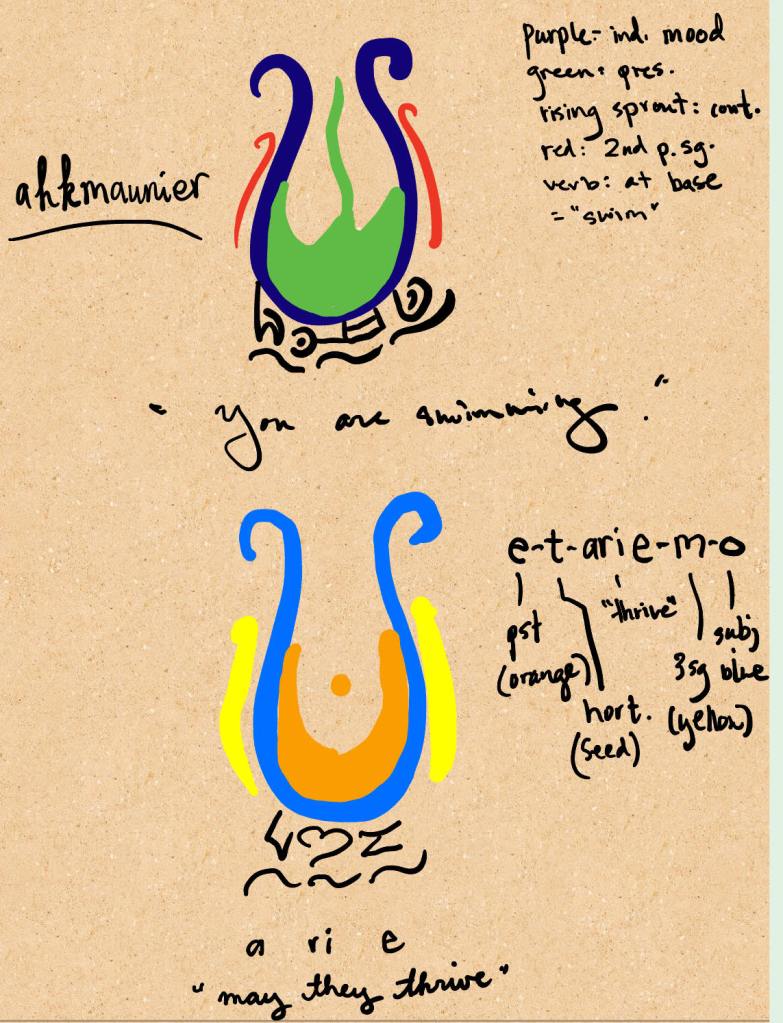
Below, you can see the verb root, which is written in a syllabary, below the “morphological seed pod”–the non-linear portion–which adds morphology to the root. For the first picture, the word written is ahkmaunier ‘you’re swimming’. The root is mauni ‘swim’, which is written in black near the bottom. The purple sides mean ‘indicative mood’, the green is ‘present tense’, the rising sprout shape is ‘continuative aspect’, while the red outer edges indicate the 2nd person singular ‘you’. In terms of the break down of the sounds of the verb, you can find it below:

a-hk-mauni-er-∅
prs-cont-swim-2s-ind

The next picture, just above, represents the verb “may they thrive”. The same basic shape is the same–see the verb root written in black at the bottom. The colors and internal shape are different though. The past tense e- is represented in the orange. The hortative morpheme, -t- is represented by the seed dot in the center. Yellow sides represent the 3rd person singular, while the subjunctive mood –o is indicated by the blue color of the basic “pitcher” shape.

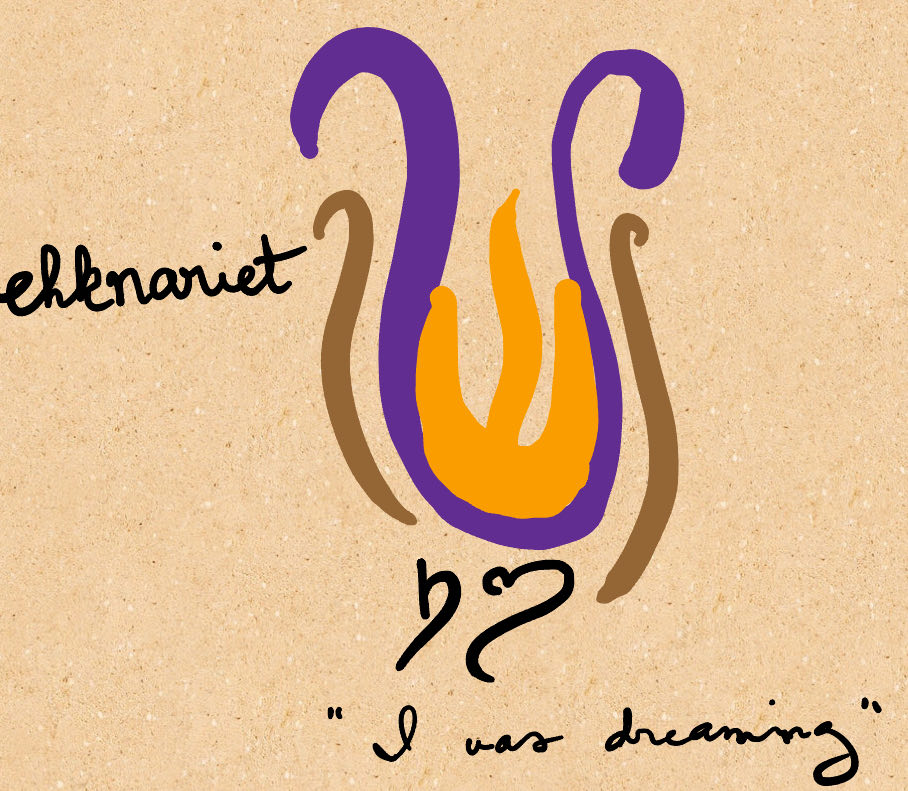
Now above, there is another example. This time, the root is nari- ‘dream’. The basic color purple indicates, again, the indicative mood, which is zero marked in this language. e-, the past tense, is represented by the center orange color. Continuative aspect -hk– is clear from the rising sprout shape. The brown sides indicate 1st person singular -(e)t.

e-hk-nari-et-∅
pst-cont-dream-1s-ind
‘I was dreaming’

Here is another example. This one represents the word ahkrōtaiam ‘he is sowing seeds’, with some additional phonological and phonetic representationss: /aʰkroːˈtaiam/ [aʰkɾoːˈtajəm]

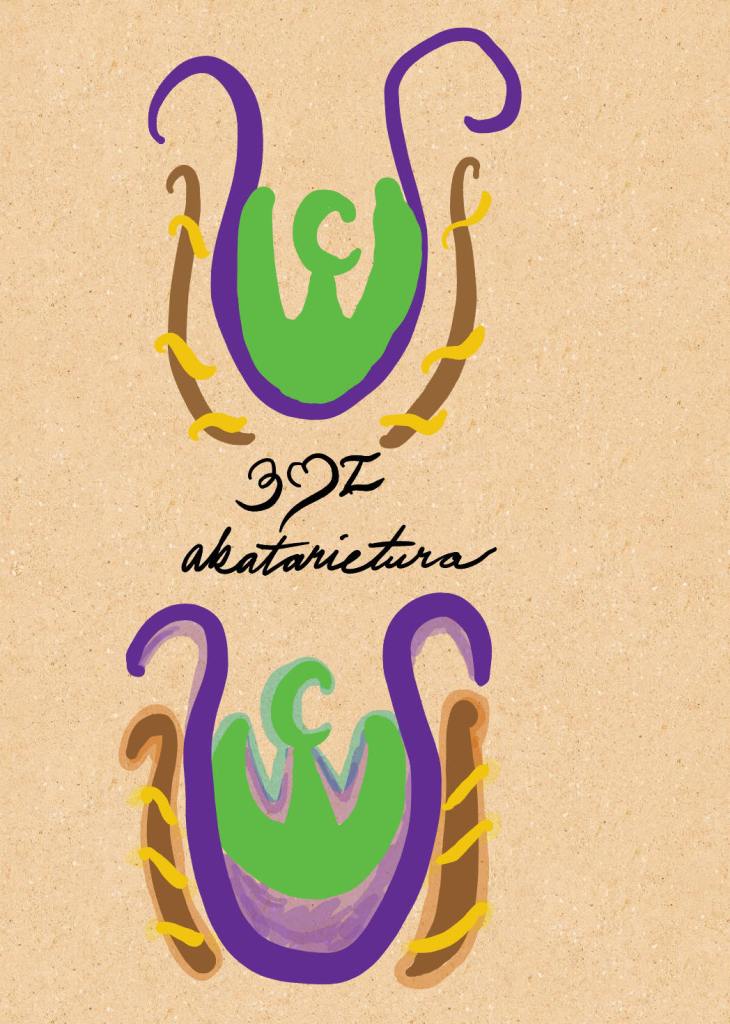
Here is another verb, akatarietura ‘I want to care for you’. This verb incorporates object marking, which is demonstrated by the yellow vines that wrap around the outer brown ‘petals’. The upper version is simpler, while the bottom version is a little fancier.

Above is a breakdown of this same word, with another version of it written/drawn. Also included here are a morphemic gloss of the word, and some examples of verb roots.

prs-vol-A-care.for-1s-2s-A
a-k-(a)-tarie-t-ura-a
akatarietura
‘I want to care for you’

I will likely be expanding this system, as well as the language it was created for, in the next few months. Stay tuned.

~Mintaka

Gotevian food?

Someone recently asked me what kind of food Gotevians eat.

Gotêvi is one of the countries within Quarios–a continent but also a kingdom, of sorts. It is in the southern hemisphere of Aeniith, with its north near the equator and its south becoming more temperate and even quite cold at times. Much of the land of Quarios is either a. forest/jungle in the north, or b. steppe and grasslands, which are where most of the agriculture takes place. Traditional foods are based on crops grown, which include grains and legumes. Spices abound in the north, which are used all over the country.

So typically, you get stews with carbohydrates and proteins (e.g. grains, beans, peas) flavored with spices. Veggies might be separate but most would be included in the stew itself. Food is pretty flavorful and trade is very common within the country itself, so everyone pretty much can afford spices from the north.

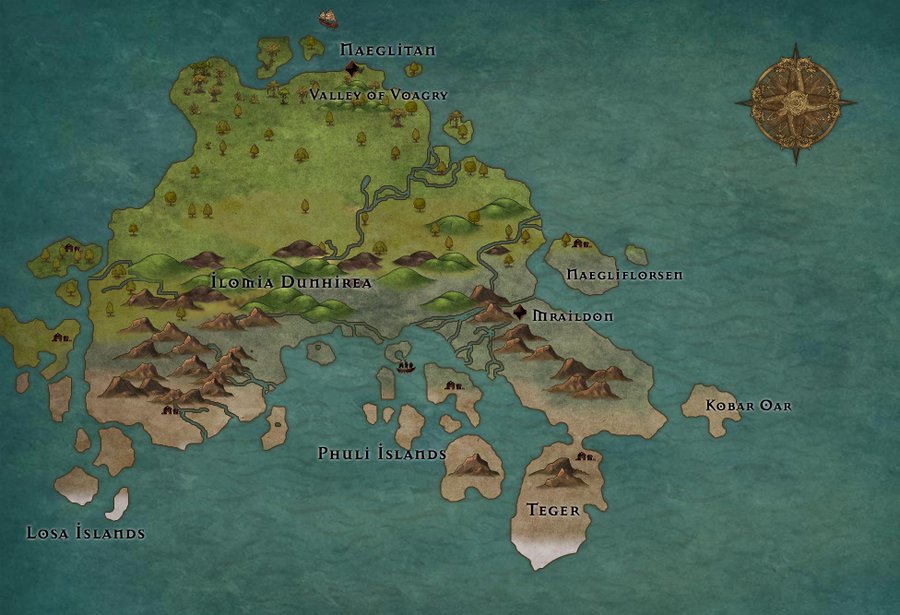
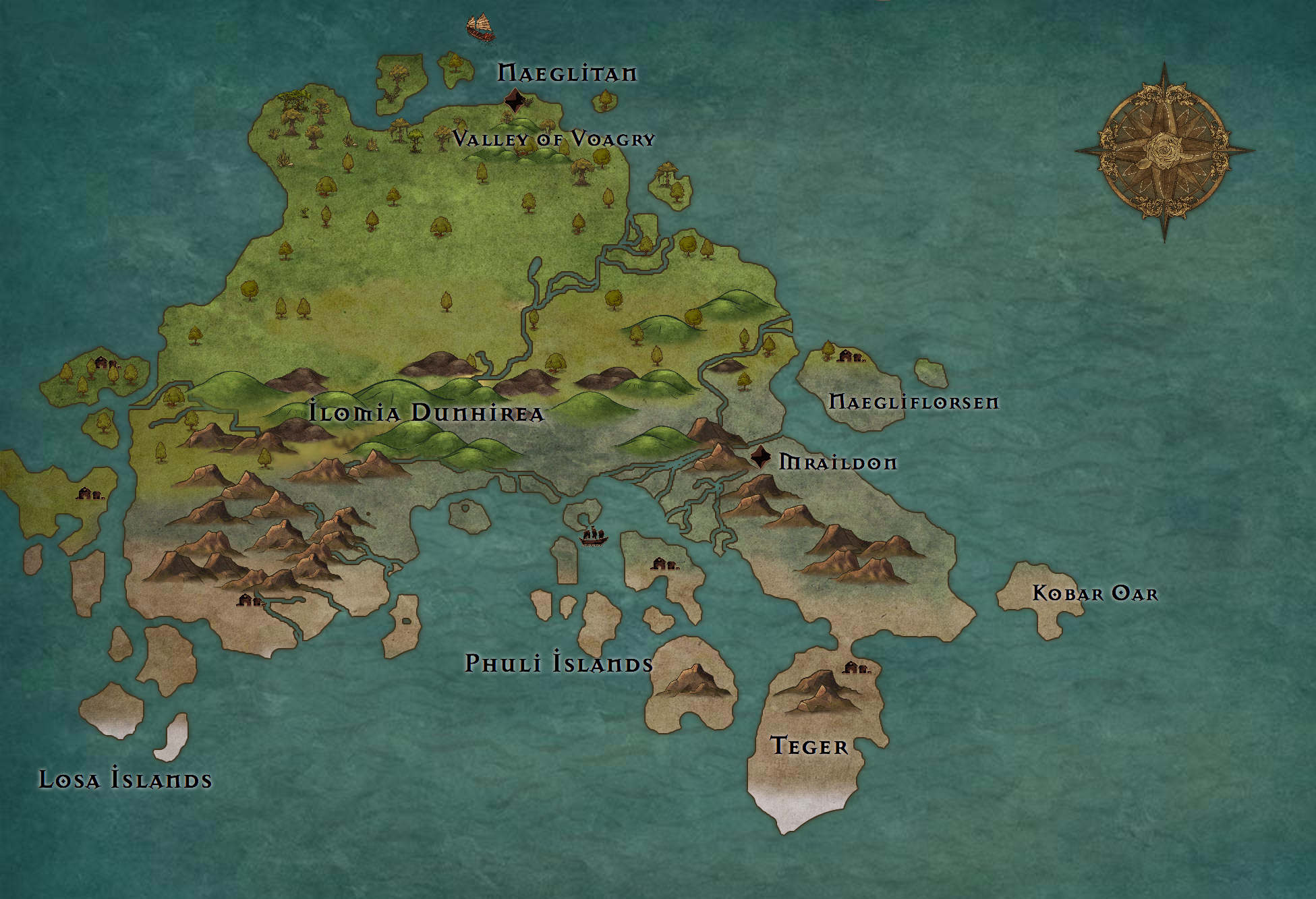
See here a map of Quarios. The equator of Aeniith is to the north of Naeglitan, the port city that brings in a lot of trade from the rest of the world. Down in Teger, the land of the Teg people, it can get quite cold. Quarios is a large continent.

Map of Quarios, a fantasy continent in the world of Aeniith.

Gotevinurae mar e nielo thanne maiad. ‘We are Gotevian and our food is tasty’

Tosi proverbs + religion

Translation of a Tosi religious proverb, from the texts of Lamat.

Sa tapi gō fū sanā jela ji chi lōlchu i
neg imp be content without kneel.before 2sg.m gen goddess obj

“Content thee with naught without first kneeling before thy goddess”

I am working on writing the tenets of Tosi belief systems, which primarily focuses on one deity, Lamat, war goddess, but also on Kalu, god of silence and peace. The current matriarchal expansionist empire of the Tosi obviously draws most political attention to the cult of Lamat, but the priesthood of Kalu endures and cannot be denied its importance to the history of the Tosi people.

The highly stratified culture of the Tosi traditionally feeds/gears different sections of the texts toward either men or women, to further enforce gender roles. The modern translation (into Tosi from Old Tosi) shows this with the use of the masculine 2nd p sg pronoun: ji, rather than da (feminine).

~

In creating these deities, I originally wanted Lamat to be the only main goddess, to show the Tosi reverence for power and might through warfare, but I then decided that they should have more nuance in their spiritual and religious beliefs. Before Tos was an Empire, it was simply a small nation, with no massive army and military force to show the world. People would have worshiped a multitude of gods and demi-gods, as well as other divine spirits. I think, as Tosi culture changed over time with the changing political structure and the ever-expanding Empire, the religious institutions would have changed too, to emphasize those things that were politically beneficial for the expansion of the state and the Empire. The primary means of this expansion was via the military, so Lamat, as the goddess of war, would have expanded as well, from a goddess to whom soldiers would offer supplications for protection before going into battle, to a central deity whose texts would come to have a greater influence over many areas of life.

The masculine deity Kalu, who represents many of the opposing forces of Lamat (silence, peace, introspection, asceticism, purity, etc) is fundamentally seen as an extension of what the Tosi view as the perfect man: one is is serene and peaceful, not governed by passion. Women are seen as intrinsically superior in this matriarchal society, but they are also seen as imperfect in that they supposedly naturally of a stormier and more tempestuous nature. Men are supposedly a tempering force of quiet, darkness, passivity, rationality, as well as “softer” emotions, such as compassion and mercy. I don’t want to remove this opposing force in Tosi society, because I think without it, the religion becomes more one-dimensional.

Previously, I had only addressed the adherents of Kalu in terms of the priesthood–men who would cloister themselves from the rest of the world (including the world of war, which is seen as primarily the purview of women) and devote their energy to preserving some special force of calm in a culture that is known for its systematic violence and occasional chaos. I want to build up this side of the religion more, and include it in more fiction that I write for the Tosi.

Naga: Land of Butterflies


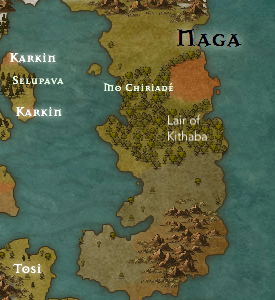
The western continent of Elta is a vast, largely tropical or forested region. It is known as Naga to outsiders, thought inhabitants don’t generally have a term for the continent as a whole. Some have adopted the term “Naga”, which is of Tosi origin, into their vocabularies. Contact with peoples of other continents, however, is mostly confined to restricted trade deals, mostly involved precious metals, timber (many common endemic trees of Naga have unique and highly sought after qualities), and fruits, although the latter are usually dried or otherwise preserved before their long journey across the sea.

Naga is known for its biodiversity. The dense jungles of its central regions rival those of northern Quarios. Culturally, Naga is not a monolith. It consists of myriad peoples, cultures, languages, and histories. There are few strict borders, and there cannot be said to be very many nation-states, but rather a variety of largely self-governing peoples that may, at any given time, interact, get along, fight, trade, or just ignore each other.

There are, however, a few notable exceptions. One is the known as the Lair of Kithaba, a religious group that has taken up resident in a long system of caves near the territory of the Alta people. They subsist largely from banditry and highway robbery, given their hidden location in the caves is suited to little else but hiding and practices their poorly understood religious practices. Despite the repeated efforts of their neighbors to eliminate their numbers, they remain a blight on the region and source of woe to many who are unfortunate enough to become their victims.

Welcome to Arcuna, southern continent of Elta.

Click for full versions: Version with biome delineations. Version with political boundaries

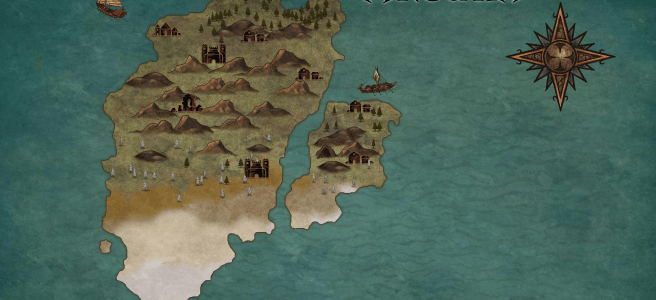
This is Arcuna, a small very southern continent in Elta (lateral hemisphere of Aeniith). In the first version, you can see political boundaries. The Tosi Empire controls the north, while the south is divided between the Arshi, Kalyu, and Keresn, which are zuna countries except for Keresn, which mostly consists of mixed zuna/amelae people. Keresn was conquered by Arshi, though they were formerly allies of Kalyu. Now Keresn and Arshi are at war with Kalyu. The Tosi Empire has halted its attempt at further expansion for th emoment, since much beyond what they already control is deemed too harsh and frigid to be worth it. They’re focused on the north of Izoi and fighting the Ríli at the moment…

More names will be added when I make them! 🙂


Welcome to Quarios!

Map-10

The second of my regional maps of Aeniith (please click here for the full version!). The first was Izoi, which has actually been a BIT modified since then to make it more geologically plausible. We go for accuracy in worldbuilding when it comes to systems like geology, economics, etc. 😛 Anyway…

Quarios is a single state nowadays, run by a consitutional monarchy, which is currently headed by Queen Inacaporia. The continent was, until pretty recently, made up of two sovereign states: Lomilin and Gotêvi. Incaporia was the Queen of Gotêvi and married a Prince of Lomilin, and they merged their lands.

In the north of Quarios, the weather is warm and humid most of the time, with mild winters. This is because Quarios is in the southern hemisphere. The southern most islands are frigid and cold. They are home two some ethnically distinct peoples known as the Teg and Phuli. These peoples speak their own languages (Teg and Phul) in addition to Gotevian. People living on the Lomilin side of Quarios (the west side) speak Lomi.

The northern port city of Naeglitan is where Elucuna arrives when she first getsto Quarios from Orikrindia (island nation to the north). She then travels with Glohitan to Valley of Voagry just to the southeast of there.

Gotevian wedding customs

I’ve been filling out cultural or customs “gaps” for Gotêvi, trying to balance it out and make it a little more “complete”. Here’s a blurb on traditional wedding customs:

Gotevian Marriage Customs

Marriage in Gotevi is a legal practice rather than a religious one, though religious marriage ceremonies can be held nonetheless. Weddings must be over seen by a magistrate (irftennir) in order to be considered legal. Usually they are held in a public building—some buildings exist constructed specifically for matrimonial purposes. Both parties usually invite their friends to the ceremony, sometimes even the entire neighborhood wherein they live will come, if only to eat and drink for free.

Traditionally, wedding clothing is bright yellow, for both bride and groom. Their clothes are similar in cut and style as well—usually shin-length tunics with long sleeves. The similarity of clothing symbolizes the binding and thus likeness of two people.

First, there is a party with food and drinks and often some type of music. Fervent dancing is traditional; this is perhaps the only case in which tradition suggests unruliness in Gotevian culture. It is considered appropriate that the woman and the man both socialize with their friends of the opposite gender to emphasize the trust of their partner. There are many traditional games played during wedding parties, including lots of gambling, though these are recent developments and are often scorned by the older generations.

After the festivities, the magistrate arrives and the people to be married sign a contract to each other. Everyone attending is technically a witness, but the magistrate’s presence is still required. After this, the couple is tied together facing each other with ribbons by their friends, and they must untangle themselves without any other help. This supposedly symbolizes the fact that now they must rely on each other to get out of trouble and have the ultimate trust in each other.


Image of a Rílin woman: Silin

Commissioned art of a Rílin woman named Silin. Free Image Hosting at FunkyIMG.com (Please click the image to see the full size version! It looks squished when I insert it here.)

Silin is a scount with the Sunulí guerilla militia. She spies on the Tosi encampments and is an expert tracker of the woods. Her home settlement was destroyed in the initial Tosi attack on Rílin border towns, and Silin’s husband and young son were murdered. She wandered for a few years and fled to the northern coast of Elinís̆. It was here she met Tsilu, another Rílin woman who had fled the invasion, and they became friends, and eventually lovers.

I want to write stories about Silin, but I have three WIPs going right now that need to be dealt with first!