Elucuna in Quarios (pt 3)

Continuation of Elucuna’s first days in Quarios. She and Glohitan meet a strange woman along the road outside of Naeglitan.

We took two amsas (1) to the edge of the city. My meager belongings were strapped onto the young female that was given to me. Glohitan called her Isma. I was unused to riding since it was not an activity considered womanly in Orikrindia, but I managed well enough given my inexperience. The mount was, thankfully, very calm and patient. Glohitan’s walking stick was tied to his back, wrapped in a saffron-colored scarf, and he rode just ahead of me as we made our way down a dark road near the outskirts of Naeglitan.

Continue reading “Elucuna in Quarios (pt 3)”

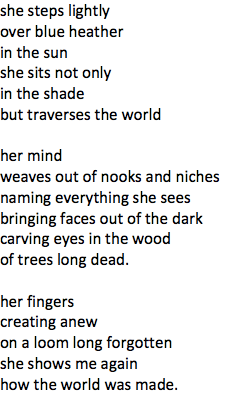
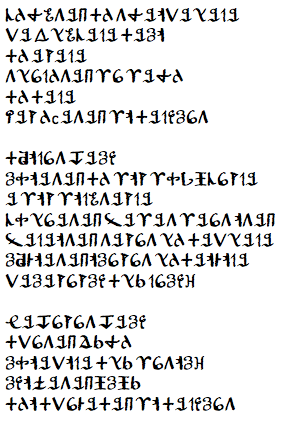
Poem to Moltirin, Orikrindian Goddess of the Forest

Mystic-Gothic-Sea-Fantasy-Statue-Dark-Forest-1305040.jpg

Poem about the Orikrindian goddess of the forest. I don’t have enough of the Ori language done yet to translate it BUT it still spoke loudly so I had to do it.

Moltirin (known alsois the Orikrindian goddess of forests, mysteries, vengence, the past, memory, and rebirth/reawakening. She is also the matron goddess of lost things, women who have died in childbirth, dead children, men who have died in battle, storms, and those who have been wronged.

the woman of the wood

the threads of days past

she weaves again

a whisper from before

taken up again

bright and vital in memory

damp with energy refound

glowing in the night

alight with vigor

surging forth once more

pulsing in the rain

dancing beneath the arms of trees.


and her eyes

lit like lodestones

a stormy blue

and shot through with light

like yesterday

the dust of an eon

settled and reformed

again we have awoken

the woman of the wood.

~

Mintaka

Conlang: Ori (relative clauses)

A bit ago I introduced some interrogative, indefinite, and negative pronouns for Ori. Related to these forms are relative pronouns, which are used to create relative clauses.

In Ori, relative clauses are head-initial, despite the generally left-branching (head-final) nature of Ori. This means that the head of the relative clause (the main noun) is placed before the relative clause (as it is done in French or English, for example).

The relative pronouns are basically all formed from verions of the interrogative pronouns, but with an additional suffix of -a at the end of the word.

nalar – ‘who?’ –> nalara ‘who’ (rel.)

nabel – ‘what?’ –> nabela ‘which, that’

nanye – ‘where?’ –> nanya ‘where’ (rel.)

nasya – ‘why?’ –> nasya ‘for which reason’ (rel.)

natin – ‘how?’ –> natina ‘in which way’ (rel.)

nalin – ‘when?’ –> nalina ‘when’ (rel.)

The trisyllable forms of the relative pronouns (nalara, nabela, natina, and nalina) also have short forms that are used more commonly in eveyday speech.

nalara –> na-

nabela –> naba-

natina –> nata-

nalina –> nana-

~

Relative pronouns take the same case that the shared noun uses in the embedded clause. In the below sentence,

Tu-hema-s na-s tet lyen-besorpa-tan nimas rya

def.art-woman-nom who-nom makes def.art-clay.pots-acc mother-nom be

‘The woman who makes the clay pots is a mother’

Lye-besorpa-s naba-t elucu-m cyan truma-s rya.

def.art-clay.pot-acc which-acc choose-1sg pst.perf red-nom be

‘The clay pot that I chose is red’

nanya, nasya, nalina/nana are all often used without a case marker at all.

Ti-trente-cya nanya ti-hiluma-pya peli-t cyan culim-bru alinda.

def.art-temple-loc where def.art-priestess-acc find-2sg pst.perf travel-1pl tomorrow

‘Tomorrow we will travel to the temple where you found the priestess’

Story: Elucuna in Quarios

This is the beginning of story (of indeterminate length so far) told by an Orikrindian woman who leaves Orikrindia at age 15 and comes to Quarios to be able to pursue a life a greater liberty (Orikrindian society doesn’t offer a lot of independence or a very wide array of options for the future of a yong woman). Like I said, I still don’t know what’s in store for this story, how well I’ll end up liking it, how well anyone else will end up liking it, etc. If you DO want to see more, I’ll probably consider continuing it. Its main purpose now is to help me explore Orikrindian vs Quariosian (i.e. Gotevian and Lomi) cultures, as well as a peak into some other Aeniithian cultures/people/stuff. 😀

Continue reading “Story: Elucuna in Quarios”

Upcoming works are brewing…

I’m writing some mini-stories about Orikrindians that I will probably post in the future. Topics may/will include:

– An Orikrindian girl who leaves her country at age 15 and moves to Quarios, some of her thoughts, motivations, and memories (telling her story in retrospect)

– Two Orikrindian brothers who are separated due to a war with a neighboring country

– A story of the devotees of the mountain goddess and fire god who go on a pilgrimage to a great mountain. Fewer will descend that those who went up

I’m also recording new poems in Rílin now, since I am finally back in touch with my h4n Zoom audio recorder, which is higher quality than my laptop mic, unsurprisingly.

Other topics in the works: more Ori grammar, the Orikrindian pantheon, and info on Orikrindian artisanal works.

This has been a semi-update with a bunch of teasers…but I’m really excited about what I’m working on so it’s ok. 😛

Mintaka

Orikrindian women abroad

I envisage Orikrindia as more patriarchal than most other Aeniithian cultures. I image this is demonstrated in everyday culture as well as by institutions such as the monarchy of kings. For this reason I think Orikrindian women would take to moving abroad if they could to pursue things that would be more difficult to do at home. Pursuits like business, art, finance, scholarship, etc. I think quite a few would go to nearby Ei to the west to Quariosian territory. Some would go directly to Quarios itself if they could afford it. I think perhaps some would marry abroad as well, as Gotevian and Lomi men would be more accepting of an independently minded woman.

I want to explore this concept more but for now it is a blurb!

Mintaka

Conlang: Ori (nouns and their cases)

Last time I told you about more Ori verbs and how to conjugate them. Now I will move on to nouns. As I’ve mentioned before, Ori nouns come in four classes (like grammatical genders): animate, inanimate, celestial, and abstract. Ori has noun cases that suffix to nouns to show their grammatical role in the sentence. There are singular and plural, and different cases depending on the class of the noun. Below are the case endings for singular animate and inanimate nouns. The column that says -C stop contains suffixes for nouns that end in an oral or nasal stop (-t, -p, -c, -b, -d, -g, -m, -n). These nouns get a little epenthetic -i- inserted before the case suffix, as you can see below.

  • Note that the blue shaded rows are where the cases for both animate and inanimate are the same.

Screen Shot 2018-06-18 at 6.12.11 PM

So what do these cases mean?

Nom = nominative: this marks the subject of a verb. Example: tu-porin-is merir ‘the shepherd is dancing’

Gen = genitive: nouns in the genitive case show possession or relation. Example: lye-bus tu-ema-re ‘the house of the woman; the woman’s house’

Dat = dative: nouns in the dative case are the indirect object of a verb. In English, this would be often marked with the preposition to or for. Example: maropye tu-porit tu-ema-te ‘give the sheep to the woman’

Acc = accusative: nouns in the accusative case are the direct object of a verb. Example: tepe-cyepu cyan ‘I took the fruit’

Loc = locative: nouns in the locative case show that something is located in, at, or on a thing. Example: bu-le ummum ‘I am staying at home’

Instr = instrumental: the instrumental case is used to show that something was done by means of some noun–that this noun is the instrument. Example: restin-ir lye-holist ayalnda ‘they are opening the door with a key’

Voc = vocative: this case is used when you mean to call out to someone or something. Example: Oa, porin-ca! ‘Hey, shepherd!’

The cases for other classes (singulars and plurals) are below.
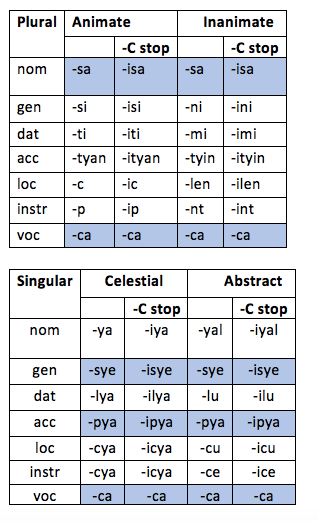
Screen Shot 2018-06-18 at 6.30.30 PM

Screen Shot 2018-06-18 at 6.31.15 PM

So let’s look at some examples of these cases in action–in actual phrases and sentences.

Hilucul-ya bellu ‘The sky is wide’

Caru-s roru-sye ‘A world of darkness’

Sesta-lu maro ‘Give [something] to life’

A hilacul-ca! ‘O, heaven!’

Yupye ti-yutar-pya! ‘Look at the cloud!’

Hustu-ce ‘by means of trust’

Hilacul-cya ‘in the sky’

Bu-s ti-hiluma-na ‘a house of the priestess’

I’ll have more examples of Ori sentences soon…


Mintaka