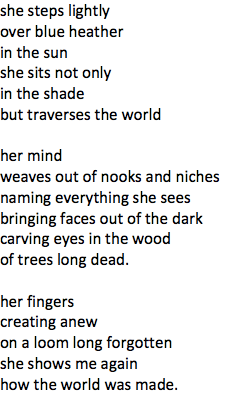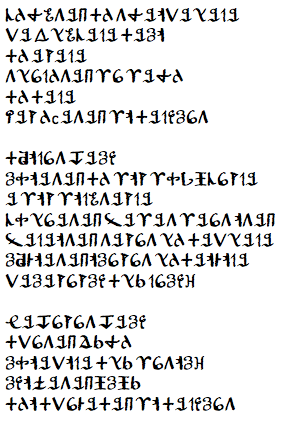
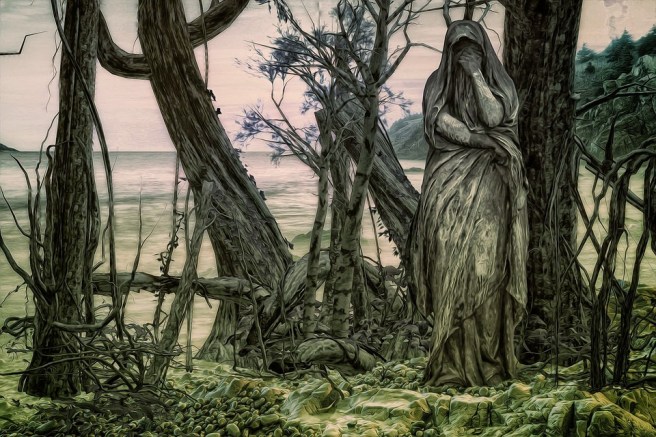
Untitled Rílin poem, originally written about my mother.


Mintaka
Untitled Rílin poem, originally written about my mother.


Mintaka
Playing with an idea that in Orikrindia, there is a kind of superstitious tendency to name a child the opposite of what the parents wish for it to become (maybe just in certain classes or subcultures?). For example, Elucuna’s name essentially means “decider”, and her parents definitely did not intend for her to be deciding much in life. Maybe someone hoping for an outgoing child would name him Pilucya ‘timid’. Kind of like avoidance of a jinx by giving a child too “fortuitous” a name and attracting the attentions of an ill-meaning demon. The Orikrindians do feel quite a bit of discomfort with regard to demons…
More of the story of Elucuna, a runaway Orikrindian woman who goes into hiding in Quarios to start a new life.
It was from there that I made my way to what I had long planned would be my destination. First, I navigated the cramped streets and alleys of Naeglitan to a man who was an acquaintance of my brother’s. His name was Glohitan and he was in the business of ground transport—whether of cargo or person, he did not care. Moreover, he was in the business of discreet transport, which was of utmost concern to me, as I did not wish for my family (other than, of course, Poltyar my brother) to get wind of my location in Quarios, or even that I had in fact fled there. For all they knew, I had perished in some dark wood of Orikrindia or fallen in the hands of highwaymen.
This is the beginning of story (of indeterminate length so far) told by an Orikrindian woman who leaves Orikrindia at age 15 and comes to Quarios to be able to pursue a life a greater liberty (Orikrindian society doesn’t offer a lot of independence or a very wide array of options for the future of a yong woman). Like I said, I still don’t know what’s in store for this story, how well I’ll end up liking it, how well anyone else will end up liking it, etc. If you DO want to see more, I’ll probably consider continuing it. Its main purpose now is to help me explore Orikrindian vs Quariosian (i.e. Gotevian and Lomi) cultures, as well as a peak into some other Aeniithian cultures/people/stuff. 😀
This is a Rílin nezeletŭ, along with its recording. This is called Tímalípin ‘We Remember’. It is, like all nezeletŭ, about the sorrow experienced by those Ríli who were driven from their forest home by the Tosi invaders.


I’m writing some mini-stories about Orikrindians that I will probably post in the future. Topics may/will include:
– An Orikrindian girl who leaves her country at age 15 and moves to Quarios, some of her thoughts, motivations, and memories (telling her story in retrospect)
– Two Orikrindian brothers who are separated due to a war with a neighboring country
– A story of the devotees of the mountain goddess and fire god who go on a pilgrimage to a great mountain. Fewer will descend that those who went up
I’m also recording new poems in Rílin now, since I am finally back in touch with my h4n Zoom audio recorder, which is higher quality than my laptop mic, unsurprisingly.
Other topics in the works: more Ori grammar, the Orikrindian pantheon, and info on Orikrindian artisanal works.
This has been a semi-update with a bunch of teasers…but I’m really excited about what I’m working on so it’s ok. 😛
Mintaka
So this is a song I recorded a long time ago (like ten years ago lol) that I wrote even longer ago in Old Rílin and Rílin. I was originally inspired by the lush vegetation in southern Georgia when I was visiting there a long while ago. The first verse is in Old Rílin and the rest in Rílin. I imagine it could be from the perspective of a Ríla visiting a southern country (as they are native to the northern half of Izoi and thus would not have experience with certain types of biomes, perhaps being very impressed by certain plants and trees as I was).
Composition, vocals, and lyrics are all by me. Piano arrangement and performance credit goes to Eric Barker (www.ericbarker.com).
http://www.whitealicemusic.com/music/BvePfaRi.mp3
Lyrics are below:
Bve Pfa R̂í
(old Rílin)
Bve Pfa R̂í
/bve pfa ʂi/
tree blue yearn
‘yearning green’
Goxe
/goxe/
stir
‘stirring’
bi-ly
/bi’ly/
seed-push
‘seeds springing forth’
bil-i
/bi’li/
innerground-wet
‘moist soil’
naqa r̂í
/naqa ʂi/
gentle yearn
‘gentle yearning’
na genk
inf sleep
‘to sleep’
re kanad
/ɾe kanad/
out.of forest
‘out of the forest’
be
/be/
smile
‘a smile’
(modern Rílin)
Phala tösh
/ɸa-la tøʃ/
air-instr ash
Ash in the air
Aghu
/aɣu/
Blind
Wunís myrûí
/wunis myɾʌi/
breath burning
Breath burning
(instrumental)
pilu ní
/pɪlu ni/
center.of.flower clear
Clear center of a flower
uka
/uka/
Companion
Be ŕíky zöet
/bɛ ʐi-ky zø-ɛt/
neg expel-imp trust-abs
don’t expel trust
Despyxa
/dɛspyxa/
Paper of tissue
Moías
/mɔias/
Tapestry
Kaíkr̂ŭ ŝala
/kaikʂɯ ʃa-la/
warmth.from.light petal-instr
Warm light through the petals

This is the purple flower of Orikrindia, the nation emblem. Its six petals represent the six provinces of Orikrindia.
~
Here are a few more pronouns in Ori (non-personal pronons). The base forms of these words is the indeterminate pronouns (something, somewhere, etc.), while adding na- makes the words interrogative (who?, what, etc.). Similarly, adding ca- makes them negative (no one, no way, etc.). See below for the forms and some examples sentences.
alar ‘someone’
nalar? ‘who?’
calar ‘no one’
bel ‘something’
nabel? ‘what?’
cabel ‘nothing’
nye ‘somewhere’
nanye? ‘where?’
canye ‘nowhere’
sya ‘some reason’
nasya? ‘why?’
casya ‘for no reason’
tin ‘in some way’
natin? ‘how?’
catin ‘in no way’
lin ‘some time’
nalin ‘when?’
calin ‘never’
Examples:
Alars tari cyan pye Mirmis cleppat proru cyan ‘Someone said Mirmi ate poison’
Nanye minim ti-trentepya ma? ‘Where can I find the temple?’
Nasya tranye ti ma? ‘Why are you here?’
Calars tin-nelcag iyuru can ‘No one sees the gods’
Tu-porinis tun-porityan tin peli bil ‘The shepherd will probably find the sheep somehow’
~
Deicitc adjectives
Ori has two sets of deictic adjectives. These are adjectives that modify nominals to show relative spatial position–in English we have ‘this’, ‘that’, ‘these’, ‘those’. In Ori, one set of adjectives relates to spaces near and away from the 1st person (the speaker), while the other set is used with references to all other persons (2nd and 3rd).
From 1st person perspective:
ti ‘that’
tra ‘this’
tim ‘those’
tram ‘these’
From 2nd person or 3rd person perspective:
dum ‘that
del ‘this’
dumi ‘those’
deli ‘these’
Plural vs singular is the only morphological distinction, and there is no class agreement on deictic adjectives.
Examples:
dumi porisa ‘those sheep’ (far from you/another)
deli porisa ‘these sheep’ (near you/another)
tim porisa ‘those sheep’ (far from me)
tram porisa ‘these sheep’ (near me)
~
Ori has a few irregular verbs, like all natural languages. Many of them are quite common verbs.
li ‘come’
me ‘go’
te ‘do, make’
celi ‘have’
syalu ‘use’
tyelu ‘know’
malu ‘be’
maro ‘give’
Examples of conjugations of irregular verbs (where two forms are listed under 3rd person, the first form is for animate/inanimate nouns and the second is for celestial/abstract nouns):


More irregular verbs and other stuff to come!
Mintaka