
Thoughts on Orikrindian vs Quariosian culture

It’s kind of difficult to me to say what Quariosian culture is, because it’s made up of so many things/people/histories. It is, by nature, multi-faceted. Quarios is, at the time of Elucuna’s arrival, a relatively new state. It was born, politically, of a merger of two countries, Gotêvi and Lomilin. Gotêvi also consisted of several different nations in its southern regions, such as the Teg and Phul peoples. From an early time, then, these two separate nations were not homogenous, but culturally complex. The first rulers to merge the two countries were Queen Inacaporia of Gotêvi annnnd…some other dude whose name I forget, who was the Prince of Lomilin. Anyway, I think they merged the country both via their marriage to each other and also by a mutually agreed upon pact that would combine their states into one. The process, as you could imagine, was not a quick one. It took years to carefully intertwine the countries into one new country, which now covered the whole of the continent. The name Quarios was previously just the name of the continent, but then began to refer to the new country as well.

The port city where Elucuna lands in Quarios, Naeglitan, is a Gotevian city. It is Gotevian in its cultural origins, the language used there is Gotevian (even though Quarios has two official languages, Gotevian and Lomi, only governmental documents, signs, etc. are required to be in both languages). Glohitan is culturally and ethnically Gotevian (the meaning of ethnicity here, is separated from physical identifiers such as skin color, as people in Quarios have differing skin tones/facial features depending on whether their ancestors came from the north or south of the continent–the northerners tend to be darker in tone, but this fact is not as culturally salient for the Gotevians as other factors of their origins may be), but he is multilingual, and speaks to Elucuna in her native Ori. He considers himself a Gotevian, but also a Quariosian. Many inhabitants of Lomilin would likewise say that they are Lomi, but also Quariosian. Members of the other nations of peoples of Gotêvi identify themselves as Teg, or Phul, or whatever, but also Quariosian. Some of these people would also use the word Gotevian to describe themselves, depending on their personal attitude toward the government/majority culture of Gotêvi.

So all of that is what’s behind my thoughts when I think, “What does it mean for Elucuna to be in Quarios? What is this culture she is encountering?” The thing is, her journey is just beginning, and she will come into contact with myriad aspects of Quarios, and will discover how different from each other they can be. She’ll also discover that what she thinks she knows about Quarios may not always hold true–still other elements of her new surroundings will surprise her. For example, I imagine that Elucuna is a skilled knitter and fiber artist. This is a typical kind of skill to teach girls in upper-class Orikrindian homes. She views this activity as deeply feminine and completely hidden from the world of men. In Gotêvi, however, there are artisanal guilds of fiber artists, and many of their members are male. This is something that both surprises and intrigues here. In Orikrindia, men habitually do not devote any thought or attention, and certainly not any admiration, to the private arts of women (when it comes to things like knitting, embroidery, etc., at least). In Gotêvi, I think she would feel almost overly flattered that a man would show interest in her work and her skills, even though to them, it is just a normal amount of respect as one would show to a skilled colleague whose work is interesting or worthy of attention. Perhaps one of these men who compliments her work or shows interest in it is slightly confused as to why she feels so honored that he would talk with her about it, as for him, he talks with his female colleagues all of the time and does not consider it particularly special.

I have all of these scenarios forming in my head about how Elucuna interacts with, and responds to, the differing cultural environments around her. I hope that my writing will hold tight when it comes time to put these ideas into the story.

~

Mintaka
Elucuna in Quarios (pt 4)

A bit more of Elucuna’s story. She arrives in a new location with Glohitan and is met with the prospect of a new ally.

~

Morning had broken, and my fatigue weighed ever more heavily on me. It started in my eyes and spread outward, dulling the adrenaline of traveling in a strange land with a man I had never met before. Glohitan remained reticent throughout much of our journey, and I was hesitant to start any kind of conversation again, given his short manner with me before. I was surprised that the amsas weren’t tired, but they seemed steadfastly unaffected.

Continue reading “Elucuna in Quarios (pt 4)”

Elucuna in Quarios (pt 3)

Continuation of Elucuna’s first days in Quarios. She and Glohitan meet a strange woman along the road outside of Naeglitan.

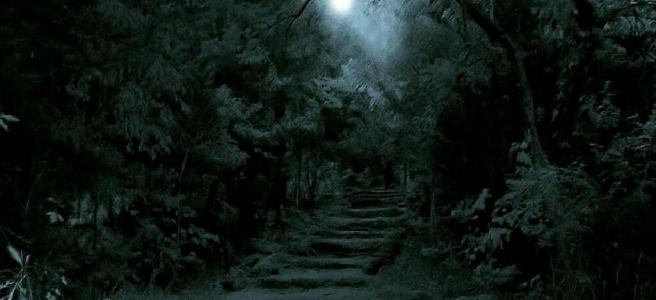
We took two amsas (1) to the edge of the city. My meager belongings were strapped onto the young female that was given to me. Glohitan called her Isma. I was unused to riding since it was not an activity considered womanly in Orikrindia, but I managed well enough given my inexperience. The mount was, thankfully, very calm and patient. Glohitan’s walking stick was tied to his back, wrapped in a saffron-colored scarf, and he rode just ahead of me as we made our way down a dark road near the outskirts of Naeglitan.

Continue reading “Elucuna in Quarios (pt 3)”

Poem to Moltirin, Orikrindian Goddess of the Forest

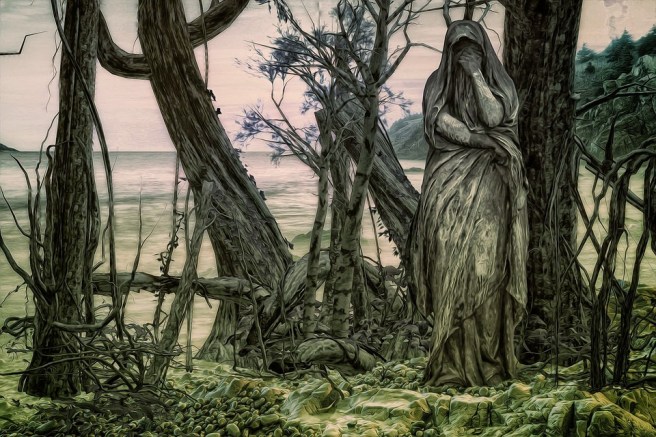
Mystic-Gothic-Sea-Fantasy-Statue-Dark-Forest-1305040.jpg

Poem about the Orikrindian goddess of the forest. I don’t have enough of the Ori language done yet to translate it BUT it still spoke loudly so I had to do it.

Moltirin (known alsois the Orikrindian goddess of forests, mysteries, vengence, the past, memory, and rebirth/reawakening. She is also the matron goddess of lost things, women who have died in childbirth, dead children, men who have died in battle, storms, and those who have been wronged.

the woman of the wood

the threads of days past

she weaves again

a whisper from before

taken up again

bright and vital in memory

damp with energy refound

glowing in the night

alight with vigor

surging forth once more

pulsing in the rain

dancing beneath the arms of trees.


and her eyes

lit like lodestones

a stormy blue

and shot through with light

like yesterday

the dust of an eon

settled and reformed

again we have awoken

the woman of the wood.

~

Mintaka

Conlang: Ori (relative clauses)

A bit ago I introduced some interrogative, indefinite, and negative pronouns for Ori. Related to these forms are relative pronouns, which are used to create relative clauses.

In Ori, relative clauses are head-initial, despite the generally left-branching (head-final) nature of Ori. This means that the head of the relative clause (the main noun) is placed before the relative clause (as it is done in French or English, for example).

The relative pronouns are basically all formed from verions of the interrogative pronouns, but with an additional suffix of -a at the end of the word.

nalar – ‘who?’ –> nalara ‘who’ (rel.)

nabel – ‘what?’ –> nabela ‘which, that’

nanye – ‘where?’ –> nanya ‘where’ (rel.)

nasya – ‘why?’ –> nasya ‘for which reason’ (rel.)

natin – ‘how?’ –> natina ‘in which way’ (rel.)

nalin – ‘when?’ –> nalina ‘when’ (rel.)

The trisyllable forms of the relative pronouns (nalara, nabela, natina, and nalina) also have short forms that are used more commonly in eveyday speech.

nalara –> na-

nabela –> naba-

natina –> nata-

nalina –> nana-

~

Relative pronouns take the same case that the shared noun uses in the embedded clause. In the below sentence,

Tu-hema-s na-s tet lyen-besorpa-tan nimas rya

def.art-woman-nom who-nom makes def.art-clay.pots-acc mother-nom be

‘The woman who makes the clay pots is a mother’

Lye-besorpa-s naba-t elucu-m cyan truma-s rya.

def.art-clay.pot-acc which-acc choose-1sg pst.perf red-nom be

‘The clay pot that I chose is red’

nanya, nasya, nalina/nana are all often used without a case marker at all.

Ti-trente-cya nanya ti-hiluma-pya peli-t cyan culim-bru alinda.

def.art-temple-loc where def.art-priestess-acc find-2sg pst.perf travel-1pl tomorrow

‘Tomorrow we will travel to the temple where you found the priestess’

Ideas on Ori names

Playing with an idea that in Orikrindia, there is a kind of superstitious tendency to name a child the opposite of what the parents wish for it to become (maybe just in certain classes or subcultures?). For example, Elucuna’s name essentially means “decider”, and her parents definitely did not intend for her to be deciding much in life. Maybe someone hoping for an outgoing child would name him Pilucya ‘timid’. Kind of like avoidance of a jinx by giving a child too “fortuitous” a name and attracting the attentions of an ill-meaning demon. The Orikrindians do feel quite a bit of discomfort with regard to demons…

Elucuna in Quarios (pt 2)

More of the story of Elucuna, a runaway Orikrindian woman who goes into hiding in Quarios to start a new life.


It was from there that I made my way to what I had long planned would be my destination. First, I navigated the cramped streets and alleys of Naeglitan to a man who was an acquaintance of my brother’s. His name was Glohitan and he was in the business of ground transport—whether of cargo or person, he did not care. Moreover, he was in the business of discreet transport, which was of utmost concern to me, as I did not wish for my family (other than, of course, Poltyar my brother) to get wind of my location in Quarios, or even that I had in fact fled there. For all they knew, I had perished in some dark wood of Orikrindia or fallen in the hands of highwaymen.

Continue reading “Elucuna in Quarios (pt 2)”

Story: Elucuna in Quarios

This is the beginning of story (of indeterminate length so far) told by an Orikrindian woman who leaves Orikrindia at age 15 and comes to Quarios to be able to pursue a life a greater liberty (Orikrindian society doesn’t offer a lot of independence or a very wide array of options for the future of a yong woman). Like I said, I still don’t know what’s in store for this story, how well I’ll end up liking it, how well anyone else will end up liking it, etc. If you DO want to see more, I’ll probably consider continuing it. Its main purpose now is to help me explore Orikrindian vs Quariosian (i.e. Gotevian and Lomi) cultures, as well as a peak into some other Aeniithian cultures/people/stuff. 😀

Continue reading “Story: Elucuna in Quarios”

Upcoming works are brewing…

I’m writing some mini-stories about Orikrindians that I will probably post in the future. Topics may/will include:

– An Orikrindian girl who leaves her country at age 15 and moves to Quarios, some of her thoughts, motivations, and memories (telling her story in retrospect)

– Two Orikrindian brothers who are separated due to a war with a neighboring country

– A story of the devotees of the mountain goddess and fire god who go on a pilgrimage to a great mountain. Fewer will descend that those who went up

I’m also recording new poems in Rílin now, since I am finally back in touch with my h4n Zoom audio recorder, which is higher quality than my laptop mic, unsurprisingly.

Other topics in the works: more Ori grammar, the Orikrindian pantheon, and info on Orikrindian artisanal works.

This has been a semi-update with a bunch of teasers…but I’m really excited about what I’m working on so it’s ok. 😛

Mintaka

Conlang: Ori (interrogative pronouns, deictic adjectives, a few irregular verbs)…

orikrindiaemblem

This is the purple flower of Orikrindia, the nation emblem. Its six petals represent the six provinces of Orikrindia. 

~

Here are a few more pronouns in Ori (non-personal pronons). The base forms of these words is the indeterminate pronouns (something, somewhere, etc.), while adding na- makes the words interrogative (who?, what, etc.). Similarly, adding ca- makes them negative (no one, no way, etc.). See below for the forms and some examples sentences.

alar ‘someone’

nalar? ‘who?’

calar ‘no one’


bel ‘something’

nabel? ‘what?’

cabel ‘nothing’


nye ‘somewhere’

nanye? ‘where?’

canye ‘nowhere’


sya ‘some reason’

nasya? ‘why?’

casya ‘for no reason’


tin ‘in some way’

natin? ‘how?’

catin ‘in no way’


lin ‘some time’

nalin ‘when?’

calin ‘never’


Examples:

Alars tari cyan pye Mirmis cleppat proru cyan ‘Someone said Mirmi ate poison’


Nanye minim ti-trentepya ma? ‘Where can I find the temple?’


Nasya tranye ti ma? ‘Why are you here?’


Calars tin-nelcag iyuru can ‘No one sees the gods’


Tu-porinis tun-porityan tin peli bil ‘The shepherd will probably find the sheep somehow’

~

Deicitc adjectives

Ori has two sets of deictic adjectives. These are adjectives that modify nominals to show relative spatial position–in English we have ‘this’, ‘that’, ‘these’, ‘those’. In Ori, one set of adjectives relates to spaces near and away from the 1st person (the speaker), while the other set is used with references to all other persons (2nd and 3rd).

From 1st person perspective:

ti ‘that’

tra ‘this’


tim ‘those’

tram ‘these’


From 2nd person or 3rd person perspective:

dum ‘that

del ‘this’


dumi ‘those’

deli ‘these’

Plural vs singular is the only morphological distinction, and there is no class agreement on deictic adjectives.


Examples:

dumi porisa ‘those sheep’ (far from you/another)

deli porisa ‘these sheep’ (near you/another)


tim porisa ‘those sheep’ (far from me)

tram porisa ‘these sheep’ (near me)

~

Ori has a few irregular verbs, like all natural languages. Many of them are quite common verbs.

li ‘come’

me ‘go’

te ‘do, make’

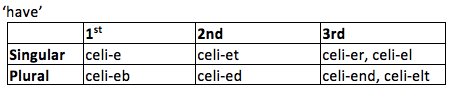
celi ‘have’

syalu ‘use’

tyelu ‘know’

malu ‘be’

maro ‘give’

Examples of conjugations of irregular verbs (where two forms are listed under 3rd person, the first form is for animate/inanimate nouns and the second is for celestial/abstract nouns):

Screen Shot 2018-06-30 at 12.18.15 AM

Screen Shot 2018-06-30 at 12.20.18 AM

Screen Shot 2018-06-30 at 12.22.41 AM

More irregular verbs and other stuff to come!

Mintaka