Valency Series: Intro

Recently, I gave a presentation at 11th Language Creation Conference at the University of Maryland. I’m going to reproduce some of the content of that presentation on this blog, in the context in which it was intended: using linguistic typology to show some interesting grammatical things that can be done in conlangs, and why you, as a conlanger, should care. In the presentation, I gave an overview of different structural manifestations and semantic uses of valency-changing operations, how they appear in natural languages and how I have implemented them in my various conlangs.

Basically, a valency-change operation increases or decreases the number of core arguments in a verb. Core arguments are those that are considered necessary for a given verb: semantically, they are represented by A (agent), S (sole/subject), and P (patient). Agents are those in control of the action of a verb (broadly speaking), Patients (also sometimes called Themes) are those most affected by the verb, and Subjects or Soles are the sole argument of a verb. Languages vary in how they treat S, A, and P morphosyntactically. Nominative-accusative languages group S and A together, leaving P marked differently. Thus we get sentences like, “I bit him” and “I sleep”, in which the word “I” is used regardless of whether it refers to an A (“I bit him”) or an S (“I sleep”). Therefore, A and S are both in the nominative case and P is in accusative. Ergative-absolutive languages, by contrast, group S and P together, with A being the distinctive one. S-P are usually in the absolutive case, while A is in the ergative case. The distinction of these core argument groupings is called the verbal alignment or morphosyntactic alignment of a language.

Morphosyntactic alignment plays somewhat into valency change. When we use a valency-changing operation, we are manipulating the core arguments of a verb. Ultimately, the way a language treats core arguments becomes relevant when we fiddle with those core arguments.

First, I will outline two broad categories I will cover in this blog post series. The first is (1) valency-decreasing operations and the second is (2) valency-increasing operations. I actually hope to cover more of each than I was able to in just 20 minutes of slides and speaking for the presentation version of this essay. Ultimately, I’ll discuss: causatives, applicatives, passives, antipassives, anticausatives/middle voice, and reflexives/reciprocals. Some of these categories may overlap to a greater or lesser degree, depending on the language. It’s also true that convention often dictates the terminology used for these categories in the traditions of specific languages. I’ll try to be as explanatory as possible when describing each feature.

For now, I’ll start off with causatives, the first valency-increasing operation.

Simply put, causatives add another core argument to a verb, by inserting a causer and turning either an A or S into a causee, one who is caused by the causer to do the action. See for example, the English example below.

‘Joshua ate the spaghetti’ –> ‘I made Joshua eat the spaghetti’

The first sentence is transitive, wherein the A (Joshua) eats the P (spaghetti). In the second sentence, I use a causative (a periphrastic one that uses the verb make), thereby adding another core argument to the verb eat. “I” is now the causer, “Joshua” is the causee, and “spaghetti” is still a P undergoing the action of being eaten.

Languages vary morphosyntactically in the ways they do causatives. Some are periphrastic or analytic, as in English. Another example is in French:

‘J’ai fait manger les spaghettis à Joshua’
1s.S-aux make.pstprt eat the spaghetti to J.
‘I made Joshua eat the spaghetti’

Note how in the French version of this sentence, the causee is now marked as an oblique, preceded by the preposition à ‘to’. This one of two major strategies languages use to show that a former A/S is now no longer such, due to the addition of the causer. The causee can either be marked oblique, as above, or it may be marked the way other P nouns are. In the latter case, we see examples like that in Sanskrit below, in which the causative allows two accusative-marked nouns to coexist in one clause.

Rama-m veda-m adhyapa-yate
Rama-acc veda-acc learn-caus
‘He teaches Rama the Veda’ (Literally: ‘He makes Rama learn the Veda.’)

In the above sentence, you can see that this causative construction allows two nouns to be marked accusatives. One is the causee (Rama), and one is the object of the verb (the Veda) that the causee is being caused to perform .

The above example also shows us that causatives can be morphological, or marked directly on the verb with some morpheme. This is also a cross-linguistically very common way of doing causatives. Sometimes, languages differentiate between which causatives apply to transitive verbs and those apply to intransitive verbs. See the examples below from Turkish. ‘die’ is an intransitive verb, and thus when it is causativized, it gets the -dür causative.

Hasan öl-dü
H.       die-pst
Hasan died’

Ali Hasan-t öl-dür-dü
A. H. -acc die-caus-pst
‘Ali killed Hasan’

However, if the verb we start out with is already a transitive verb, a different causative morpheme is used, the -t morpheme. The first sentence below shows a regular transitive sentence, “The director signed the letter”. Then we see how such a sentence could be causativized: “The dentist made the director sign the letter.”

Müdür mektub-ü imzala-dı
director letter-acc sign-pst
‘The director signed the letter’

Dišçi mektub-ü müdür-e imzala-t-tı
dentist letter-acc director-dat sign-caus-pst
‘The dentist made the director sign the letter’

Causatives can also be lexical. That is, they can be represented by totally separate lexemes or words. This is not an instance of a word being modified by a morpheme, but something else entirely. English has several examples of this, notably the die and kill pair. ‘kill’ is a causative of ‘die’. Another such pair is eat and feed. A cross-linguistic tendency noted in Haiman (1983): within languages that have multiple strategies for creating causatives, lexical causatives tend to show a greater level of control and directness of causation than morphological causatives, which in turn show a greater degree of such than analytic causatives.

Below, I’ll provide a few examples of ways I have created causatives in my conlangs. The first example comes from Seloi. This somewhat isolating language has an analytic causative. The particle here is sli. It was, historically, a verb, and it still sits in a verbal position in the clause, but it lacks any other trappings of a real verb, such as tense, aspect, or modality. Therefore, it can be said to be fully grammaticalized.

Vali sli    na te-keva          te-koi        ai Iskila
3s.m caus for def-woman  come-fem loc Iskila 
‘He is having the woman come to Iskila’

Note how in this construction, the causee is demoted to an oblique role, prefaced by the preposition na ‘for’.

In Rílin, morphology is the main way to implement a causative. The prefix xa- increases the valency of a verb by adding a causer. For example, the intransitive verb psílha [‘psiɬa] means ‘to bleed’. xapsilha is ‘to make bleed’, with an extended meaning ‘to injure, to hurt’. lhesti [‘ɬɛstɪ] is ‘to listen’, can be either transitive or intransitive, while xalhesti is ‘to make listen’ and by extension, ‘to warn, to make heed’. So we can increase the valency of these verbs with xa-, regardless of whether they are intransitive or transitive to begin with. Some of the resulting meanings of the causative forms have become idiomatic, such as zaryxía [zary’xia] ‘to rust’ and xazaryxia ‘to renounce’. The latter has moved completely into its metaphorical meaning, which has now become its primary sense.

Rílin also has a number of lexical causatives. zansa ‘to kill’ has no etymological relation to lemua ‘to die’. But zansa replaces any instance of *xalemua, which is not attested. Similarly, saísa ‘to rise’ and hare ‘to raise’ have no structural or etymological relationship, but the latter can be said to be a (semantically) causative form of the former.

Karkin, another of my conlangs, has an active-stative aligment system. Karkin has four causative morphemes, each of which shows a different implication about harm and benefit on the part of the causer and/or causee.

Type 1: Karkin causative Type 1 implies a benefit for the causee of the action (the one who was caused to act).

məl-a-i ava-a mi                        shoʔonthe-‘ə  pa ʃtuxtə-peq-aː

mother-1S.POSS.A father-1S.POSS to river-P PART cross-CAUS-PST

‘My mother made my father cross the river (it was good for him/he liked it)’

You can identify this causative by use of the morpheme –peq– preceding the tense morpheme at the end of the verb. Avaa ‘my father’ is in an oblique case, shown by the postposition mi.

Type 2: Karkin causative Type 2 implies harm or misfortune toward the causee.

məl-a-i                ava-a-ʔə           shoʔonthe-ʔə pa      ʃtuxtə-vur-aː

mother-1S.POSS.A father-1S.POSS-P river-P                PART    cross-CAUS-PST

‘My mother made my father cross the river (it was bad for him/he didn’t want to)’

This kind of causative is marked by the verbal morpheme -vur-. It also marks the causee, avaa, with a patient marker instead of an oblique one: -ʔə.

Type 3ː Karkin causative Type 3 implies neutrality for the causee as to benefit/harm.

məl-a-i ava-a mi                        shoʔonthe-‘ə  pa ʃtuxtə-χe-aː

mother-1S.POSS.A father-1S.POSS to river-P PART cross-CAUS-PST

‘My mother made my father cross the river (it was neutral)’

This kind of causative is marked by the verbal morpheme –χe-. The causee is marked obliquely with –mi-.

Type 4: The final causative type implies mutual benefit between causer and causee.


məl-a-i ava-a mi                         shoʔonthe-‘ə pa   ʃtuxtə-li-aː

mother-1S.POSS-A father-1S.POSS to river-P           PART    cross-CAUS-PST

‘My mother made my father cross the river (it was mutually beneficial)’

This type of causative uses the –li– morpheme and marks the causee with oblique mi.

~

I’m going to end or at least pause my discussion of causatives. Next time, I will likely write about applicatives. This is one subject I didn’t have time to discuss in my presentation of this topic, so I’ll be pleased to put my thoughts into words.
I liiiive~

Or should I say: kyílaíkim!

It’s been a while! I have been involved in so many things recently, not least of which was finishing my PhD in December 2022! Now that I am now longer writing my dissertation, I have more time.

What is new in Aeniith?

Well, I began some preliminary work on a non-linear, multi-modal writing system. I also structured a language that it is used for, although only the basics of that are done. The orthography is based on shapes, color, and other features of abstract pictoral representations. Essentially, different morphemes of this rather agglutinative language are represented variously by shapes, colors, etc. featured in what are basically pictures. There is a basic template, onto which different additional shapes in different colors can be added. These add the “flavor” of the verb, which is the inflectional morphology.

Below, you can see the verb root, which is written in a syllabary, below the “morphological seed pod”–the non-linear portion–which adds morphology to the root. For the first picture, the word written is ahkmaunier ‘you’re swimming’. The root is mauni ‘swim’, which is written in black near the bottom. The purple sides mean ‘indicative mood’, the green is ‘present tense’, the rising sprout shape is ‘continuative aspect’, while the red outer edges indicate the 2nd person singular ‘you’. In terms of the break down of the sounds of the verb, you can find it below:

a-hk-mauni-er-∅
prs-cont-swim-2s-ind

The next picture, just above, represents the verb “may they thrive”. The same basic shape is the same–see the verb root written in black at the bottom. The colors and internal shape are different though. The past tense e- is represented in the orange. The hortative morpheme, -t- is represented by the seed dot in the center. Yellow sides represent the 3rd person singular, while the subjunctive mood –o is indicated by the blue color of the basic “pitcher” shape.

Now above, there is another example. This time, the root is nari- ‘dream’. The basic color purple indicates, again, the indicative mood, which is zero marked in this language. e-, the past tense, is represented by the center orange color. Continuative aspect -hk– is clear from the rising sprout shape. The brown sides indicate 1st person singular -(e)t.

e-hk-nari-et-∅
pst-cont-dream-1s-ind
‘I was dreaming’

Here is another example. This one represents the word ahkrōtaiam ‘he is sowing seeds’, with some additional phonological and phonetic representationss: /aʰkroːˈtaiam/ [aʰkɾoːˈtajəm]

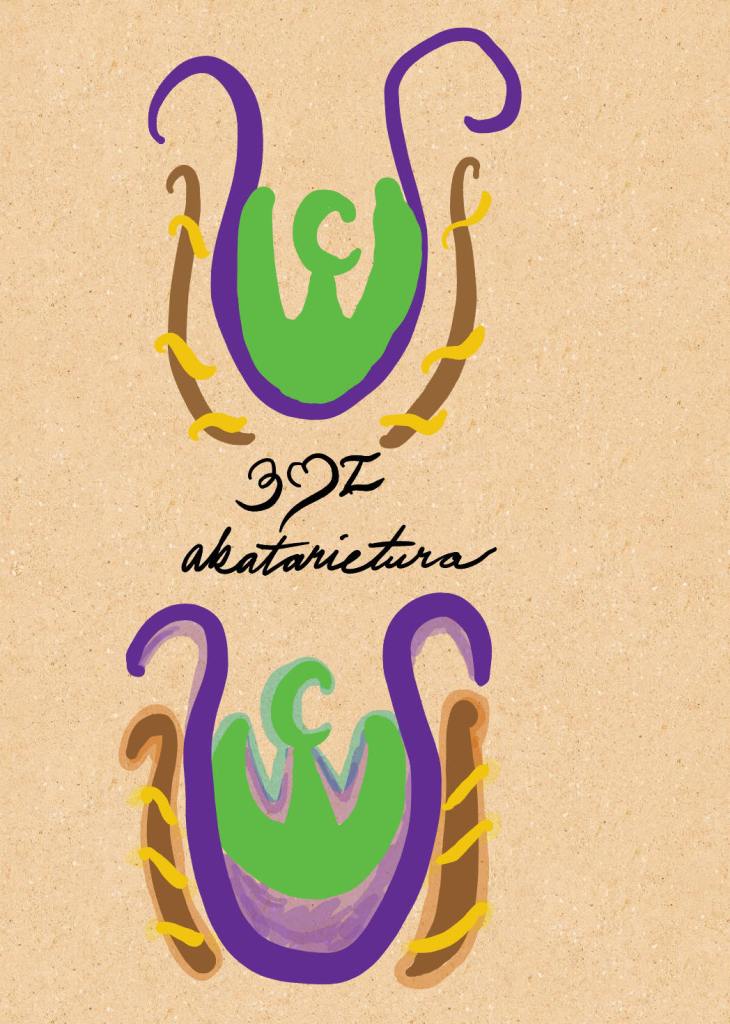
Here is another verb, akatarietura ‘I want to care for you’. This verb incorporates object marking, which is demonstrated by the yellow vines that wrap around the outer brown ‘petals’. The upper version is simpler, while the bottom version is a little fancier.

Above is a breakdown of this same word, with another version of it written/drawn. Also included here are a morphemic gloss of the word, and some examples of verb roots.

prs-vol-A-care.for-1s-2s-A
a-k-(a)-tarie-t-ura-a
akatarietura
‘I want to care for you’

I will likely be expanding this system, as well as the language it was created for, in the next few months. Stay tuned.

~Mintaka

Gotevian food?

Someone recently asked me what kind of food Gotevians eat.

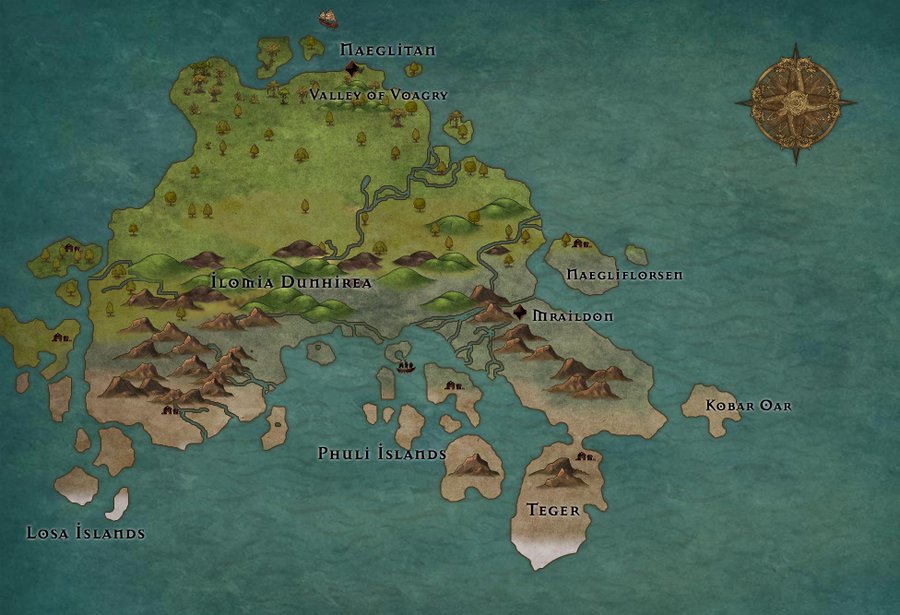
Gotêvi is one of the countries within Quarios–a continent but also a kingdom, of sorts. It is in the southern hemisphere of Aeniith, with its north near the equator and its south becoming more temperate and even quite cold at times. Much of the land of Quarios is either a. forest/jungle in the north, or b. steppe and grasslands, which are where most of the agriculture takes place. Traditional foods are based on crops grown, which include grains and legumes. Spices abound in the north, which are used all over the country.

So typically, you get stews with carbohydrates and proteins (e.g. grains, beans, peas) flavored with spices. Veggies might be separate but most would be included in the stew itself. Food is pretty flavorful and trade is very common within the country itself, so everyone pretty much can afford spices from the north.

See here a map of Quarios. The equator of Aeniith is to the north of Naeglitan, the port city that brings in a lot of trade from the rest of the world. Down in Teger, the land of the Teg people, it can get quite cold. Quarios is a large continent.

Map of Quarios, a fantasy continent in the world of Aeniith.

Gotevinurae mar e nielo thanne maiad. ‘We are Gotevian and our food is tasty’

Zezhi script: a syllabary

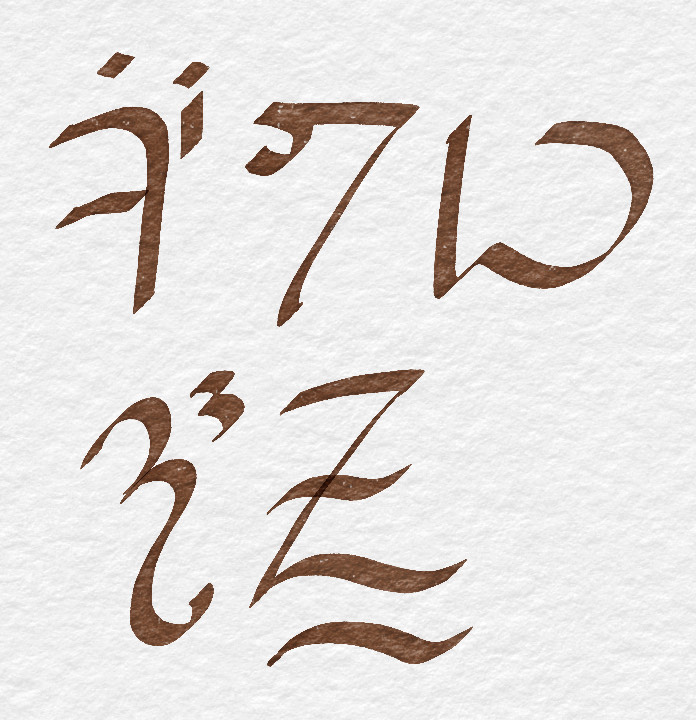
In addition to working on the Vinuvu abugida, I’ve also been creating a new conscript, called Zezhi. It is a syllabary, and is used in Keta, specifically in and around Ngyenau Bwezh, a small country in Ei (north of Quarios). I have the beginnings of a majority language of Ngyenau Bwezh, called Bwezhi, but it’s far from usable yet. It’s at that awkward stage where I know what the phonemes are and some basics about verbs, nouns, and word order, but not much else. It is essentially a fetus.

Zezhi itself has independent symbols for combinations of consonants and vowels, in the CV syllable structure. It also has symbols for lone vowels: V structure. It doesn’t have codas embedded in each symbol, but rather marks a “default” syllable as “vowelless” for this purpose, as Bwezhi does have some codas.

Here are some examples:

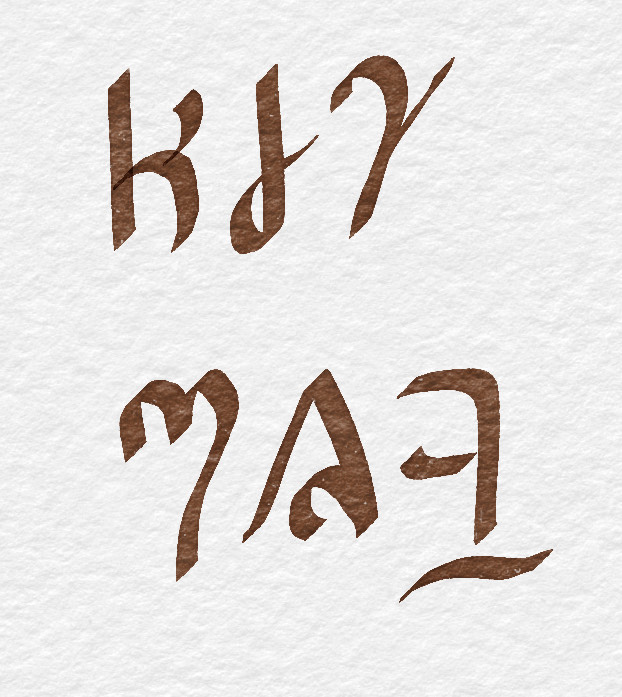
This is a given name: Miza Lie

Another name: Minisa Burun.
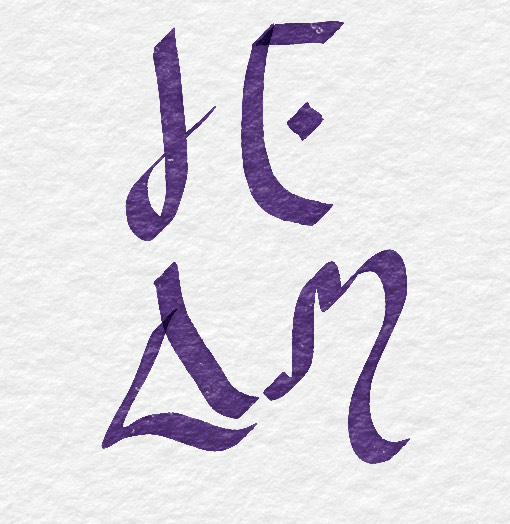
This is the name of the country Ngyenau Bwezh /ˈŋʲɛnau bʷɛʒ/. You can see the diacritics that indicate patalization and labialization in co
nsonants. The line under the final character means that there is a null vowel after this consonant, i.e. a syllable coda. You can also see that in the previous name “Burun”. The character used for codas is always the Ce (consonant plus /ɛ/) character. So without the line underneath, the name would appear as “Burune”.

Below is a transliteration of my full name: Margaret Neal Ransdell-Green.
The transliteration works out to: /margaret nil ranzdɛl grin/

Conscripts

I’ve been refining and practicing the Vinuvu script, which I first created in summer 2019. It’s getting more to where I want it in terms of specifics, but remains largely how I originally designed it. I’m practicing writing in it in calligraphic software on iPad/with Apple pencil, as well as using actual pen/ink.

Vinuvu is the second script I’ve created that I’m still using. The first is the Rílin script, which I made into a font. You can see more about this font/script on the Rílin phonology page. You can also download the font itself here.

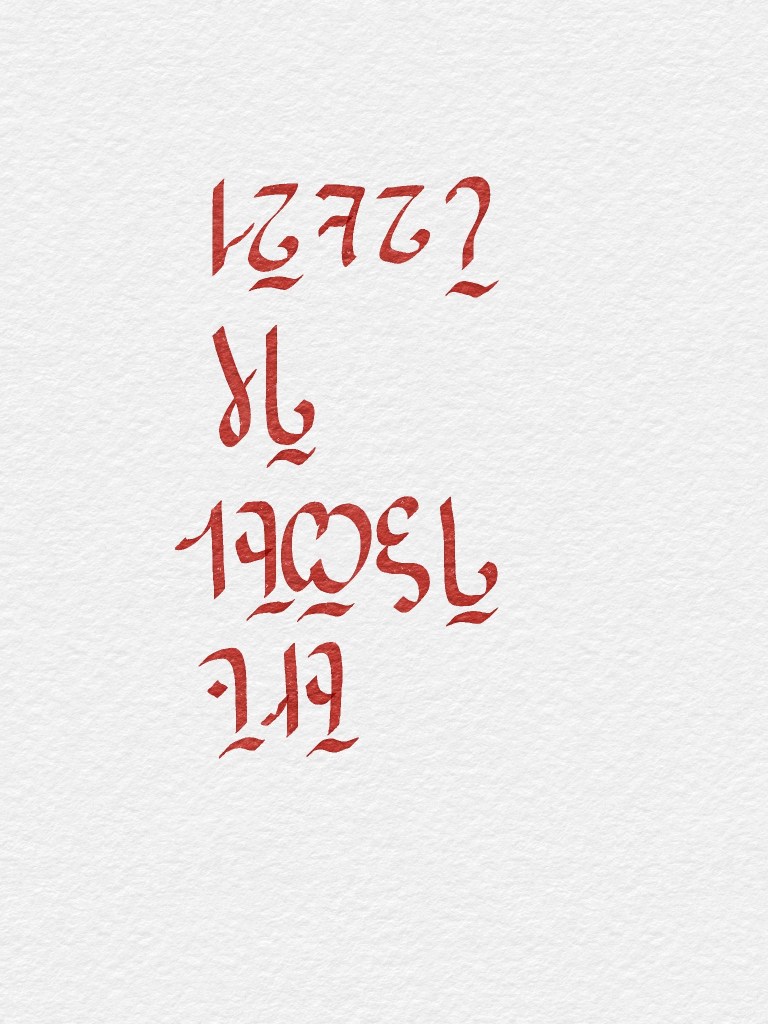
Here are some recent examples of the Vinuvu script as used to write Karkin.

I’d like to develop a font for Vinuvu too, though because it is an abugida, and vowels are usually marked using diacritics, it might present an additional challenge, since different characters will essentially need to be overlaid on each other to form syllables.

New alphabet (abugida) for Seloi and Karkin!

I have been doing a LOT of conscripting (making new writing system) for my languages this summer! Now that the semester has started (only just), I may slow down somewhat but I am promising myself not to stop!

Much of what I’ve worked on has been the new alphabet for the Seloi and Karkin languages. Before I get into the writing system itself, I will give a little background on the people who use this alphabet.

The Selupa (speakers of Seloi) and Karkin people live on a shared island, off the east coast of the Izoi continent (in Elta–so we’re on the side of Aeniith with Tosi, Ríli, etc.). The Selupa (of the zuna species of humanoid–same as the Tosi and Karkin) have a very secretive but comparatively technically advanced society. Their cities are highly protected, entry and exit is tightly regulated, and their technology and medical advances are not generously shared, when they are shared at all. The Selupa value art and culture as well as science, and are famous for their universities where topics like drama, writing, philosophy, rhetoric, and even culinary skills are taught.

The other major cultural group on the island are the Karkin, also a zuna people, who live in parts of the island not inhabited by the Selupa. Their population is largely split into two–some live inside seven cities that are protected by ruling clans. Just outside of these guarded cities are agricultural areas that supply these cities with food. Others, who dwell outside the protection of the cities, live in an arid expanse of land called the Planulum (sōngē’ën /soːˈŋeːʔən/ in Karkin). This is a harsh land, and its soil is hard and difficult to grow in. The people who live in the Planulum are not under rule of the city clans, and lawlessness is rampant in areas that are outside of settlements. Settlements in the Planulum are lightly governed by consensus, if at all. In the winters, sand storms ravage crops, and in the summer, hot winds can wilt them if not enough rains come. It is a difficult place to live. Caravans travel between the various Planulum settlements and the seven cities, but sometimes are detained due to crime or bad weather conditions.

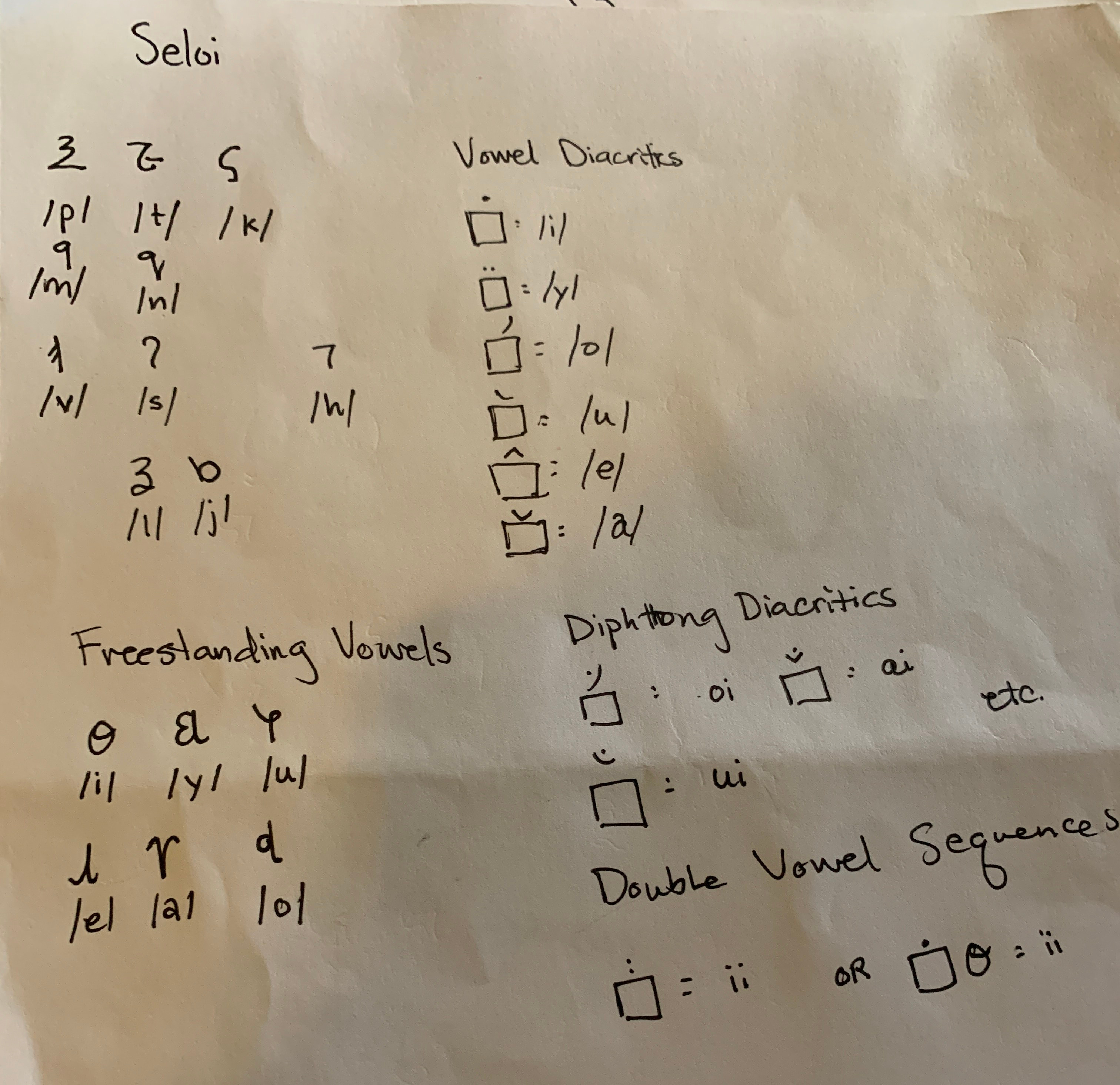
The original inventors of the present alphabet, which I’m tentatively calling Vinuvu (Seloi for ‘scratched pieces’ or ‘written bits’), are the Selupa. Seloi itself has a very small phonemic inventory (collection of differently recognized sounds)–just 10 consonants and 6 vowels. Vinuvu is technically an abugida–a variant of alphabet in which the consonants are represented by full letters and the vowels are represented by modifications to the consonants (often diacritics or small marks on or near the consonant letters). The following is the version used for Seloi, its original intended use.

Seloi alphabet: VinuvuEach consonant is a full letter with the following vowels being marked as diacritics over the consonant. Freestanding vowels are written as full, and diphthongs and double vowels are either combined diacritics or a full vowel symbol plus a diacritic.
So this is simple enough, but then I decided I wanted this whole system to be used by other zuna cultures in the region of Izoi. That includes the Tosi and Karkin. The Tosi are a massive empire, but I decided that I wanted them to have borrowed the alphabet after the Karkin–the immediate neighbors of the Seloi–had already borrowed it.

The main challenge here was due to the Karkin language itself. It has a lot of sounds, far more than the particularly sparse Seloi. Karkin is mad for different consonants: it has 32 of them! It also has six vowels that can all be long or short (in duration). So obviously, when the Karkin borrowed this writing system, they were going to have to do a lot of modification to make it work for their language…

Behold!
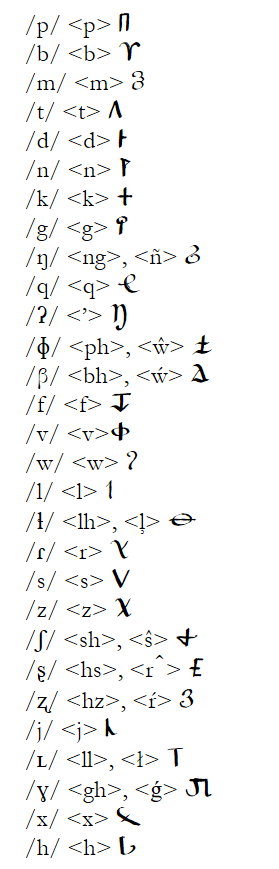
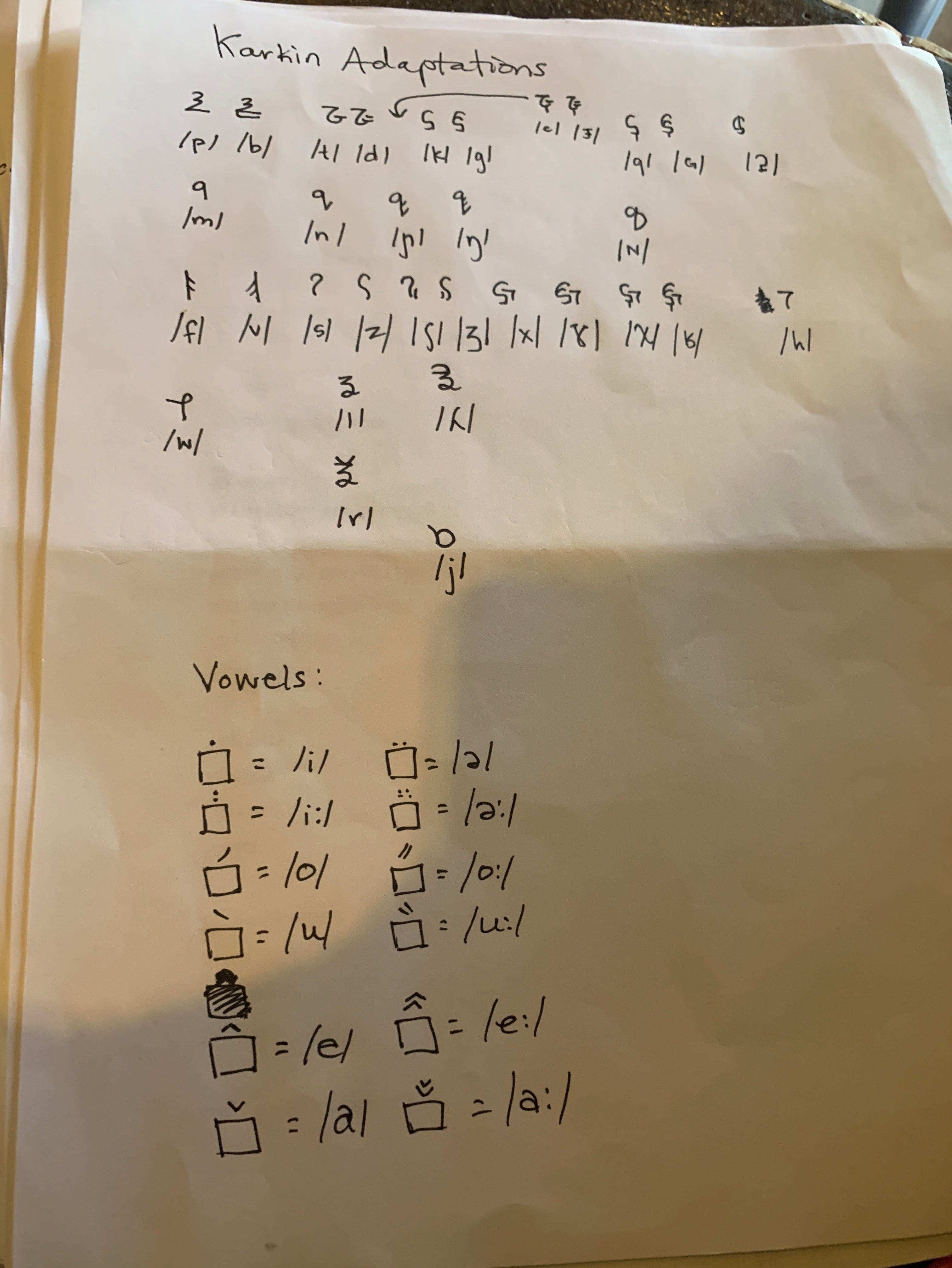
Karkin modifications to VinuvuAs you can see, many letters are modified to represent the numerous additional sounds that Karkin has. Some consonants have added marks to indicate that voicing (Seloi doesn’t have voiced stops like b, d, g, for example). Some letters have descender marks below them to indicate a change in place of articulation (usually farther back in the mouth). Some fricatives (like the letters for v and s) are reversed to show a change in voicing (f and z). The letter for /l/ is modified to represent /r/ and /ʎ/. Various other changes show sounds that don’t exist in Seloi. Long vowel are represented by double diacritics.
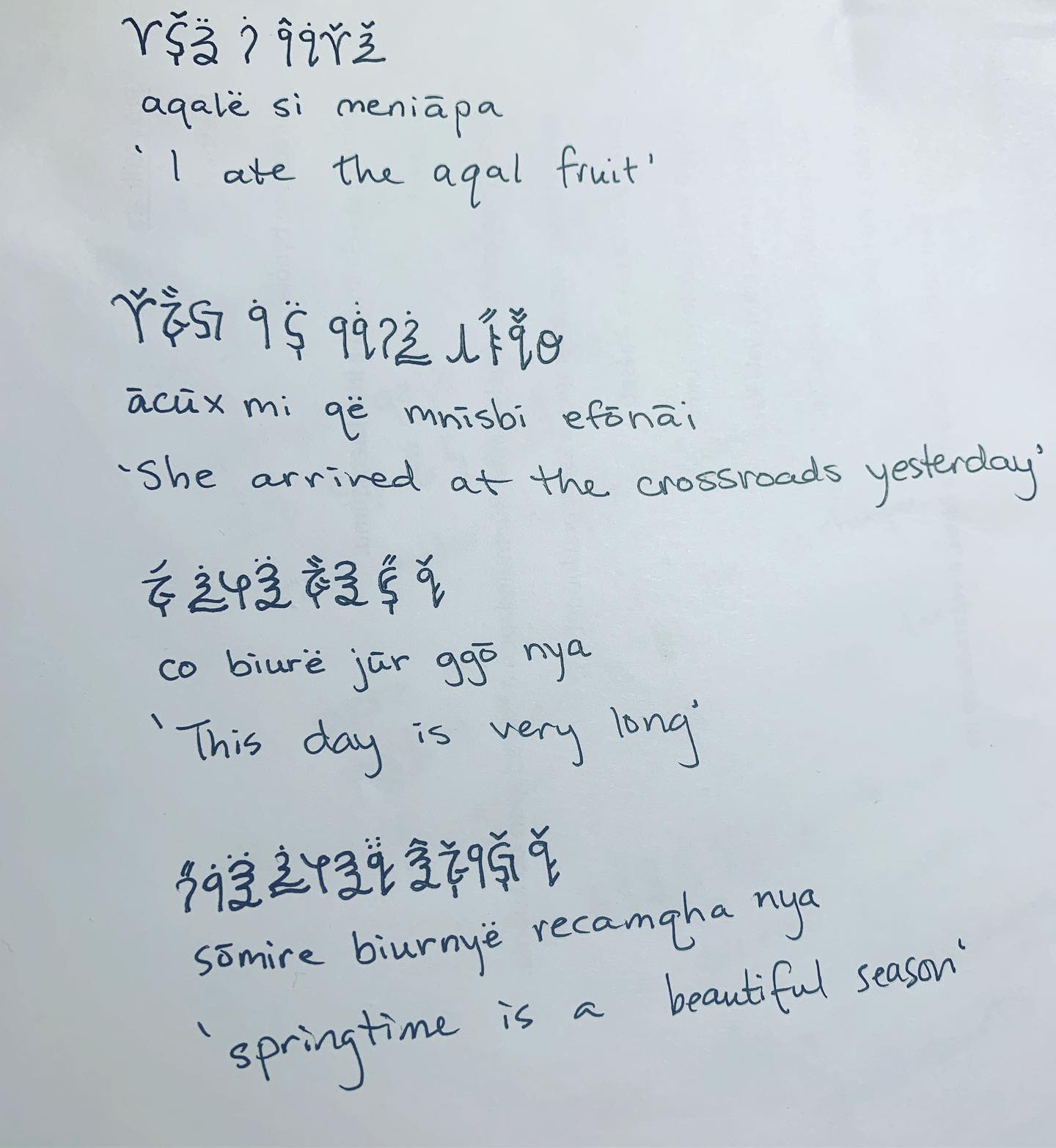
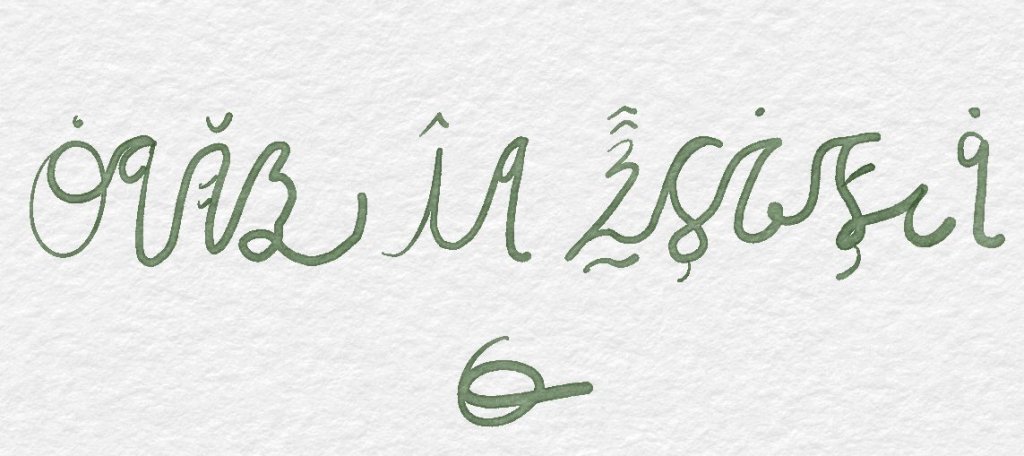
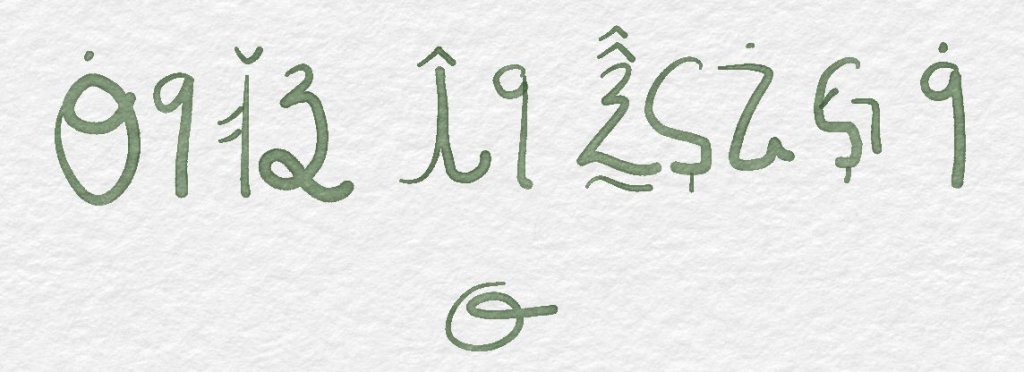
A few examples of writing in Vinuvu for Karkin.

ED3F05DA-B0EF-4B37-BF5E-7951C2B44AE3

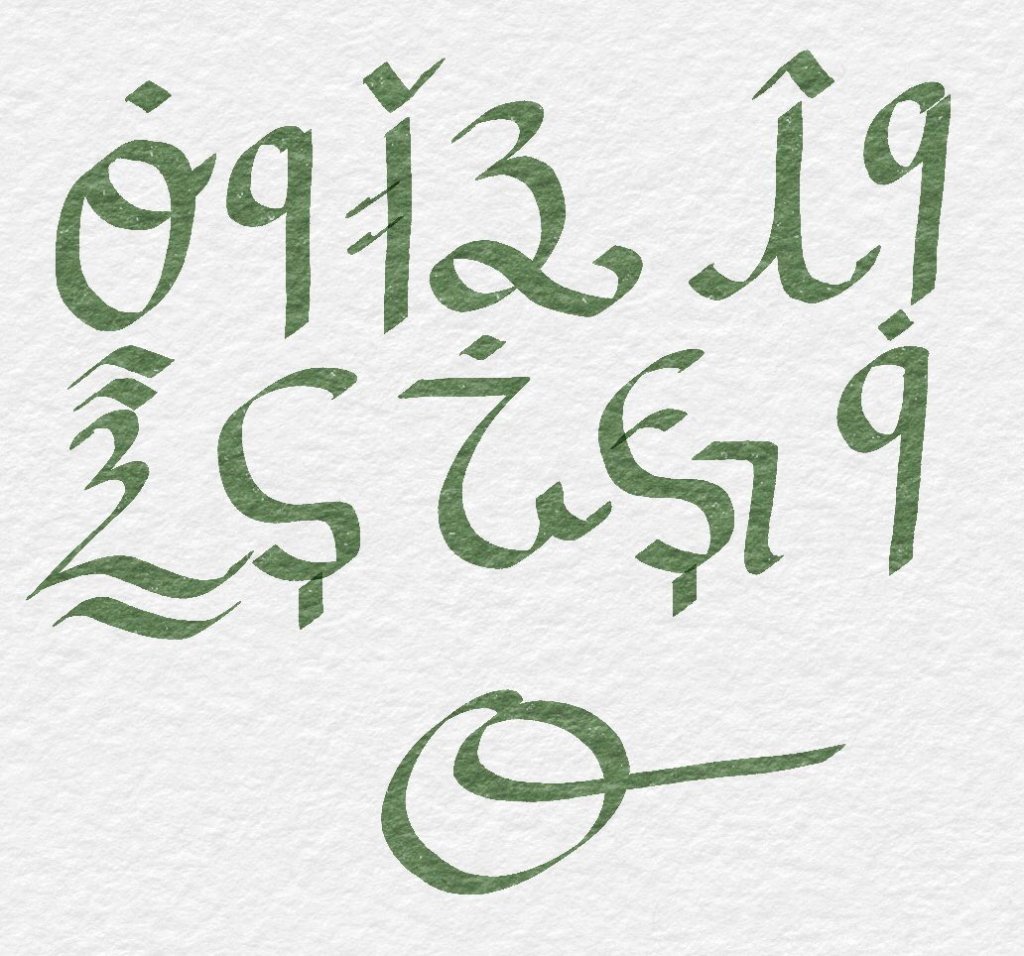
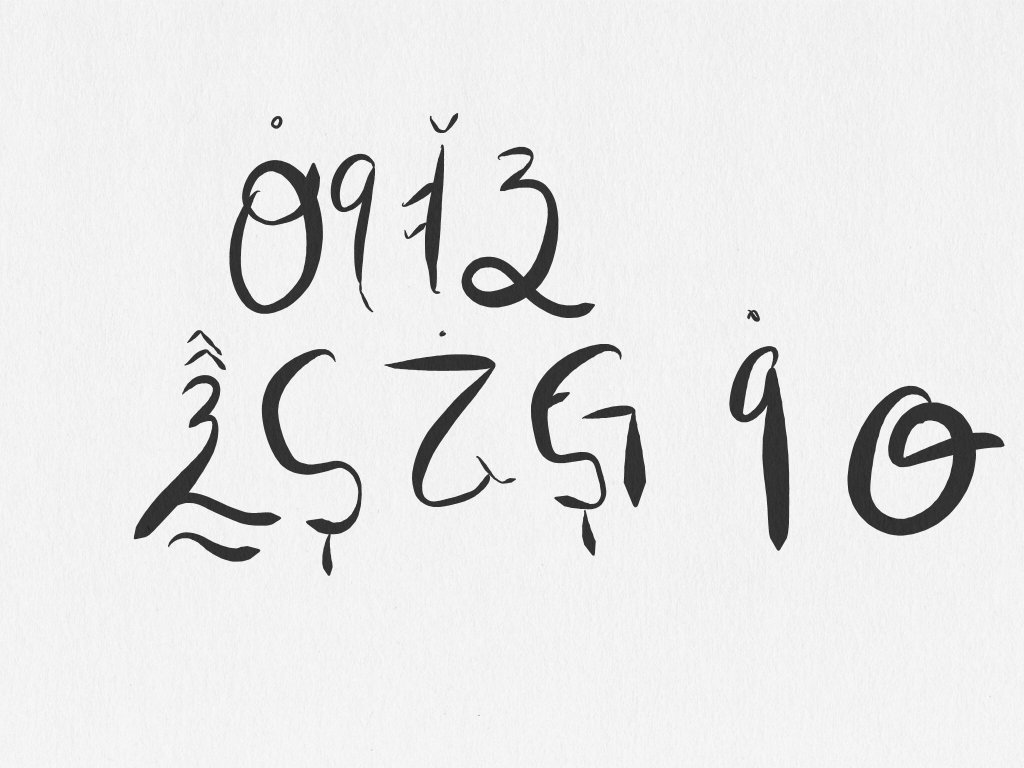
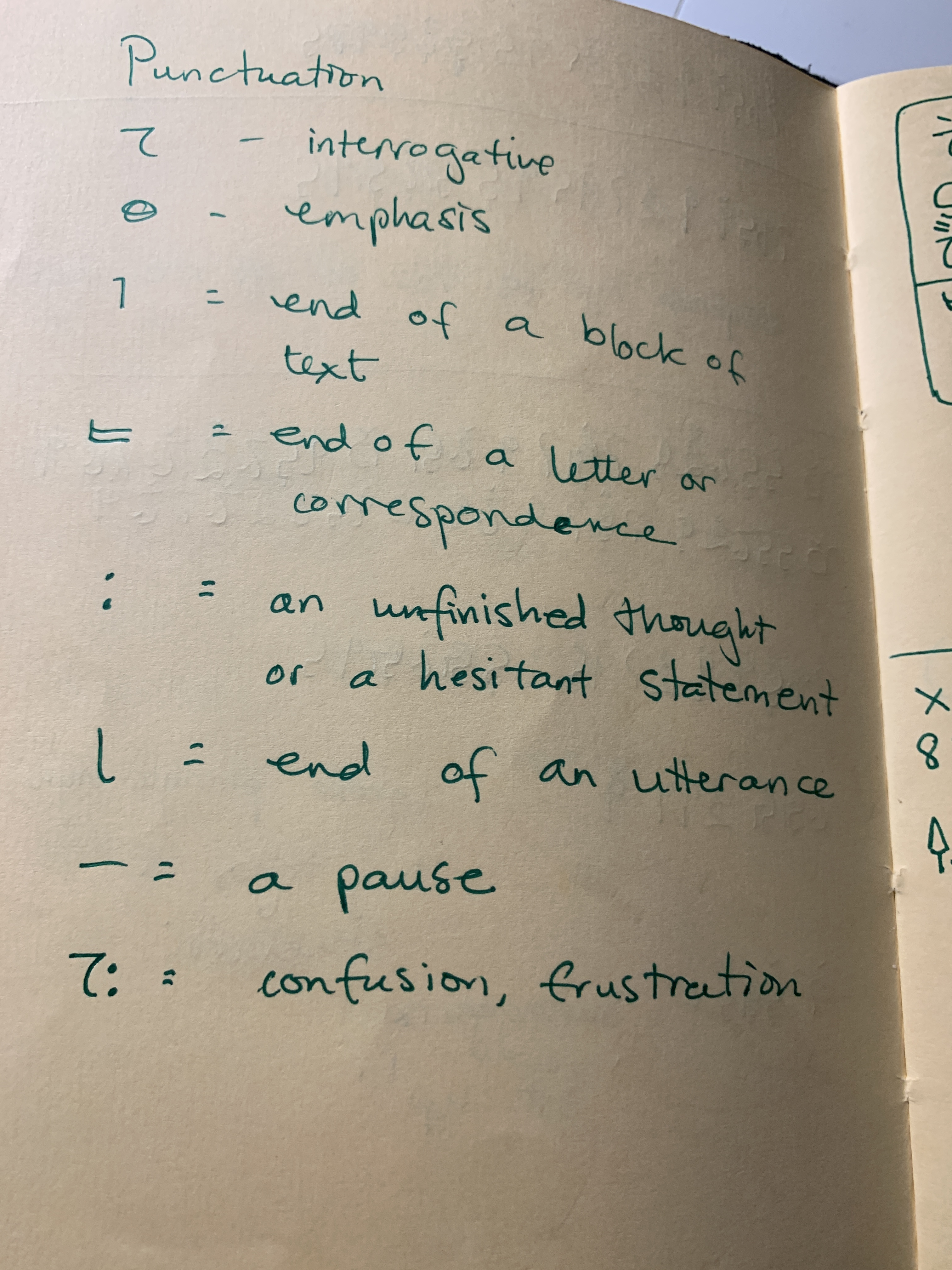
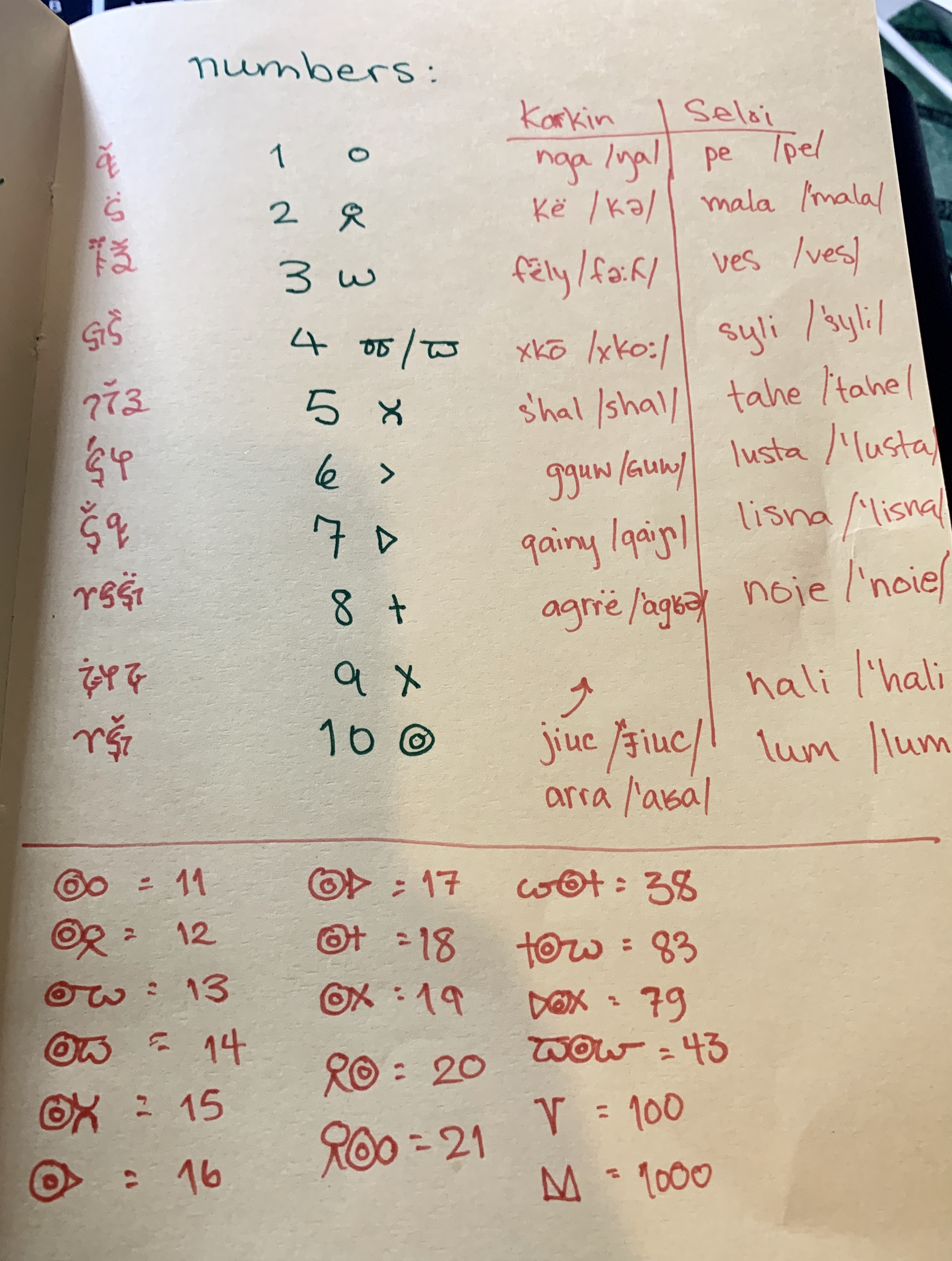
Also the punctuation marks and numerals:
IMG_1497
fullsizeoutput_728

More information will be coming–watch this space!


Margaret

Rílin script

So you’ve all probably seen at least some of my numerous poems written in Rílin, along with their accompanying script. I wanted to explain how the alphabet for Rílin works.

It is pretty simple conceptually. Rílin traditionally uses a phonetic alphabet, where each letter corresponds to a phoneme (distinguished sound) in the language. Rílin has a large phonemic inventory (29 consonants and 13 vowels), so there are as many letters in the alphabet.

In the below image, you can see the IPA symbol for each Rílin phoneme, followed by (in brackets) the Romanized representation (sometimes there are variants available for those times when it is not convenient or possible to use diacritic marks)

rilinletters
Consonants

vowels
Vowels


Ori poem

A poem in Ori. I use poetry to expand on my lexicon and grammar, as well as invent new ways of doing metaphor.

~

Clidolyal

Catyin-gae nalistityin tyae

Calin natin nalepa can iyutu cyan

Yullacu tyuhacu

Bane cohace

Nye nalemasye


Catyin eltrutyin tyae

Na lyen-tatyin tyo

Ilu cyalace

Na syutace

Milis cuheo bumi

Na misuhile lunin cyon-lastilen

Bine

Nyilleya hatanulya.


A false vow

But you knew my reasons

You never saw me how you should

Every year

We would slip further

From the truth.


You know my ways

And I know yours

We come together again

And split apart

A tree cloven in two

And from the sap running from our wounds

Perhaps

A new story.

Welcome to Quarios!

Map-10

The second of my regional maps of Aeniith (please click here for the full version!). The first was Izoi, which has actually been a BIT modified since then to make it more geologically plausible. We go for accuracy in worldbuilding when it comes to systems like geology, economics, etc. 😛 Anyway…

Quarios is a single state nowadays, run by a consitutional monarchy, which is currently headed by Queen Inacaporia. The continent was, until pretty recently, made up of two sovereign states: Lomilin and Gotêvi. Incaporia was the Queen of Gotêvi and married a Prince of Lomilin, and they merged their lands.

In the north of Quarios, the weather is warm and humid most of the time, with mild winters. This is because Quarios is in the southern hemisphere. The southern most islands are frigid and cold. They are home two some ethnically distinct peoples known as the Teg and Phuli. These peoples speak their own languages (Teg and Phul) in addition to Gotevian. People living on the Lomilin side of Quarios (the west side) speak Lomi.

The northern port city of Naeglitan is where Elucuna arrives when she first getsto Quarios from Orikrindia (island nation to the north). She then travels with Glohitan to Valley of Voagry just to the southeast of there.