Conlang: Ori (interrogative pronouns, deictic adjectives, a few irregular verbs)…

orikrindiaemblem

This is the purple flower of Orikrindia, the nation emblem. Its six petals represent the six provinces of Orikrindia. 

~

Here are a few more pronouns in Ori (non-personal pronons). The base forms of these words is the indeterminate pronouns (something, somewhere, etc.), while adding na- makes the words interrogative (who?, what, etc.). Similarly, adding ca- makes them negative (no one, no way, etc.). See below for the forms and some examples sentences.

alar ‘someone’

nalar? ‘who?’

calar ‘no one’


bel ‘something’

nabel? ‘what?’

cabel ‘nothing’


nye ‘somewhere’

nanye? ‘where?’

canye ‘nowhere’


sya ‘some reason’

nasya? ‘why?’

casya ‘for no reason’


tin ‘in some way’

natin? ‘how?’

catin ‘in no way’


lin ‘some time’

nalin ‘when?’

calin ‘never’


Examples:

Alars tari cyan pye Mirmis cleppat proru cyan ‘Someone said Mirmi ate poison’


Nanye minim ti-trentepya ma? ‘Where can I find the temple?’


Nasya tranye ti ma? ‘Why are you here?’


Calars tin-nelcag iyuru can ‘No one sees the gods’


Tu-porinis tun-porityan tin peli bil ‘The shepherd will probably find the sheep somehow’

~

Deicitc adjectives

Ori has two sets of deictic adjectives. These are adjectives that modify nominals to show relative spatial position–in English we have ‘this’, ‘that’, ‘these’, ‘those’. In Ori, one set of adjectives relates to spaces near and away from the 1st person (the speaker), while the other set is used with references to all other persons (2nd and 3rd).

From 1st person perspective:

ti ‘that’

tra ‘this’


tim ‘those’

tram ‘these’


From 2nd person or 3rd person perspective:

dum ‘that

del ‘this’


dumi ‘those’

deli ‘these’

Plural vs singular is the only morphological distinction, and there is no class agreement on deictic adjectives.


Examples:

dumi porisa ‘those sheep’ (far from you/another)

deli porisa ‘these sheep’ (near you/another)


tim porisa ‘those sheep’ (far from me)

tram porisa ‘these sheep’ (near me)

~

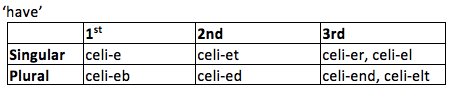
Ori has a few irregular verbs, like all natural languages. Many of them are quite common verbs.

li ‘come’

me ‘go’

te ‘do, make’

celi ‘have’

syalu ‘use’

tyelu ‘know’

malu ‘be’

maro ‘give’

Examples of conjugations of irregular verbs (where two forms are listed under 3rd person, the first form is for animate/inanimate nouns and the second is for celestial/abstract nouns):
Screen Shot 2018-06-30 at 12.18.15 AM

Screen Shot 2018-06-30 at 12.20.18 AM

Screen Shot 2018-06-30 at 12.22.41 AM

More irregular verbs and other stuff to come!

Mintaka

Conlang/conculture: Ori(krindia): (temples, quick note on ‘s’, independent pronouns)…

Alrighty.

I am posting some photos of cliffs and mountains like this, since this is how I envisage some of the Orikrindian temples appearing, situated high in the mountains and built into the rock itself. My feeling at this point is one of their primary deities of their pantheon is a mountain goddess who is seen as a mother, supporting and giving life to many other smaller gods who represent entities that dwell on or around the mountain. I know there is a god that is represented by fire/volcanoes, since those are everywhere in Orikrindia. Somehow I want connect the fire god/mountain goddess in a kind of symbiotic relationship. I’m not sure how yet.

~

One more small note on noun cases: I failed to mention that any nouns ending in -s are a little different. I noted that nouns ending in stops (oral or nasal) got an epenthetic -i- inserted before the main case ending for their class. Other final consonants like -r and -l do not. -s however is a little different. In certain respects, it follows the pattern of -l and -r in that it doesn’t get an epenthetic -i-, but in other instances, it does. See below for examples. Note which cases use the epenthetic -i- and which do not.

Inanimate noun: holis ‘door’

Animate noun: selis ‘teacher’

Celestial noun: tus ‘beam of light’

Abstract noun: lyos ‘grief’

nom sg: holis-is OR holis-∅; selis-is/selis-is; tus-ya; lyos-yal

gen sg: holis-ni; selis-ire; tus-sye; lyos-sye

dat sg: holis-im; selis-te; tus-ilya; lyos-lu

acc sg: holis-t selis-t; tus-pya; lyos-pya

loc sg: holis-il; selis-le; tus-cya; lyos-cu

instr sg: holis-ir; selis-in; tus-cya; lyos-ce

voc sg: holis-ca; (all use -ca)

nom pl: holis-sa; selis-sa; tus-ta; lyos-ta

gen pl: holis-ni; selis-si; tus-na; lyos-nya

dat pl: holis-mi; selis-ti; tus-lo; lyos-bi

acc pl: holis-tyin; selis-tyan; tus-ig; lyos-gya

loc pl: holis-len; selis-ic; tus-id; lyos-tya

instr pl: holis-ip; selis-int; tus-id; lyos-tya

voc pl: (all use -ca)

~

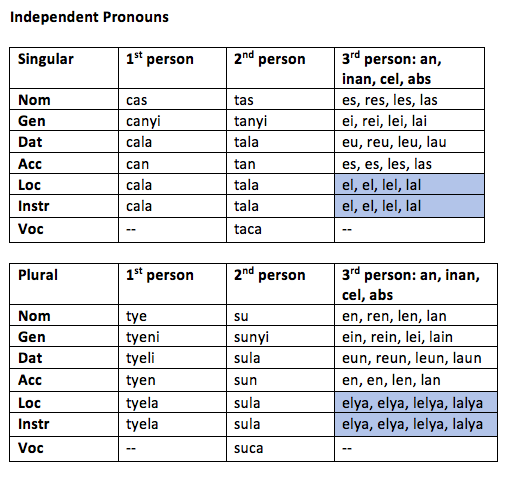
So we have looked at the case system for full nouns of all classes. Now it is time to look at independent personal pronouns. Ori does mark the subject of the verb as a suffix, but it also includes personal pronouns that are not attached to the verb. See the chart below for how these pronouns exist in each case. Note that third person pronouns are irregular, and also that they exist differently for each class.

These pronouns can be made reflexive by the addition of the suffix -(i)cye:

canicye iyum cyan ‘I saw myself’

Example of pronoun use:

Cala ipalnda ‘I like them’ (lit: they are pleasing to me)

Tan yubru! ‘We see you!’

Elya abarita tresita ummultu ‘In them all blessings lie’

Maropye en eun! ‘Give it to them!’

Lye-trumat suhit ryesubru cyan na tyeli ipalir cyan ‘We sipped the red nectar and it pleased us’

Eu lye-tepet maroi cyan ‘I gave her the fruit’


~

Mintaka