Valency Series: Intro

Recently, I gave a presentation at 11th Language Creation Conference at the University of Maryland. I’m going to reproduce some of the content of that presentation on this blog, in the context in which it was intended: using linguistic typology to show some interesting grammatical things that can be done in conlangs, and why you, as a conlanger, should care. In the presentation, I gave an overview of different structural manifestations and semantic uses of valency-changing operations, how they appear in natural languages and how I have implemented them in my various conlangs.

Basically, a valency-change operation increases or decreases the number of core arguments in a verb. Core arguments are those that are considered necessary for a given verb: semantically, they are represented by A (agent), S (sole/subject), and P (patient). Agents are those in control of the action of a verb (broadly speaking), Patients (also sometimes called Themes) are those most affected by the verb, and Subjects or Soles are the sole argument of a verb. Languages vary in how they treat S, A, and P morphosyntactically. Nominative-accusative languages group S and A together, leaving P marked differently. Thus we get sentences like, “I bit him” and “I sleep”, in which the word “I” is used regardless of whether it refers to an A (“I bit him”) or an S (“I sleep”). Therefore, A and S are both in the nominative case and P is in accusative. Ergative-absolutive languages, by contrast, group S and P together, with A being the distinctive one. S-P are usually in the absolutive case, while A is in the ergative case. The distinction of these core argument groupings is called the verbal alignment or morphosyntactic alignment of a language.

Morphosyntactic alignment plays somewhat into valency change. When we use a valency-changing operation, we are manipulating the core arguments of a verb. Ultimately, the way a language treats core arguments becomes relevant when we fiddle with those core arguments.

First, I will outline two broad categories I will cover in this blog post series. The first is (1) valency-decreasing operations and the second is (2) valency-increasing operations. I actually hope to cover more of each than I was able to in just 20 minutes of slides and speaking for the presentation version of this essay. Ultimately, I’ll discuss: causatives, applicatives, passives, antipassives, anticausatives/middle voice, and reflexives/reciprocals. Some of these categories may overlap to a greater or lesser degree, depending on the language. It’s also true that convention often dictates the terminology used for these categories in the traditions of specific languages. I’ll try to be as explanatory as possible when describing each feature.

For now, I’ll start off with causatives, the first valency-increasing operation.

Simply put, causatives add another core argument to a verb, by inserting a causer and turning either an A or S into a causee, one who is caused by the causer to do the action. See for example, the English example below.

‘Joshua ate the spaghetti’ –> ‘I made Joshua eat the spaghetti’

The first sentence is transitive, wherein the A (Joshua) eats the P (spaghetti). In the second sentence, I use a causative (a periphrastic one that uses the verb make), thereby adding another core argument to the verb eat. “I” is now the causer, “Joshua” is the causee, and “spaghetti” is still a P undergoing the action of being eaten.

Languages vary morphosyntactically in the ways they do causatives. Some are periphrastic or analytic, as in English. Another example is in French:

‘J’ai fait manger les spaghettis à Joshua’
1s.S-aux make.pstprt eat the spaghetti to J.
‘I made Joshua eat the spaghetti’

Note how in the French version of this sentence, the causee is now marked as an oblique, preceded by the preposition à ‘to’. This one of two major strategies languages use to show that a former A/S is now no longer such, due to the addition of the causer. The causee can either be marked oblique, as above, or it may be marked the way other P nouns are. In the latter case, we see examples like that in Sanskrit below, in which the causative allows two accusative-marked nouns to coexist in one clause.

Rama-m veda-m adhyapa-yate
Rama-acc veda-acc learn-caus
‘He teaches Rama the Veda’ (Literally: ‘He makes Rama learn the Veda.’)

In the above sentence, you can see that this causative construction allows two nouns to be marked accusatives. One is the causee (Rama), and one is the object of the verb (the Veda) that the causee is being caused to perform .

The above example also shows us that causatives can be morphological, or marked directly on the verb with some morpheme. This is also a cross-linguistically very common way of doing causatives. Sometimes, languages differentiate between which causatives apply to transitive verbs and those apply to intransitive verbs. See the examples below from Turkish. ‘die’ is an intransitive verb, and thus when it is causativized, it gets the -dür causative.

Hasan öl-dü
H.       die-pst
Hasan died’

Ali Hasan-t öl-dür-dü
A. H. -acc die-caus-pst
‘Ali killed Hasan’

However, if the verb we start out with is already a transitive verb, a different causative morpheme is used, the -t morpheme. The first sentence below shows a regular transitive sentence, “The director signed the letter”. Then we see how such a sentence could be causativized: “The dentist made the director sign the letter.”

Müdür mektub-ü imzala-dı
director letter-acc sign-pst
‘The director signed the letter’

Dišçi mektub-ü müdür-e imzala-t-tı
dentist letter-acc director-dat sign-caus-pst
‘The dentist made the director sign the letter’

Causatives can also be lexical. That is, they can be represented by totally separate lexemes or words. This is not an instance of a word being modified by a morpheme, but something else entirely. English has several examples of this, notably the die and kill pair. ‘kill’ is a causative of ‘die’. Another such pair is eat and feed. A cross-linguistic tendency noted in Haiman (1983): within languages that have multiple strategies for creating causatives, lexical causatives tend to show a greater level of control and directness of causation than morphological causatives, which in turn show a greater degree of such than analytic causatives.

Below, I’ll provide a few examples of ways I have created causatives in my conlangs. The first example comes from Seloi. This somewhat isolating language has an analytic causative. The particle here is sli. It was, historically, a verb, and it still sits in a verbal position in the clause, but it lacks any other trappings of a real verb, such as tense, aspect, or modality. Therefore, it can be said to be fully grammaticalized.

Vali sli    na te-keva          te-koi        ai Iskila
3s.m caus for def-woman  come-fem loc Iskila 
‘He is having the woman come to Iskila’

Note how in this construction, the causee is demoted to an oblique role, prefaced by the preposition na ‘for’.

In Rílin, morphology is the main way to implement a causative. The prefix xa- increases the valency of a verb by adding a causer. For example, the intransitive verb psílha [‘psiɬa] means ‘to bleed’. xapsilha is ‘to make bleed’, with an extended meaning ‘to injure, to hurt’. lhesti [‘ɬɛstɪ] is ‘to listen’, can be either transitive or intransitive, while xalhesti is ‘to make listen’ and by extension, ‘to warn, to make heed’. So we can increase the valency of these verbs with xa-, regardless of whether they are intransitive or transitive to begin with. Some of the resulting meanings of the causative forms have become idiomatic, such as zaryxía [zary’xia] ‘to rust’ and xazaryxia ‘to renounce’. The latter has moved completely into its metaphorical meaning, which has now become its primary sense.

Rílin also has a number of lexical causatives. zansa ‘to kill’ has no etymological relation to lemua ‘to die’. But zansa replaces any instance of *xalemua, which is not attested. Similarly, saísa ‘to rise’ and hare ‘to raise’ have no structural or etymological relationship, but the latter can be said to be a (semantically) causative form of the former.

Karkin, another of my conlangs, has an active-stative aligment system. Karkin has four causative morphemes, each of which shows a different implication about harm and benefit on the part of the causer and/or causee.

Type 1: Karkin causative Type 1 implies a benefit for the causee of the action (the one who was caused to act).

məl-a-i ava-a mi                        shoʔonthe-‘ə  pa ʃtuxtə-peq-aː

mother-1S.POSS.A father-1S.POSS to river-P PART cross-CAUS-PST

‘My mother made my father cross the river (it was good for him/he liked it)’

You can identify this causative by use of the morpheme –peq– preceding the tense morpheme at the end of the verb. Avaa ‘my father’ is in an oblique case, shown by the postposition mi.

Type 2: Karkin causative Type 2 implies harm or misfortune toward the causee.

məl-a-i                ava-a-ʔə           shoʔonthe-ʔə pa      ʃtuxtə-vur-aː

mother-1S.POSS.A father-1S.POSS-P river-P                PART    cross-CAUS-PST

‘My mother made my father cross the river (it was bad for him/he didn’t want to)’

This kind of causative is marked by the verbal morpheme -vur-. It also marks the causee, avaa, with a patient marker instead of an oblique one: -ʔə.

Type 3ː Karkin causative Type 3 implies neutrality for the causee as to benefit/harm.

məl-a-i ava-a mi                        shoʔonthe-‘ə  pa ʃtuxtə-χe-aː

mother-1S.POSS.A father-1S.POSS to river-P PART cross-CAUS-PST

‘My mother made my father cross the river (it was neutral)’

This kind of causative is marked by the verbal morpheme –χe-. The causee is marked obliquely with –mi-.

Type 4: The final causative type implies mutual benefit between causer and causee.


məl-a-i ava-a mi                         shoʔonthe-‘ə pa   ʃtuxtə-li-aː

mother-1S.POSS-A father-1S.POSS to river-P           PART    cross-CAUS-PST

‘My mother made my father cross the river (it was mutually beneficial)’

This type of causative uses the –li– morpheme and marks the causee with oblique mi.

~

I’m going to end or at least pause my discussion of causatives. Next time, I will likely write about applicatives. This is one subject I didn’t have time to discuss in my presentation of this topic, so I’ll be pleased to put my thoughts into words.
Some Lexember examples: new words in conlangs

December is the month that conlangers of all kinds participate in something called Lexember. We create a new word (in the lexicon) for our conlang(s) every day of the month. I’ve been participating and sharing words largely through tumblr (user: aeniith) and twitter (@MintakaGlow). Here are a few from the first days so far.


Rílin

Dec 1:

íha [ˈiha], [v tr/intr] : [1] forgive, pardon; accept, understand; [2] know, acknowledge, recognize; [3] bring attention to, point out, remark on; [4] notice, realize

Etymology: Possibly from iŵ- [iɸ] ‘take in, accept’ and ja ‘know’

Example:

íhazim kasa tañ lönenet naba ŵedínla
íha      -z        -im kasa       tañ        lön -en-et     naba                  ŵedí -n-la
forgive-pst.prf-1s already dist woman-pl-abs whatever wrongdoing-pl-instr
“I have already forgiven those women for any wrongdoing’

Karkin

Dec 2:

vkāmēgh [vkɑːˈmeːɣ] [v tr/intr] (ki-verb class) : [1] break out of, escape from within; [2] break down a wall or other barrier; [3] (fig) destroy a boundary, flout a rule, defy expectations

Etymology: From vkā ‘strike, hit’ and mēgh ‘run, run away’.

Example:

Psi  nux-ë     twë  qhrō    ki    vkāmēgh-ā  -yi         vuq     kuqhkë mi  ja   wëngi-ā   -pa   
dist girl-3s.p  who early part defy        -pst-3s.a    all       clan      gen part speak-pst-1s.a
“I spoke with that girl who had previously broken all the boundaries of her family clan.”

Rílin

Dec 3:

bióŝû [bɪˈoʃʌ] [v intr] : [1] walk precariously, walk on a slippery or icy surface; [2] be in a precarious or unsure state; [3] be in a risky state, ‘walk on thin ice’.

Etymology: From bió ‘slip, slide’ and [jó]ŝû ‘walk’.

Example:

Ŝy-ky  sé    zaín séfet   tû pre-t       pato        bióŝû -l -í
be-irr prox time now do care-abs because walk.slippery-prs.hab-2s.fam
‘Now is the time to take care because you are in a precious position’

Rílin

Dec 4:

móníhas [moˈnihas] [n, inan] : [1] portent, omen, sign; [2] hint, clue; [3] tell, revealing action.

Etymology: From móní ‘watch, guard’ and has ‘sign, signal’.

Example: Né      í-t     -íí          kuala              -n-et ómina-mí,    x-óly    -t      -aap      lí-et      
      if   look-npst-2s.fut constellation-pl-abs sky-gen  caus-solve-npst-3s.fut 2s-abs the

                 bí ǵom-et ka-ŝó      kalum-mí a       oma-mí.  
                 knot-abs two-adv world-gen and  soul-gen

“If you look into the constellations in the sky, it will let you untie the knot of both the world and the soul.”

Tosi

tūgh [tuːɣ] [n] : [1] face; [2] front; [3] cover, outside covering, skin; [4] sleeve, sock, outer layer (e.g. of a wrapping, of clothing); [5] protective layer, protection, assurance, aide, help, assistance, back-up, auxiliary force.

Etymology: From Old Tosi tūhuz- “face; scalp”

Example:

Tapi sur ja da chi tūgh i vis rīy.
imp angle vrblz 2s.fem gen face obj to sky
“Turn your face toward the sky”

Tosi

Dec 6:

gungar [ˈɡuŋɡar] [v, tr] : [1] chase, pursue; [2] hunt (e.g. animals); [3] fish, catch fish; [4] seek out, look for, search for.

Etymology: From gar ‘follow’, and gun-, an emphatic prefix (cf. gun ‘great, might’).

Example:
Na gangur na chi xeti gek i, gempe tapi ixari!
1s.f pursue 1s.f gen female.servant drunk obj please imp help
“I’m chasing after my drunken servant, please help me!”

Tosi

Dec 7:

hās [hɑːs] [v, tr] : [1] fill; [2] replenish; [3] add to, increase.

Etymology: From old Tosi hāh-, hāθ- ‘full, plentiful’

Example:
Tapi hās na chi kūn i ge na gō tiv gunāl.
imp fill 3s.f gen cup obj if 3sg.f be punct.fut empty
“Fill her cup if it is empty”


Conlang: Ori (prepositions!)

More developements in Ori grammar…


Prepositions

 Although Ori uses cases to show location in many situations (typically by use of the dative, locative, or instrumental cases), it also uses prepositions to further indicate more specific location or relationships.

bulu ‘through’

menya ‘across’

nye ‘out of, from, away from’

nela ‘amongst, midst’

amo ‘around, surrounding’

ebel ‘for the sake of’

dranme ‘thanks to’

he ‘by, next to, near, with, close to’

pa ‘beneath, under(neath)’

pel ‘during’

casya ‘without’

nimi ‘inside (of), in’


These prepositions maybe used with nouns in various cases: it depends on the preposition.

Prepositions with the locative case:

bulu ti-mulyurati ‘through the forest’

menya embete ‘across a river’

nelanyendac ‘amongst friends’

amo oltacya ‘around a tomb’

pa bestiti ‘under ground’


Prepositions with the genitive case:

nye ti-tyagalpan ‘away from the storm’

pel plenyullasye ‘during the autumn’


Prepositions with the dative case:

ebel calya nimalya ‘for the sake of my mother’

dranme tate tyollate ‘thanks to your younger brother’


Some prepositions may be used with different cases, which give different shades of meaning.

nimi ti-mulyurati ‘inside the forest’ (used with locative): implies deep within the forest, perhaps out of sight

nimi ti-mulyurato ‘into the forest’ (used with accusative): implies movement to and through the forest

Ori needed more declensions?

I decided Ori needs more nouns declensions. 😛

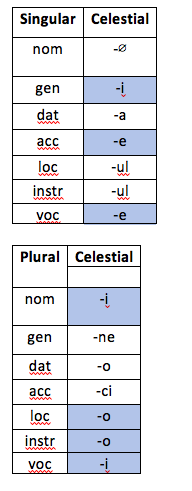
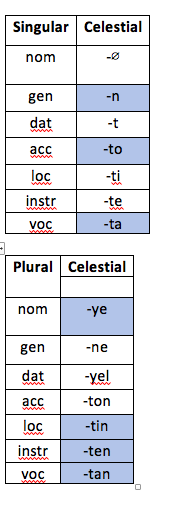
So here are two new celestial class declensions.

2nd declension (celestial)

These nouns often end in -n or -m.

Btw, the -∅ symbol in linguistics means ‘null’ or ‘nothing’. So that means the nom. sg. forms don’t add a suffix.

image

Using Calcurassen’s name as an example (in the singular, of course–there is only one of the God of Justice):

Calcurassen ryintat trulali ‘Calcurassen drinks wine’

Ti-clespes Calcurasseni astere lya. ‘Calcurassen’s jewel is bright’

Murlinis Calcurassene iyuru ‘A raven sees Calcurassen’

Hensapya Calcurassena maroi cyan ‘I gave praise to Calcurassen’

Calcurassenul minim cyan nalemapya peli. ‘By means of Calcurassen, I was able to find justice’

Hestinyal Calcurassenul lya. ‘Hope lies with Calcurassen’

Oa, Calcurassene! Maropye tyeli abarig! ‘Oh, Calcurassen! Give us blessings.’

~

The next declension is also for celestial nouns–most of these ending in vowels.

3rd celestial declension

image

Examples:

Ti-hembe lilya rya. ‘The body of fresh water is small’ (Note that ‘small’ still agrees with embe–it just uses a different celestial (nom sg. suffix, the one from the very first celestial declension I introduced, which is -ya rather than -∅.)

Culleryal caben bellu. ‘The expanse of the world is wide’

Gilupye yalutyin tatyin ti-trahellet ‘Turn your eyes to the meteor shower’

Ok, you get the idea. 🙂

~

Mintaka

Ori derivational morphology

So this is obviously a work in progress, BUT here are some new Ori derivational morphemes! Yay! I like them.

Derivational Morphemes

-u

This morpheme comes from the word hu‘one’, and it often added to adjectives to create a noun.


lil ‘small’ –> lilu ‘small one’

truma ‘red’ –> trumu ‘red one’


It can also be used with other nouns, however:


cleppa ‘poison’ –> cleppu ‘poisoned one’


-ya


-ya is a gerund marker; it nominalizes a verb (transitive or intransitive):


ta ‘speak’ –> taya ‘speaking’

aste ‘reckon’ –> asteya ‘mathematics’

pra ‘listen’ –> praya ‘listening; educational lecture’

lyeppe ‘enjoy’ –> lyeppeya ‘enjoyment’

clasin ‘become flat’ –> clasinya ‘flattening; (of a person) becoming boring’


-uya


-uya is a suffix that indicates ‘beginning of V/N’, meaning it can attach to either a verb or a noun.


Note that if there is a vowel at the end of the bound morpheme, that first vowel is deleted before -uya.


lyannis ‘make a pilgrimage’ –> lyannisuya ‘beginning of a pilgrimage’

ta ‘speak’ –> tuya ‘beginning of a speech’

syala ‘rule, reign’ –> syaluya ‘beginning of the reign of a king’

becul ‘cave’ –> beculuya ‘antechamber of a cave’

besti ‘earth, ground’ –> bestuya ‘top layer of soil’

cul ‘moon’ –> culuya ‘new moon’

Sometimes the meaning of this suffix implies smallness due to something being “only the beginning of [and no more]” V/N:


lar ‘laugh’ –> laruya ‘a short laugh, a clipped laugh’

lubela ‘secret’ –> lubeluya ‘just a little secret’


-on


-on is an augmentative suffix that applies to nouns.


lyuha ‘dog’ –> lyuhon ‘large dog’

ori ‘man’ –> orion ‘big man’

mil ‘tree’ –> milon ‘large tree’


-li


-li is the opposite of -on, a diminutive suffix for nouns.


lyuha ‘dog’ –> lyuhali ‘puppy’

bistraya ‘flower’ –> bistrayali ‘bud, small blossom’

coru ‘rock’ –> coruli ‘pebble’

bu ‘house’ –> buli ‘room inside a house, chamber’

hesta ‘mountain’ –> hestali ‘hill’


e

-e is a common ending for adjectives (e.g. nale ‘true’, clippe ‘rotten’, balnye ‘great’). It can also function as a derivative morpheme for adjectivization from nouns.


Usually, if there is a final vowel on the base noun, it is replaced by -e.


hustu ‘belief, trust’ –> huste ‘trusting’

cleppa ‘poison’ –> cleppe ‘poisonous’

galacil ‘smoke’ –> galacile ‘smoky’

lubela ‘secret’ –> lubele ‘secret (adj.)’

roru ‘darkness’ –> rore ‘dark’


cli-/clip-

This is a pejorative prefix that usually affixes to nouns. It comes from the adjective clippe‘rotten, sour’. The cli- form precedes consonant-initial words, whereas the clip- form is used with vowel-initial words.


prasta ‘mind, thoughts; behavior, actions’ –> cliprasta ‘betrayal; treason’

olta ‘tomb’ –> clipolta ‘a badly made or ritualistically wrong or unclean burial’

gerum ‘death’ –> cligerum ‘a dishonorable death’

ha-


This prefix can be used as either an augmentative or an ameliorative (“good N”) prefix.


pyelli ‘pain’ –> hapyelli ‘great pain’

selis ‘teacher’ –> haselis ‘a good teacher’

lyuha ‘dog’ –> halyuha ‘a particularly loyal dog’

bela ‘word’ –> habela ‘eloquence’

belta ‘wind’ –> habelta ‘a sudden warm wind in the winter’


Mintaka2

Conlang: Ori (relative clauses)

A bit ago I introduced some interrogative, indefinite, and negative pronouns for Ori. Related to these forms are relative pronouns, which are used to create relative clauses.

In Ori, relative clauses are head-initial, despite the generally left-branching (head-final) nature of Ori. This means that the head of the relative clause (the main noun) is placed before the relative clause (as it is done in French or English, for example).

The relative pronouns are basically all formed from verions of the interrogative pronouns, but with an additional suffix of -a at the end of the word.

nalar – ‘who?’ –> nalara ‘who’ (rel.)

nabel – ‘what?’ –> nabela ‘which, that’

nanye – ‘where?’ –> nanya ‘where’ (rel.)

nasya – ‘why?’ –> nasya ‘for which reason’ (rel.)

natin – ‘how?’ –> natina ‘in which way’ (rel.)

nalin – ‘when?’ –> nalina ‘when’ (rel.)

The trisyllable forms of the relative pronouns (nalara, nabela, natina, and nalina) also have short forms that are used more commonly in eveyday speech.

nalara –> na-

nabela –> naba-

natina –> nata-

nalina –> nana-

~

Relative pronouns take the same case that the shared noun uses in the embedded clause. In the below sentence,

Tu-hema-s na-s tet lyen-besorpa-tan nimas rya

def.art-woman-nom who-nom makes def.art-clay.pots-acc mother-nom be

‘The woman who makes the clay pots is a mother’

Lye-besorpa-s naba-t elucu-m cyan truma-s rya.

def.art-clay.pot-acc which-acc choose-1sg pst.perf red-nom be

‘The clay pot that I chose is red’

nanya, nasya, nalina/nana are all often used without a case marker at all.

Ti-trente-cya nanya ti-hiluma-pya peli-t cyan culim-bru alinda.

def.art-temple-loc where def.art-priestess-acc find-2sg pst.perf travel-1pl tomorrow

‘Tomorrow we will travel to the temple where you found the priestess’

Upcoming works are brewing…

I’m writing some mini-stories about Orikrindians that I will probably post in the future. Topics may/will include:

– An Orikrindian girl who leaves her country at age 15 and moves to Quarios, some of her thoughts, motivations, and memories (telling her story in retrospect)

– Two Orikrindian brothers who are separated due to a war with a neighboring country

– A story of the devotees of the mountain goddess and fire god who go on a pilgrimage to a great mountain. Fewer will descend that those who went up

I’m also recording new poems in Rílin now, since I am finally back in touch with my h4n Zoom audio recorder, which is higher quality than my laptop mic, unsurprisingly.

Other topics in the works: more Ori grammar, the Orikrindian pantheon, and info on Orikrindian artisanal works.

This has been a semi-update with a bunch of teasers…but I’m really excited about what I’m working on so it’s ok. 😛

Mintaka

Conlang: Ori (interrogative pronouns, deictic adjectives, a few irregular verbs)…

orikrindiaemblem

This is the purple flower of Orikrindia, the nation emblem. Its six petals represent the six provinces of Orikrindia. 

~

Here are a few more pronouns in Ori (non-personal pronons). The base forms of these words is the indeterminate pronouns (something, somewhere, etc.), while adding na- makes the words interrogative (who?, what, etc.). Similarly, adding ca- makes them negative (no one, no way, etc.). See below for the forms and some examples sentences.

alar ‘someone’

nalar? ‘who?’

calar ‘no one’


bel ‘something’

nabel? ‘what?’

cabel ‘nothing’


nye ‘somewhere’

nanye? ‘where?’

canye ‘nowhere’


sya ‘some reason’

nasya? ‘why?’

casya ‘for no reason’


tin ‘in some way’

natin? ‘how?’

catin ‘in no way’


lin ‘some time’

nalin ‘when?’

calin ‘never’


Examples:

Alars tari cyan pye Mirmis cleppat proru cyan ‘Someone said Mirmi ate poison’


Nanye minim ti-trentepya ma? ‘Where can I find the temple?’


Nasya tranye ti ma? ‘Why are you here?’


Calars tin-nelcag iyuru can ‘No one sees the gods’


Tu-porinis tun-porityan tin peli bil ‘The shepherd will probably find the sheep somehow’

~

Deicitc adjectives

Ori has two sets of deictic adjectives. These are adjectives that modify nominals to show relative spatial position–in English we have ‘this’, ‘that’, ‘these’, ‘those’. In Ori, one set of adjectives relates to spaces near and away from the 1st person (the speaker), while the other set is used with references to all other persons (2nd and 3rd).

From 1st person perspective:

ti ‘that’

tra ‘this’


tim ‘those’

tram ‘these’


From 2nd person or 3rd person perspective:

dum ‘that

del ‘this’


dumi ‘those’

deli ‘these’

Plural vs singular is the only morphological distinction, and there is no class agreement on deictic adjectives.


Examples:

dumi porisa ‘those sheep’ (far from you/another)

deli porisa ‘these sheep’ (near you/another)


tim porisa ‘those sheep’ (far from me)

tram porisa ‘these sheep’ (near me)

~

Ori has a few irregular verbs, like all natural languages. Many of them are quite common verbs.

li ‘come’

me ‘go’

te ‘do, make’

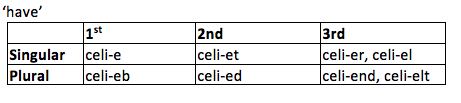
celi ‘have’

syalu ‘use’

tyelu ‘know’

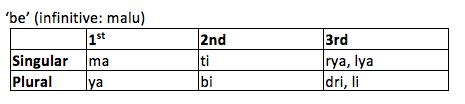
malu ‘be’

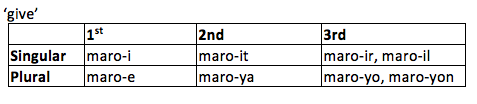
maro ‘give’

Examples of conjugations of irregular verbs (where two forms are listed under 3rd person, the first form is for animate/inanimate nouns and the second is for celestial/abstract nouns):

Screen Shot 2018-06-30 at 12.18.15 AM

Screen Shot 2018-06-30 at 12.20.18 AM

Screen Shot 2018-06-30 at 12.22.41 AM

More irregular verbs and other stuff to come!

Mintaka

Conlang/conculture: Ori(krindia): (temples, quick note on ‘s’, independent pronouns)…

Alrighty.

I am posting some photos of cliffs and mountains like this, since this is how I envisage some of the Orikrindian temples appearing, situated high in the mountains and built into the rock itself. My feeling at this point is one of their primary deities of their pantheon is a mountain goddess who is seen as a mother, supporting and giving life to many other smaller gods who represent entities that dwell on or around the mountain. I know there is a god that is represented by fire/volcanoes, since those are everywhere in Orikrindia. Somehow I want connect the fire god/mountain goddess in a kind of symbiotic relationship. I’m not sure how yet.

~

One more small note on noun cases: I failed to mention that any nouns ending in -s are a little different. I noted that nouns ending in stops (oral or nasal) got an epenthetic -i- inserted before the main case ending for their class. Other final consonants like -r and -l do not. -s however is a little different. In certain respects, it follows the pattern of -l and -r in that it doesn’t get an epenthetic -i-, but in other instances, it does. See below for examples. Note which cases use the epenthetic -i- and which do not.

Inanimate noun: holis ‘door’

Animate noun: selis ‘teacher’

Celestial noun: tus ‘beam of light’

Abstract noun: lyos ‘grief’

nom sg: holis-is OR holis-∅; selis-is/selis-is; tus-ya; lyos-yal

gen sg: holis-ni; selis-ire; tus-sye; lyos-sye

dat sg: holis-im; selis-te; tus-ilya; lyos-lu

acc sg: holis-t selis-t; tus-pya; lyos-pya

loc sg: holis-il; selis-le; tus-cya; lyos-cu

instr sg: holis-ir; selis-in; tus-cya; lyos-ce

voc sg: holis-ca; (all use -ca)

nom pl: holis-sa; selis-sa; tus-ta; lyos-ta

gen pl: holis-ni; selis-si; tus-na; lyos-nya

dat pl: holis-mi; selis-ti; tus-lo; lyos-bi

acc pl: holis-tyin; selis-tyan; tus-ig; lyos-gya

loc pl: holis-len; selis-ic; tus-id; lyos-tya

instr pl: holis-ip; selis-int; tus-id; lyos-tya

voc pl: (all use -ca)

~

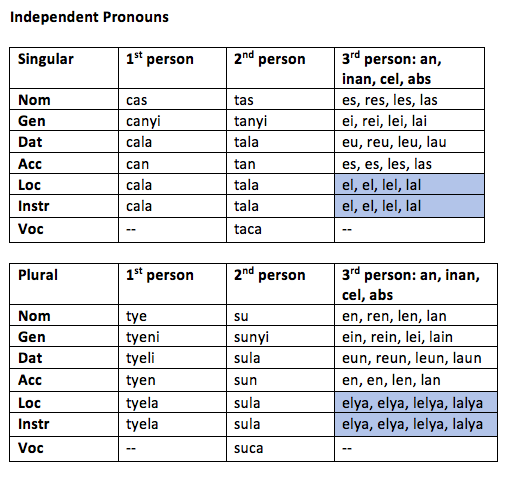
So we have looked at the case system for full nouns of all classes. Now it is time to look at independent personal pronouns. Ori does mark the subject of the verb as a suffix, but it also includes personal pronouns that are not attached to the verb. See the chart below for how these pronouns exist in each case. Note that third person pronouns are irregular, and also that they exist differently for each class.

These pronouns can be made reflexive by the addition of the suffix -(i)cye:

canicye iyum cyan ‘I saw myself’

Example of pronoun use:

Cala ipalnda ‘I like them’ (lit: they are pleasing to me)

Tan yubru! ‘We see you!’

Elya abarita tresita ummultu ‘In them all blessings lie’

Maropye en eun! ‘Give it to them!’

Lye-trumat suhit ryesubru cyan na tyeli ipalir cyan ‘We sipped the red nectar and it pleased us’

Eu lye-tepet maroi cyan ‘I gave her the fruit’


~

Mintaka

Conlang: Ori (nouns and their cases)

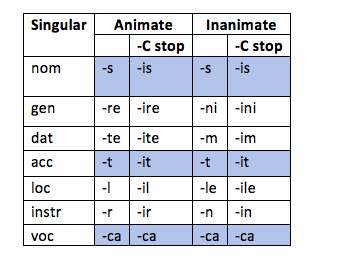
Last time I told you about more Ori verbs and how to conjugate them. Now I will move on to nouns. As I’ve mentioned before, Ori nouns come in four classes (like grammatical genders): animate, inanimate, celestial, and abstract. Ori has noun cases that suffix to nouns to show their grammatical role in the sentence. There are singular and plural, and different cases depending on the class of the noun. Below are the case endings for singular animate and inanimate nouns. The column that says -C stop contains suffixes for nouns that end in an oral or nasal stop (-t, -p, -c, -b, -d, -g, -m, -n). These nouns get a little epenthetic -i- inserted before the case suffix, as you can see below.

  • Note that the blue shaded rows are where the cases for both animate and inanimate are the same.

Screen Shot 2018-06-18 at 6.12.11 PM

So what do these cases mean?

Nom = nominative: this marks the subject of a verb. Example: tu-porin-is merir ‘the shepherd is dancing’

Gen = genitive: nouns in the genitive case show possession or relation. Example: lye-bus tu-ema-re ‘the house of the woman; the woman’s house’

Dat = dative: nouns in the dative case are the indirect object of a verb. In English, this would be often marked with the preposition to or for. Example: maropye tu-porit tu-ema-te ‘give the sheep to the woman’

Acc = accusative: nouns in the accusative case are the direct object of a verb. Example: tepe-cyepu cyan ‘I took the fruit’

Loc = locative: nouns in the locative case show that something is located in, at, or on a thing. Example: bu-le ummum ‘I am staying at home’

Instr = instrumental: the instrumental case is used to show that something was done by means of some noun–that this noun is the instrument. Example: restin-ir lye-holist ayalnda ‘they are opening the door with a key’

Voc = vocative: this case is used when you mean to call out to someone or something. Example: Oa, porin-ca! ‘Hey, shepherd!’

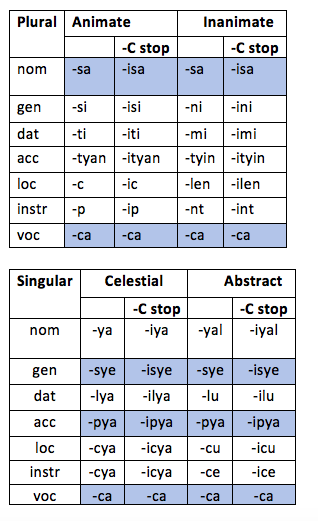
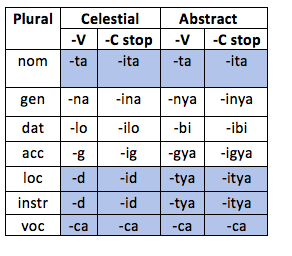
The cases for other classes (singulars and plurals) are below.

Screen Shot 2018-06-18 at 6.30.30 PM

Screen Shot 2018-06-18 at 6.31.15 PM

So let’s look at some examples of these cases in action–in actual phrases and sentences.

Hilucul-ya bellu ‘The sky is wide’

Caru-s roru-sye ‘A world of darkness’

Sesta-lu maro ‘Give [something] to life’

A hilacul-ca! ‘O, heaven!’

Yupye ti-yutar-pya! ‘Look at the cloud!’

Hustu-ce ‘by means of trust’

Hilacul-cya ‘in the sky’

Bu-s ti-hiluma-na ‘a house of the priestess’

I’ll have more examples of Ori sentences soon…


Mintaka