Valency Series: Intro

Recently, I gave a presentation at 11th Language Creation Conference at the University of Maryland. I’m going to reproduce some of the content of that presentation on this blog, in the context in which it was intended: using linguistic typology to show some interesting grammatical things that can be done in conlangs, and why you, as a conlanger, should care. In the presentation, I gave an overview of different structural manifestations and semantic uses of valency-changing operations, how they appear in natural languages and how I have implemented them in my various conlangs.

Basically, a valency-change operation increases or decreases the number of core arguments in a verb. Core arguments are those that are considered necessary for a given verb: semantically, they are represented by A (agent), S (sole/subject), and P (patient). Agents are those in control of the action of a verb (broadly speaking), Patients (also sometimes called Themes) are those most affected by the verb, and Subjects or Soles are the sole argument of a verb. Languages vary in how they treat S, A, and P morphosyntactically. Nominative-accusative languages group S and A together, leaving P marked differently. Thus we get sentences like, “I bit him” and “I sleep”, in which the word “I” is used regardless of whether it refers to an A (“I bit him”) or an S (“I sleep”). Therefore, A and S are both in the nominative case and P is in accusative. Ergative-absolutive languages, by contrast, group S and P together, with A being the distinctive one. S-P are usually in the absolutive case, while A is in the ergative case. The distinction of these core argument groupings is called the verbal alignment or morphosyntactic alignment of a language.

Morphosyntactic alignment plays somewhat into valency change. When we use a valency-changing operation, we are manipulating the core arguments of a verb. Ultimately, the way a language treats core arguments becomes relevant when we fiddle with those core arguments.

First, I will outline two broad categories I will cover in this blog post series. The first is (1) valency-decreasing operations and the second is (2) valency-increasing operations. I actually hope to cover more of each than I was able to in just 20 minutes of slides and speaking for the presentation version of this essay. Ultimately, I’ll discuss: causatives, applicatives, passives, antipassives, anticausatives/middle voice, and reflexives/reciprocals. Some of these categories may overlap to a greater or lesser degree, depending on the language. It’s also true that convention often dictates the terminology used for these categories in the traditions of specific languages. I’ll try to be as explanatory as possible when describing each feature.

For now, I’ll start off with causatives, the first valency-increasing operation.

Simply put, causatives add another core argument to a verb, by inserting a causer and turning either an A or S into a causee, one who is caused by the causer to do the action. See for example, the English example below.

‘Joshua ate the spaghetti’ –> ‘I made Joshua eat the spaghetti’

The first sentence is transitive, wherein the A (Joshua) eats the P (spaghetti). In the second sentence, I use a causative (a periphrastic one that uses the verb make), thereby adding another core argument to the verb eat. “I” is now the causer, “Joshua” is the causee, and “spaghetti” is still a P undergoing the action of being eaten.

Languages vary morphosyntactically in the ways they do causatives. Some are periphrastic or analytic, as in English. Another example is in French:

‘J’ai fait manger les spaghettis à Joshua’
1s.S-aux make.pstprt eat the spaghetti to J.
‘I made Joshua eat the spaghetti’

Note how in the French version of this sentence, the causee is now marked as an oblique, preceded by the preposition à ‘to’. This one of two major strategies languages use to show that a former A/S is now no longer such, due to the addition of the causer. The causee can either be marked oblique, as above, or it may be marked the way other P nouns are. In the latter case, we see examples like that in Sanskrit below, in which the causative allows two accusative-marked nouns to coexist in one clause.

Rama-m veda-m adhyapa-yate
Rama-acc veda-acc learn-caus
‘He teaches Rama the Veda’ (Literally: ‘He makes Rama learn the Veda.’)

In the above sentence, you can see that this causative construction allows two nouns to be marked accusatives. One is the causee (Rama), and one is the object of the verb (the Veda) that the causee is being caused to perform .

The above example also shows us that causatives can be morphological, or marked directly on the verb with some morpheme. This is also a cross-linguistically very common way of doing causatives. Sometimes, languages differentiate between which causatives apply to transitive verbs and those apply to intransitive verbs. See the examples below from Turkish. ‘die’ is an intransitive verb, and thus when it is causativized, it gets the -dür causative.

Hasan öl-dü
H.       die-pst
Hasan died’

Ali Hasan-t öl-dür-dü
A. H. -acc die-caus-pst
‘Ali killed Hasan’

However, if the verb we start out with is already a transitive verb, a different causative morpheme is used, the -t morpheme. The first sentence below shows a regular transitive sentence, “The director signed the letter”. Then we see how such a sentence could be causativized: “The dentist made the director sign the letter.”

Müdür mektub-ü imzala-dı
director letter-acc sign-pst
‘The director signed the letter’

Dišçi mektub-ü müdür-e imzala-t-tı
dentist letter-acc director-dat sign-caus-pst
‘The dentist made the director sign the letter’

Causatives can also be lexical. That is, they can be represented by totally separate lexemes or words. This is not an instance of a word being modified by a morpheme, but something else entirely. English has several examples of this, notably the die and kill pair. ‘kill’ is a causative of ‘die’. Another such pair is eat and feed. A cross-linguistic tendency noted in Haiman (1983): within languages that have multiple strategies for creating causatives, lexical causatives tend to show a greater level of control and directness of causation than morphological causatives, which in turn show a greater degree of such than analytic causatives.

Below, I’ll provide a few examples of ways I have created causatives in my conlangs. The first example comes from Seloi. This somewhat isolating language has an analytic causative. The particle here is sli. It was, historically, a verb, and it still sits in a verbal position in the clause, but it lacks any other trappings of a real verb, such as tense, aspect, or modality. Therefore, it can be said to be fully grammaticalized.

Vali sli    na te-keva          te-koi        ai Iskila
3s.m caus for def-woman  come-fem loc Iskila 
‘He is having the woman come to Iskila’

Note how in this construction, the causee is demoted to an oblique role, prefaced by the preposition na ‘for’.

In Rílin, morphology is the main way to implement a causative. The prefix xa- increases the valency of a verb by adding a causer. For example, the intransitive verb psílha [‘psiɬa] means ‘to bleed’. xapsilha is ‘to make bleed’, with an extended meaning ‘to injure, to hurt’. lhesti [‘ɬɛstɪ] is ‘to listen’, can be either transitive or intransitive, while xalhesti is ‘to make listen’ and by extension, ‘to warn, to make heed’. So we can increase the valency of these verbs with xa-, regardless of whether they are intransitive or transitive to begin with. Some of the resulting meanings of the causative forms have become idiomatic, such as zaryxía [zary’xia] ‘to rust’ and xazaryxia ‘to renounce’. The latter has moved completely into its metaphorical meaning, which has now become its primary sense.

Rílin also has a number of lexical causatives. zansa ‘to kill’ has no etymological relation to lemua ‘to die’. But zansa replaces any instance of *xalemua, which is not attested. Similarly, saísa ‘to rise’ and hare ‘to raise’ have no structural or etymological relationship, but the latter can be said to be a (semantically) causative form of the former.

Karkin, another of my conlangs, has an active-stative aligment system. Karkin has four causative morphemes, each of which shows a different implication about harm and benefit on the part of the causer and/or causee.

Type 1: Karkin causative Type 1 implies a benefit for the causee of the action (the one who was caused to act).

məl-a-i ava-a mi                        shoʔonthe-‘ə  pa ʃtuxtə-peq-aː

mother-1S.POSS.A father-1S.POSS to river-P PART cross-CAUS-PST

‘My mother made my father cross the river (it was good for him/he liked it)’

You can identify this causative by use of the morpheme –peq– preceding the tense morpheme at the end of the verb. Avaa ‘my father’ is in an oblique case, shown by the postposition mi.

Type 2: Karkin causative Type 2 implies harm or misfortune toward the causee.

məl-a-i                ava-a-ʔə           shoʔonthe-ʔə pa      ʃtuxtə-vur-aː

mother-1S.POSS.A father-1S.POSS-P river-P                PART    cross-CAUS-PST

‘My mother made my father cross the river (it was bad for him/he didn’t want to)’

This kind of causative is marked by the verbal morpheme -vur-. It also marks the causee, avaa, with a patient marker instead of an oblique one: -ʔə.

Type 3ː Karkin causative Type 3 implies neutrality for the causee as to benefit/harm.

məl-a-i ava-a mi                        shoʔonthe-‘ə  pa ʃtuxtə-χe-aː

mother-1S.POSS.A father-1S.POSS to river-P PART cross-CAUS-PST

‘My mother made my father cross the river (it was neutral)’

This kind of causative is marked by the verbal morpheme –χe-. The causee is marked obliquely with –mi-.

Type 4: The final causative type implies mutual benefit between causer and causee.


məl-a-i ava-a mi                         shoʔonthe-‘ə pa   ʃtuxtə-li-aː

mother-1S.POSS-A father-1S.POSS to river-P           PART    cross-CAUS-PST

‘My mother made my father cross the river (it was mutually beneficial)’

This type of causative uses the –li– morpheme and marks the causee with oblique mi.

~

I’m going to end or at least pause my discussion of causatives. Next time, I will likely write about applicatives. This is one subject I didn’t have time to discuss in my presentation of this topic, so I’ll be pleased to put my thoughts into words.
Naming conventions in Rílin: names of people

I have been thinking a lot lately about names. In a language, names have a variety of ways they may manifest. Some are derived from older words in the language, some are identical to contemporaneous words, and some need certain morphology to indicate that they are, in fact, names, and not just regular words.

Rílin Given Names

In my various conlangs, I’ve taken different approaches to naming people. In Rílin, for example, there are specific name morphemes that mark a word as a person’s name. Some of these are gender specific, and some are gender neutral. Some have roots are traceable to either Rílin or Old Rílin words, but some do not have even discernable meaning. Below are some examples.

Feminine Names

Some feminine name suffixes include: -tót, -í, -u, -in/-ín, -ló

The following names are all derived from contemporary Rílin words, which become names with a suffix. (You can click on each name to hear it spoken.)

Bishéín [ˈbɪʃein] – from bishé ‘bright’
Esuí [ˈɛsui] – from esu ‘griffin’
Fylûlatót [fyˈlʌlatot] – from fylûla ‘bird’
Ítshaló [iˈtʃalo] – from ítsha ‘luck’
Kisin [ˈkɪsɪn] – from kis ‘honeybee’ or maybe kis ‘slender’
Mímin [ˈmimin] – from mím ‘cute, little’
Nesú [ˈnɛsu] – from nes ‘graceful’

 -tót-in/-ín-ló
bishé ‘bright’   Bishéín 
esu ‘griffin’ Esuí   
fylûla ‘bird’Fylûlatót    
ítsha ‘luck’    Ítshaló
mím ‘cute, little’   Mímín 
kis ‘honeybee’   Kisin 
nes ‘graceful’  Nesú  
Various Rílin word roots paired with naming suffixes can create names. These names are specifically feminine names.

Not all Rílin names have clear or discernible meanings. They may still include some of the typical suffixes, but when detached from the rest of the word, that series of sounds does not necessarily make up a Rílin word.

Änsu [ˈænsu]
Äshtín [ˈæʃtin]
Alaí [ˈalai]
Bûlaísí [bʌˈlaisi]
Nímu [‘nimu]
Silin [ˈsɪlɪn]
Tsilu [ˈtsɪlu]
Tsheló [ˈtʃɛlo]

Masculine Names

Some suffixes are masculine, such as -n, -ó, -a, -ret.

Awun [ˈawun] – from awu ‘upright’
Bynóret [ˈbynoɾɛt] – from bynó ‘morning’
Daghóra [daˈɣoɾa] – from daghóra ‘sacrifice’
Evekaret [ɛˈvɛkaɾɛt] – from eveka ‘streak, brook’
Fífaía -[fiˈfaja] – from fífaí ‘advantage, benefit’
Gómó [ˈgomo] – from góm ‘thought, mind, know’
Kér̂a [ˈkeʂa] – from u ‘step forward, put (oneself) forward’

 Some names may use naming suffixes but have indeterminate root meanings.
Ekhéla [ɛkˈhela]
Feneret [ˈfɛnɛɾɛt]
Gíŕan [ˈgiʐan]
Kedûn [ˈkɛdʌn]
Pirór̂nó [pɪˈɾoʂno]
Shíburet [ˈʃibuɾɛt]
Óŕina [oˈʐɪna]

Gender Neutral Names


Other name suffixes are gender neutral, such as -ja, -bí, and -tos. These could be used for a person of any gender. Some of these names are very old and no longer have clear roots.

Béíntos [ˈbeintɔs] – unknown root
Ískesébí [iskɛˈsebi] – from ískesé ‘high, tall’
Jenja [ˈjɛnja] – probably from jen ‘day’
Kótos [ˈkotɔs] – maybe from ‘intention, meaning’

Other names may not include a suffix at all. Most of these names can be used regardless of gender.

Amlim [ˈamlɪm]
Köle [ˈkølɛ]
Ŕetsŭ [ˈʐɛtsɯ]
Nemne [ˈnɛmnɛ]
Valhén [ˈvaɬen]

Rílin Family Names

Rílin family names come after given names. Names are inherited by children from their parents. Female children inherit their mother’s name, and male children their father’s name (typically, although there are exceptions to this). Therefore, they are somewhat matronymic and patroymic in function, although they also act as family names since there is no other inherited name for most Rílin people.

For example, Silin, a middle-aged Rílin woman, would have her mother’s last name, Bízunla. Her husband, Nósh, would have his father’s name, Ínómí. Their son would take his father’s name too. Family names often concern personal traits, origins, trades, and skills. Bízunla comes from bízun ‘alarm, alert’, with a possible agentive suffix -la. So the original meaning might have been “one who warns or foretells”. Ínómí looks like the word ínó ‘color’ plus a genitive suffix –, so might mean “with color, of color”. This could either have originally referred to a personal trait (some color of the body–hair, eyes, skin, or even clothing) or it could have referred to a colorful place of origin, like a green forest or floral garden, etc.

These are just a few points concerning Rílin naming conventions. In the future, I will write a bit about Rílin nicknames as well as expand on naming conventions of other cultures across Aeniith. Thanks for reading!

I liiiive~

Or should I say: kyílaíkim!

It’s been a while! I have been involved in so many things recently, not least of which was finishing my PhD in December 2022! Now that I am now longer writing my dissertation, I have more time.

What is new in Aeniith?

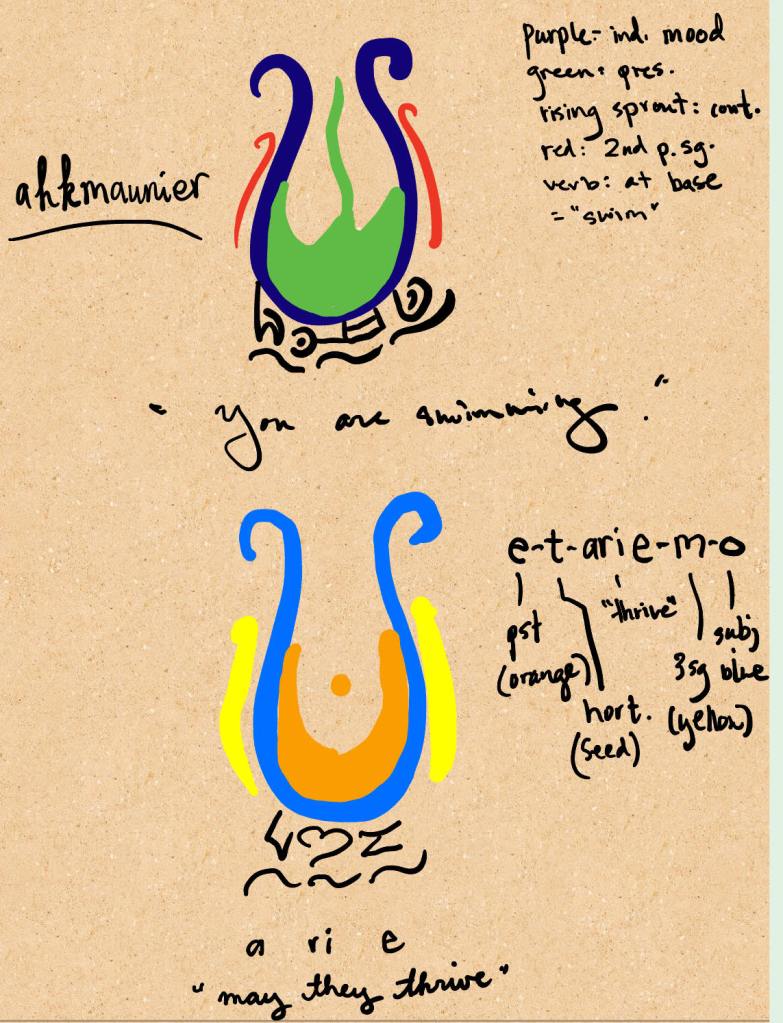
Well, I began some preliminary work on a non-linear, multi-modal writing system. I also structured a language that it is used for, although only the basics of that are done. The orthography is based on shapes, color, and other features of abstract pictoral representations. Essentially, different morphemes of this rather agglutinative language are represented variously by shapes, colors, etc. featured in what are basically pictures. There is a basic template, onto which different additional shapes in different colors can be added. These add the “flavor” of the verb, which is the inflectional morphology.

Below, you can see the verb root, which is written in a syllabary, below the “morphological seed pod”–the non-linear portion–which adds morphology to the root. For the first picture, the word written is ahkmaunier ‘you’re swimming’. The root is mauni ‘swim’, which is written in black near the bottom. The purple sides mean ‘indicative mood’, the green is ‘present tense’, the rising sprout shape is ‘continuative aspect’, while the red outer edges indicate the 2nd person singular ‘you’. In terms of the break down of the sounds of the verb, you can find it below:

a-hk-mauni-er-∅
prs-cont-swim-2s-ind

The next picture, just above, represents the verb “may they thrive”. The same basic shape is the same–see the verb root written in black at the bottom. The colors and internal shape are different though. The past tense e- is represented in the orange. The hortative morpheme, -t- is represented by the seed dot in the center. Yellow sides represent the 3rd person singular, while the subjunctive mood –o is indicated by the blue color of the basic “pitcher” shape.

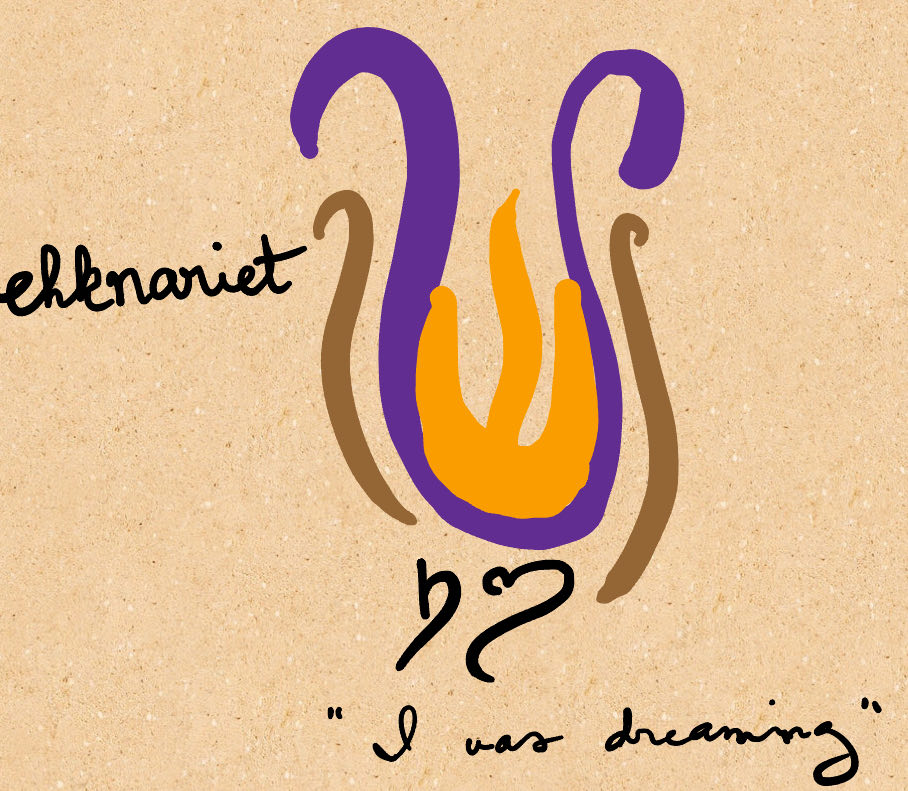
Now above, there is another example. This time, the root is nari- ‘dream’. The basic color purple indicates, again, the indicative mood, which is zero marked in this language. e-, the past tense, is represented by the center orange color. Continuative aspect -hk– is clear from the rising sprout shape. The brown sides indicate 1st person singular -(e)t.

e-hk-nari-et-∅
pst-cont-dream-1s-ind
‘I was dreaming’

Here is another example. This one represents the word ahkrōtaiam ‘he is sowing seeds’, with some additional phonological and phonetic representationss: /aʰkroːˈtaiam/ [aʰkɾoːˈtajəm]

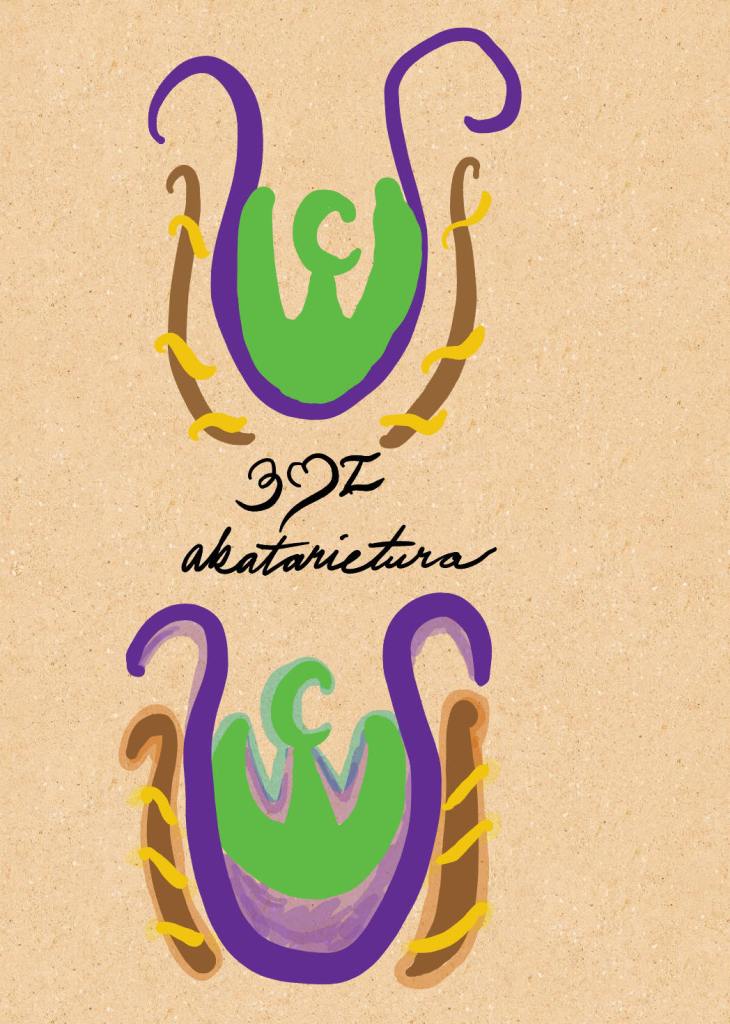
Here is another verb, akatarietura ‘I want to care for you’. This verb incorporates object marking, which is demonstrated by the yellow vines that wrap around the outer brown ‘petals’. The upper version is simpler, while the bottom version is a little fancier.

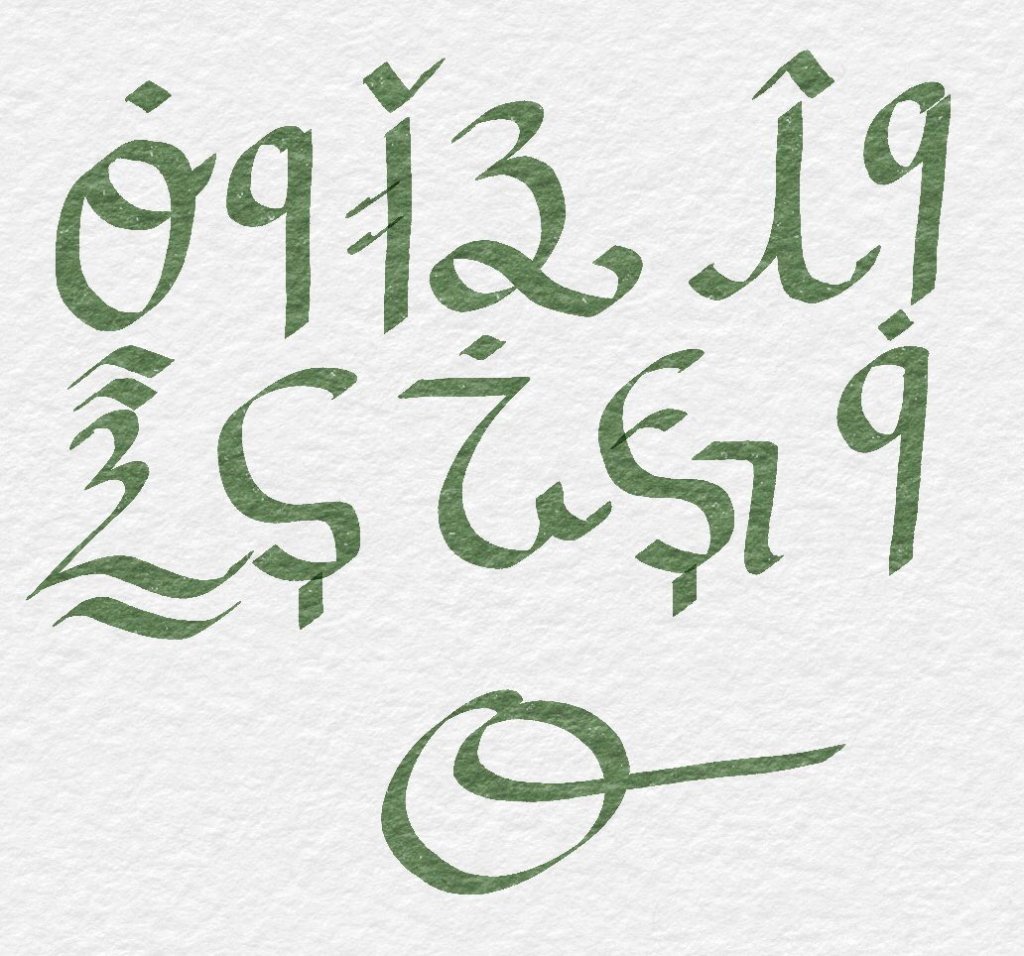
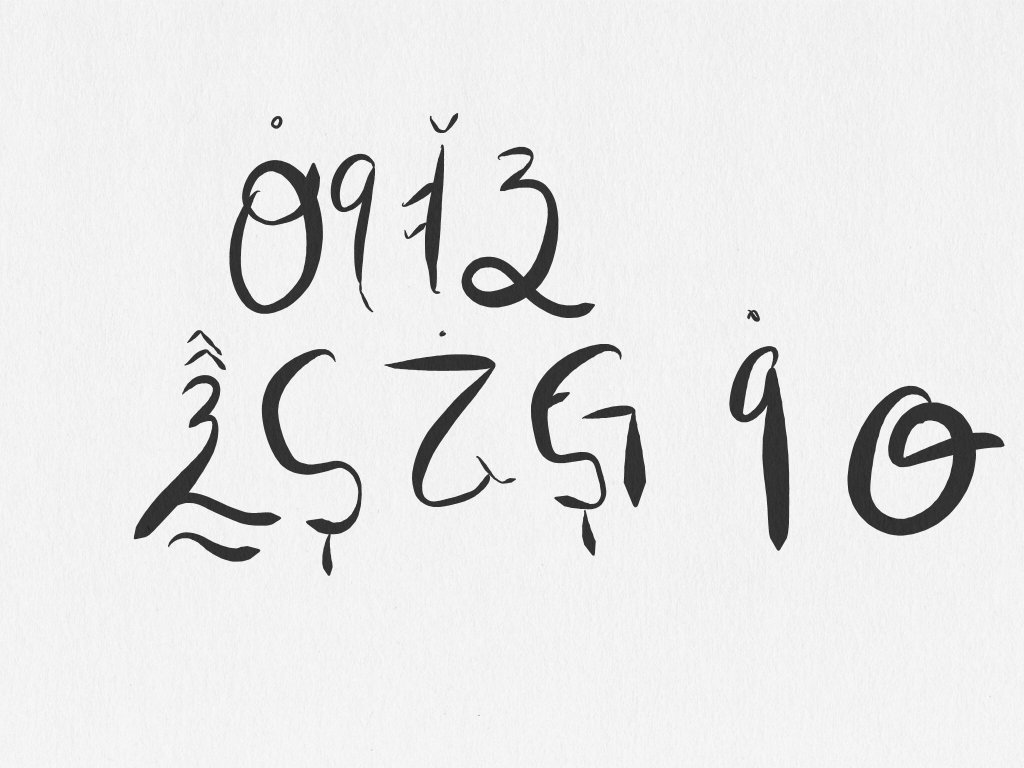
Above is a breakdown of this same word, with another version of it written/drawn. Also included here are a morphemic gloss of the word, and some examples of verb roots.

prs-vol-A-care.for-1s-2s-A
a-k-(a)-tarie-t-ura-a
akatarietura
‘I want to care for you’

I will likely be expanding this system, as well as the language it was created for, in the next few months. Stay tuned.

~Mintaka

Conscripts

I’ve been refining and practicing the Vinuvu script, which I first created in summer 2019. It’s getting more to where I want it in terms of specifics, but remains largely how I originally designed it. I’m practicing writing in it in calligraphic software on iPad/with Apple pencil, as well as using actual pen/ink.

Vinuvu is the second script I’ve created that I’m still using. The first is the Rílin script, which I made into a font. You can see more about this font/script on the Rílin phonology page. You can also download the font itself here.

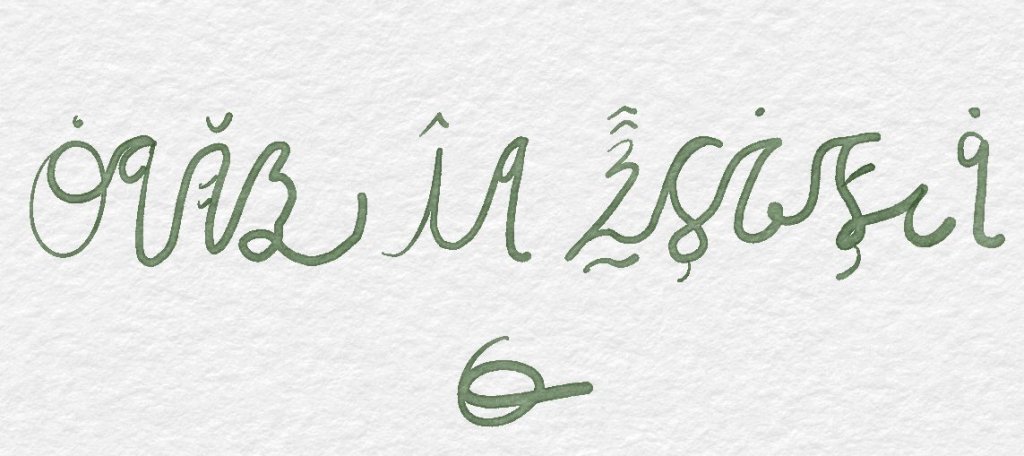
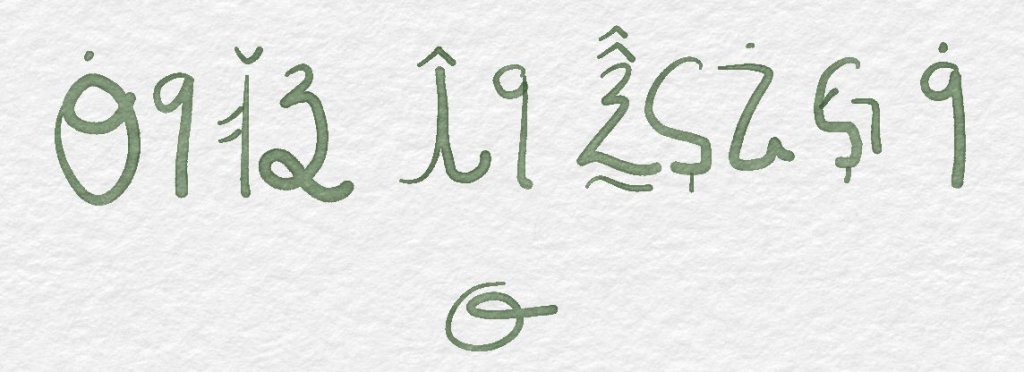
Here are some recent examples of the Vinuvu script as used to write Karkin.

I’d like to develop a font for Vinuvu too, though because it is an abugida, and vowels are usually marked using diacritics, it might present an additional challenge, since different characters will essentially need to be overlaid on each other to form syllables.

Some Lexember examples: new words in conlangs

December is the month that conlangers of all kinds participate in something called Lexember. We create a new word (in the lexicon) for our conlang(s) every day of the month. I’ve been participating and sharing words largely through tumblr (user: aeniith) and twitter (@MintakaGlow). Here are a few from the first days so far.


Rílin

Dec 1:

íha [ˈiha], [v tr/intr] : [1] forgive, pardon; accept, understand; [2] know, acknowledge, recognize; [3] bring attention to, point out, remark on; [4] notice, realize

Etymology: Possibly from iŵ- [iɸ] ‘take in, accept’ and ja ‘know’

Example:

íhazim kasa tañ lönenet naba ŵedínla
íha      -z        -im kasa       tañ        lön -en-et     naba                  ŵedí -n-la
forgive-pst.prf-1s already dist woman-pl-abs whatever wrongdoing-pl-instr
“I have already forgiven those women for any wrongdoing’

Karkin

Dec 2:

vkāmēgh [vkɑːˈmeːɣ] [v tr/intr] (ki-verb class) : [1] break out of, escape from within; [2] break down a wall or other barrier; [3] (fig) destroy a boundary, flout a rule, defy expectations

Etymology: From vkā ‘strike, hit’ and mēgh ‘run, run away’.

Example:

Psi  nux-ë     twë  qhrō    ki    vkāmēgh-ā  -yi         vuq     kuqhkë mi  ja   wëngi-ā   -pa   
dist girl-3s.p  who early part defy        -pst-3s.a    all       clan      gen part speak-pst-1s.a
“I spoke with that girl who had previously broken all the boundaries of her family clan.”

Rílin

Dec 3:

bióŝû [bɪˈoʃʌ] [v intr] : [1] walk precariously, walk on a slippery or icy surface; [2] be in a precarious or unsure state; [3] be in a risky state, ‘walk on thin ice’.

Etymology: From bió ‘slip, slide’ and [jó]ŝû ‘walk’.

Example:

Ŝy-ky  sé    zaín séfet   tû pre-t       pato        bióŝû -l -í
be-irr prox time now do care-abs because walk.slippery-prs.hab-2s.fam
‘Now is the time to take care because you are in a precious position’

Rílin

Dec 4:

móníhas [moˈnihas] [n, inan] : [1] portent, omen, sign; [2] hint, clue; [3] tell, revealing action.

Etymology: From móní ‘watch, guard’ and has ‘sign, signal’.

Example: Né      í-t     -íí          kuala              -n-et ómina-mí,    x-óly    -t      -aap      lí-et      
      if   look-npst-2s.fut constellation-pl-abs sky-gen  caus-solve-npst-3s.fut 2s-abs the

                 bí ǵom-et ka-ŝó      kalum-mí a       oma-mí.  
                 knot-abs two-adv world-gen and  soul-gen

“If you look into the constellations in the sky, it will let you untie the knot of both the world and the soul.”

Tosi

tūgh [tuːɣ] [n] : [1] face; [2] front; [3] cover, outside covering, skin; [4] sleeve, sock, outer layer (e.g. of a wrapping, of clothing); [5] protective layer, protection, assurance, aide, help, assistance, back-up, auxiliary force.

Etymology: From Old Tosi tūhuz- “face; scalp”

Example:

Tapi sur ja da chi tūgh i vis rīy.
imp angle vrblz 2s.fem gen face obj to sky
“Turn your face toward the sky”

Tosi

Dec 6:

gungar [ˈɡuŋɡar] [v, tr] : [1] chase, pursue; [2] hunt (e.g. animals); [3] fish, catch fish; [4] seek out, look for, search for.

Etymology: From gar ‘follow’, and gun-, an emphatic prefix (cf. gun ‘great, might’).

Example:
Na gangur na chi xeti gek i, gempe tapi ixari!
1s.f pursue 1s.f gen female.servant drunk obj please imp help
“I’m chasing after my drunken servant, please help me!”

Tosi

Dec 7:

hās [hɑːs] [v, tr] : [1] fill; [2] replenish; [3] add to, increase.

Etymology: From old Tosi hāh-, hāθ- ‘full, plentiful’

Example:
Tapi hās na chi kūn i ge na gō tiv gunāl.
imp fill 3s.f gen cup obj if 3sg.f be punct.fut empty
“Fill her cup if it is empty”


Tosi proverbs + religion

Translation of a Tosi religious proverb, from the texts of Lamat.

Sa tapi gō fū sanā jela ji chi lōlchu i
neg imp be content without kneel.before 2sg.m gen goddess obj

“Content thee with naught without first kneeling before thy goddess”

I am working on writing the tenets of Tosi belief systems, which primarily focuses on one deity, Lamat, war goddess, but also on Kalu, god of silence and peace. The current matriarchal expansionist empire of the Tosi obviously draws most political attention to the cult of Lamat, but the priesthood of Kalu endures and cannot be denied its importance to the history of the Tosi people.

The highly stratified culture of the Tosi traditionally feeds/gears different sections of the texts toward either men or women, to further enforce gender roles. The modern translation (into Tosi from Old Tosi) shows this with the use of the masculine 2nd p sg pronoun: ji, rather than da (feminine).

~

In creating these deities, I originally wanted Lamat to be the only main goddess, to show the Tosi reverence for power and might through warfare, but I then decided that they should have more nuance in their spiritual and religious beliefs. Before Tos was an Empire, it was simply a small nation, with no massive army and military force to show the world. People would have worshiped a multitude of gods and demi-gods, as well as other divine spirits. I think, as Tosi culture changed over time with the changing political structure and the ever-expanding Empire, the religious institutions would have changed too, to emphasize those things that were politically beneficial for the expansion of the state and the Empire. The primary means of this expansion was via the military, so Lamat, as the goddess of war, would have expanded as well, from a goddess to whom soldiers would offer supplications for protection before going into battle, to a central deity whose texts would come to have a greater influence over many areas of life.

The masculine deity Kalu, who represents many of the opposing forces of Lamat (silence, peace, introspection, asceticism, purity, etc) is fundamentally seen as an extension of what the Tosi view as the perfect man: one is is serene and peaceful, not governed by passion. Women are seen as intrinsically superior in this matriarchal society, but they are also seen as imperfect in that they supposedly naturally of a stormier and more tempestuous nature. Men are supposedly a tempering force of quiet, darkness, passivity, rationality, as well as “softer” emotions, such as compassion and mercy. I don’t want to remove this opposing force in Tosi society, because I think without it, the religion becomes more one-dimensional.

Previously, I had only addressed the adherents of Kalu in terms of the priesthood–men who would cloister themselves from the rest of the world (including the world of war, which is seen as primarily the purview of women) and devote their energy to preserving some special force of calm in a culture that is known for its systematic violence and occasional chaos. I want to build up this side of the religion more, and include it in more fiction that I write for the Tosi.

Translation practice in Rílin

I’ve been doing more practice translation for Rílin, to fill out any needed grammatical or lexical gaps. Here is a recent one, taken from here.

English: “That is the city of the Goyanim. They are a strange people. They light their cities at night, as if the stars weren’t sufficient for their needs. They fight and kill each other, not realising the greater danger beyond their small world. And they do not hunt each other with bows and arrows. No, they have strange devices that kill from far away without arrows. And take care near their strange iron horses they use to travel. They travel faster than any natural beast ought to, and ignore the strength of the bow and arrow. Best if you avoid their cities, my son.”

Rílin: “Tañ yẃäp Góyanimenmu. Be’a li apen. Xavéjalapen tañ yẃäpet bänkasla, do be hyzû bín kuan. Ŝílapen apenset a zansalapen. Be mílulapen bí gaŝ krur̂ûet dexe ẃy kalumla apenmu. Be siŝulapen apenset kótûñla a ítäla. La, lykylapen be’a mönet baes zansalapen róŝó ŝa ítänla. A toroky né lí mu be’a ǵasíaínla zar̂mí baet lykylapen níñgíle. Zaílapen psötar̂ó dexe gölhañ ŝutréla, dexe lhyntíla kótûñmí a ítämí. Ptatí histä tañ yẃäpenet, mävû.”

I imagine a Rílin father telling his son about a culture with more advanced technology (possibly Tosi?). I may do an interlinear gloss but for now, it stands as-is. More to come.

New alphabet (abugida) for Seloi and Karkin!

I have been doing a LOT of conscripting (making new writing system) for my languages this summer! Now that the semester has started (only just), I may slow down somewhat but I am promising myself not to stop!

Much of what I’ve worked on has been the new alphabet for the Seloi and Karkin languages. Before I get into the writing system itself, I will give a little background on the people who use this alphabet.

The Selupa (speakers of Seloi) and Karkin people live on a shared island, off the east coast of the Izoi continent (in Elta–so we’re on the side of Aeniith with Tosi, Ríli, etc.). The Selupa (of the zuna species of humanoid–same as the Tosi and Karkin) have a very secretive but comparatively technically advanced society. Their cities are highly protected, entry and exit is tightly regulated, and their technology and medical advances are not generously shared, when they are shared at all. The Selupa value art and culture as well as science, and are famous for their universities where topics like drama, writing, philosophy, rhetoric, and even culinary skills are taught.

The other major cultural group on the island are the Karkin, also a zuna people, who live in parts of the island not inhabited by the Selupa. Their population is largely split into two–some live inside seven cities that are protected by ruling clans. Just outside of these guarded cities are agricultural areas that supply these cities with food. Others, who dwell outside the protection of the cities, live in an arid expanse of land called the Planulum (sōngē’ën /soːˈŋeːʔən/ in Karkin). This is a harsh land, and its soil is hard and difficult to grow in. The people who live in the Planulum are not under rule of the city clans, and lawlessness is rampant in areas that are outside of settlements. Settlements in the Planulum are lightly governed by consensus, if at all. In the winters, sand storms ravage crops, and in the summer, hot winds can wilt them if not enough rains come. It is a difficult place to live. Caravans travel between the various Planulum settlements and the seven cities, but sometimes are detained due to crime or bad weather conditions.

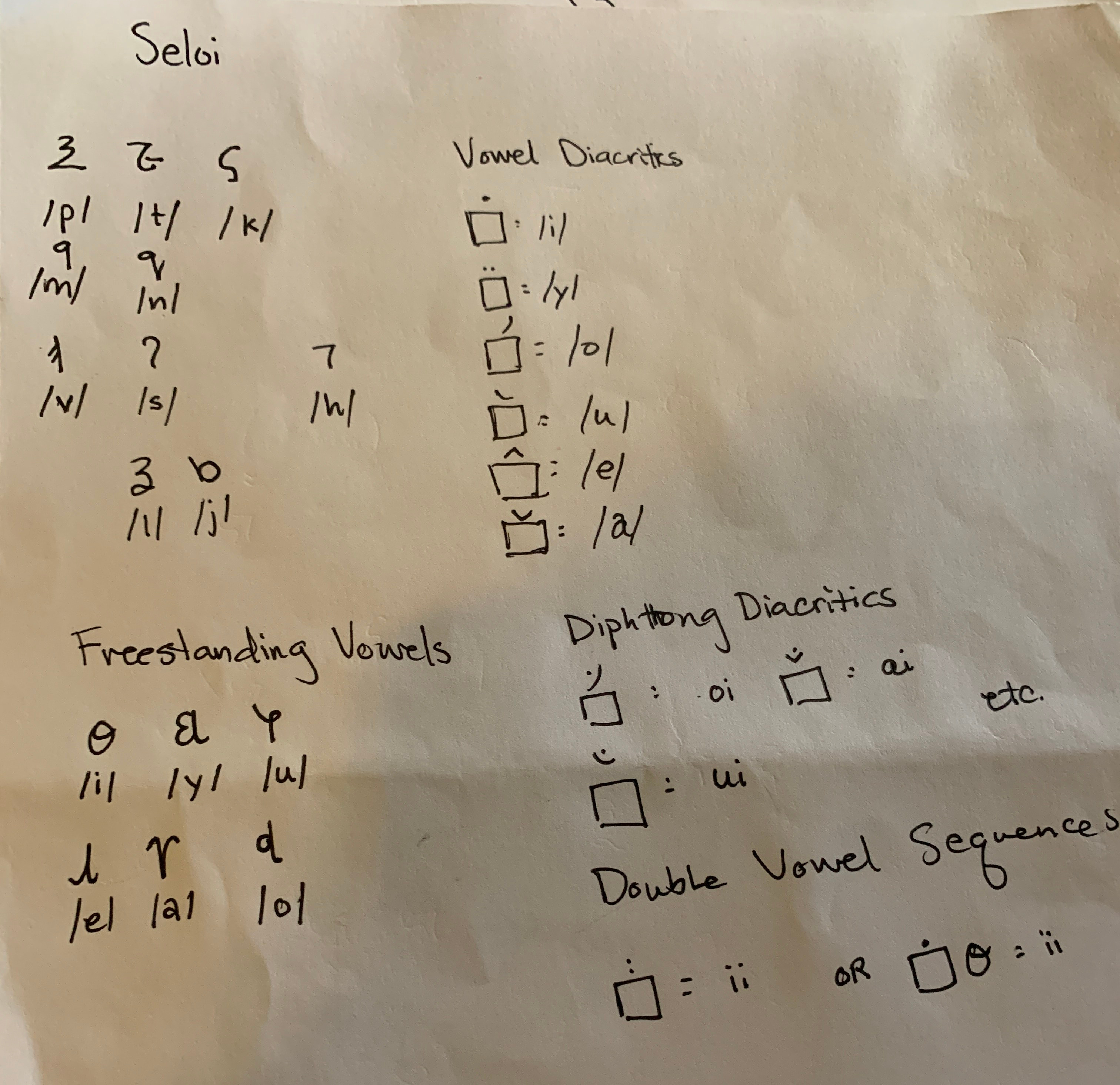
The original inventors of the present alphabet, which I’m tentatively calling Vinuvu (Seloi for ‘scratched pieces’ or ‘written bits’), are the Selupa. Seloi itself has a very small phonemic inventory (collection of differently recognized sounds)–just 10 consonants and 6 vowels. Vinuvu is technically an abugida–a variant of alphabet in which the consonants are represented by full letters and the vowels are represented by modifications to the consonants (often diacritics or small marks on or near the consonant letters). The following is the version used for Seloi, its original intended use.

Seloi alphabet: VinuvuEach consonant is a full letter with the following vowels being marked as diacritics over the consonant. Freestanding vowels are written as full, and diphthongs and double vowels are either combined diacritics or a full vowel symbol plus a diacritic.
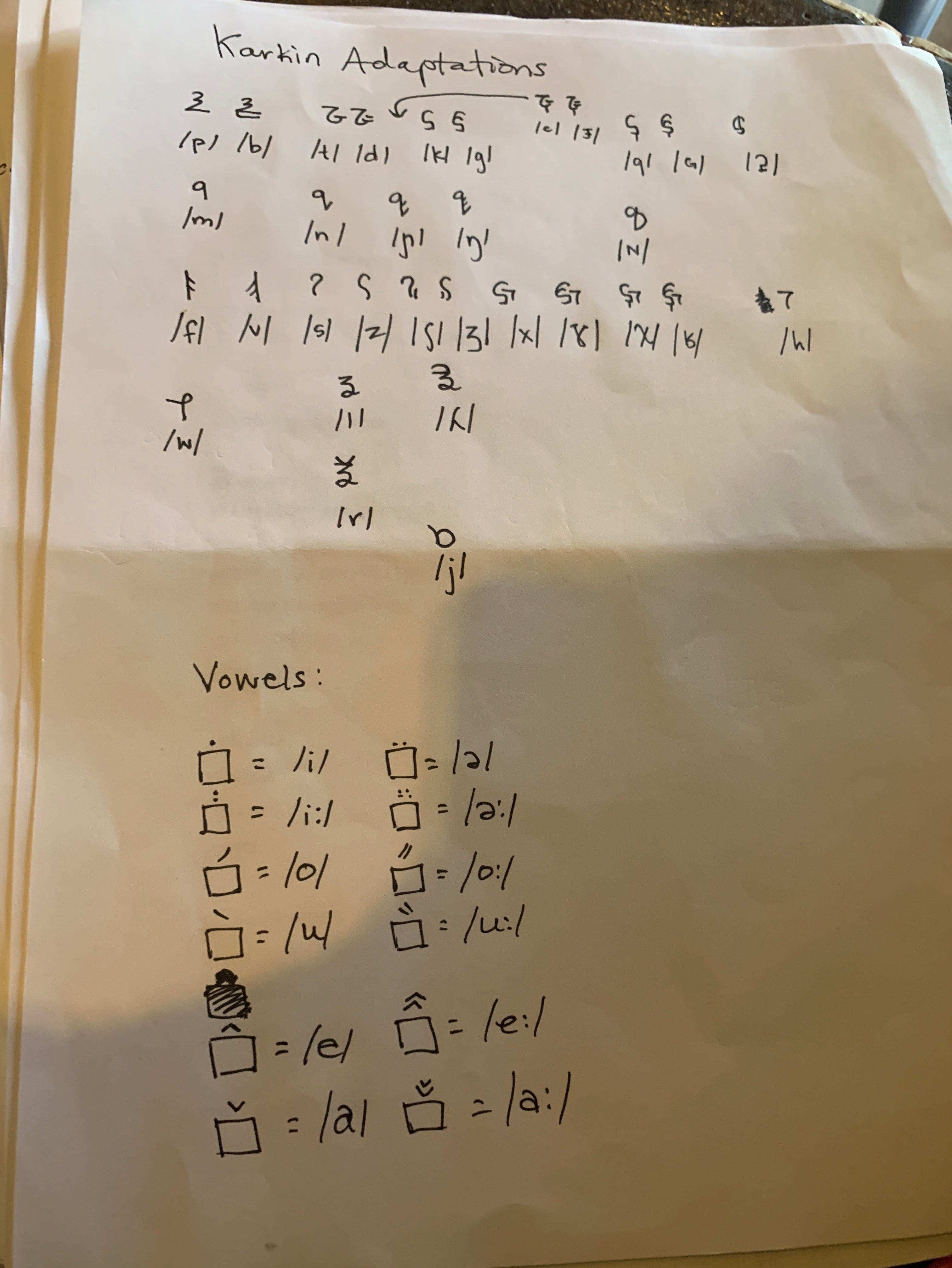
So this is simple enough, but then I decided I wanted this whole system to be used by other zuna cultures in the region of Izoi. That includes the Tosi and Karkin. The Tosi are a massive empire, but I decided that I wanted them to have borrowed the alphabet after the Karkin–the immediate neighbors of the Seloi–had already borrowed it.

The main challenge here was due to the Karkin language itself. It has a lot of sounds, far more than the particularly sparse Seloi. Karkin is mad for different consonants: it has 32 of them! It also has six vowels that can all be long or short (in duration). So obviously, when the Karkin borrowed this writing system, they were going to have to do a lot of modification to make it work for their language…

Behold!
Karkin modifications to VinuvuAs you can see, many letters are modified to represent the numerous additional sounds that Karkin has. Some consonants have added marks to indicate that voicing (Seloi doesn’t have voiced stops like b, d, g, for example). Some letters have descender marks below them to indicate a change in place of articulation (usually farther back in the mouth). Some fricatives (like the letters for v and s) are reversed to show a change in voicing (f and z). The letter for /l/ is modified to represent /r/ and /ʎ/. Various other changes show sounds that don’t exist in Seloi. Long vowel are represented by double diacritics.
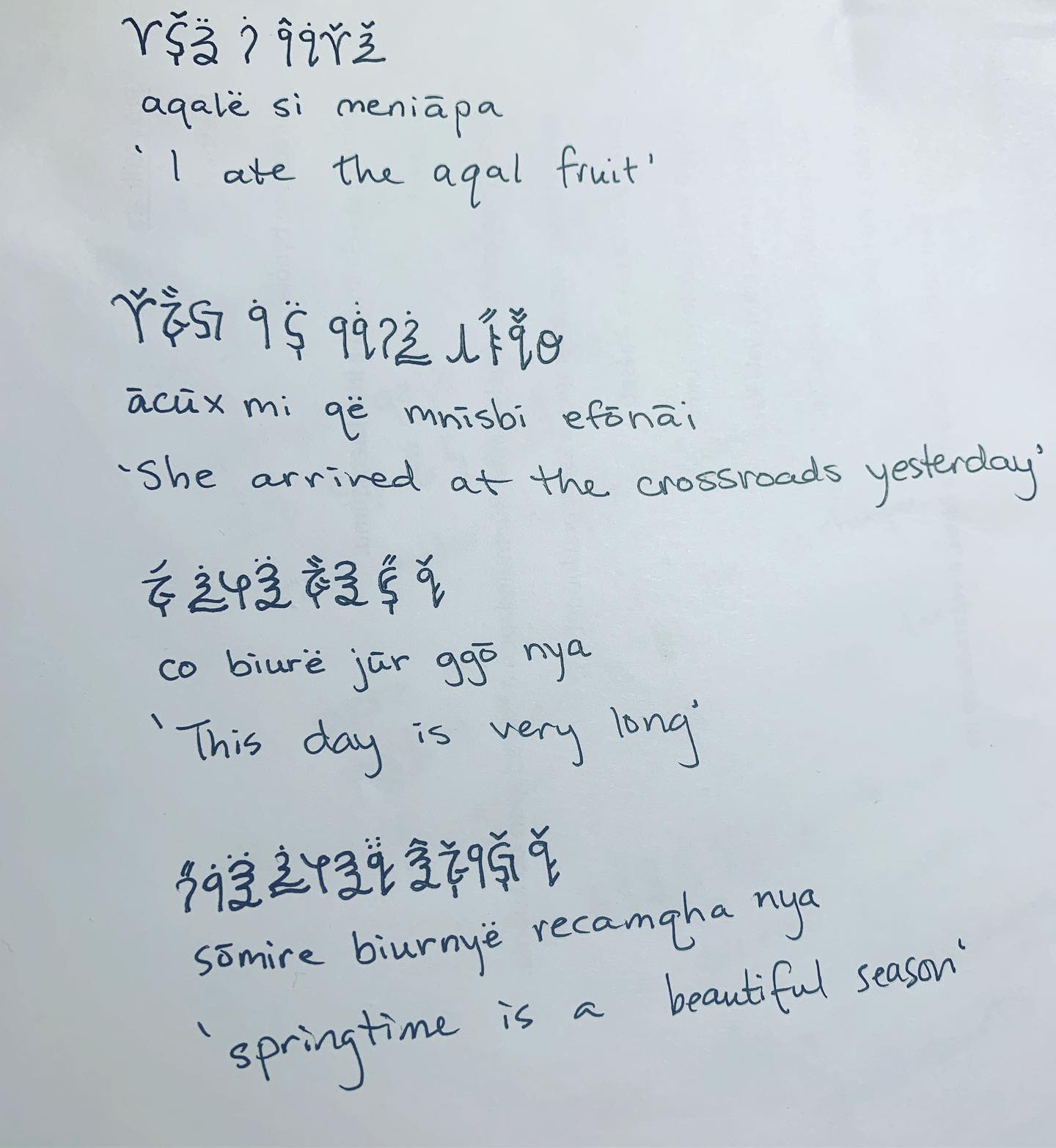
A few examples of writing in Vinuvu for Karkin.

ED3F05DA-B0EF-4B37-BF5E-7951C2B44AE3

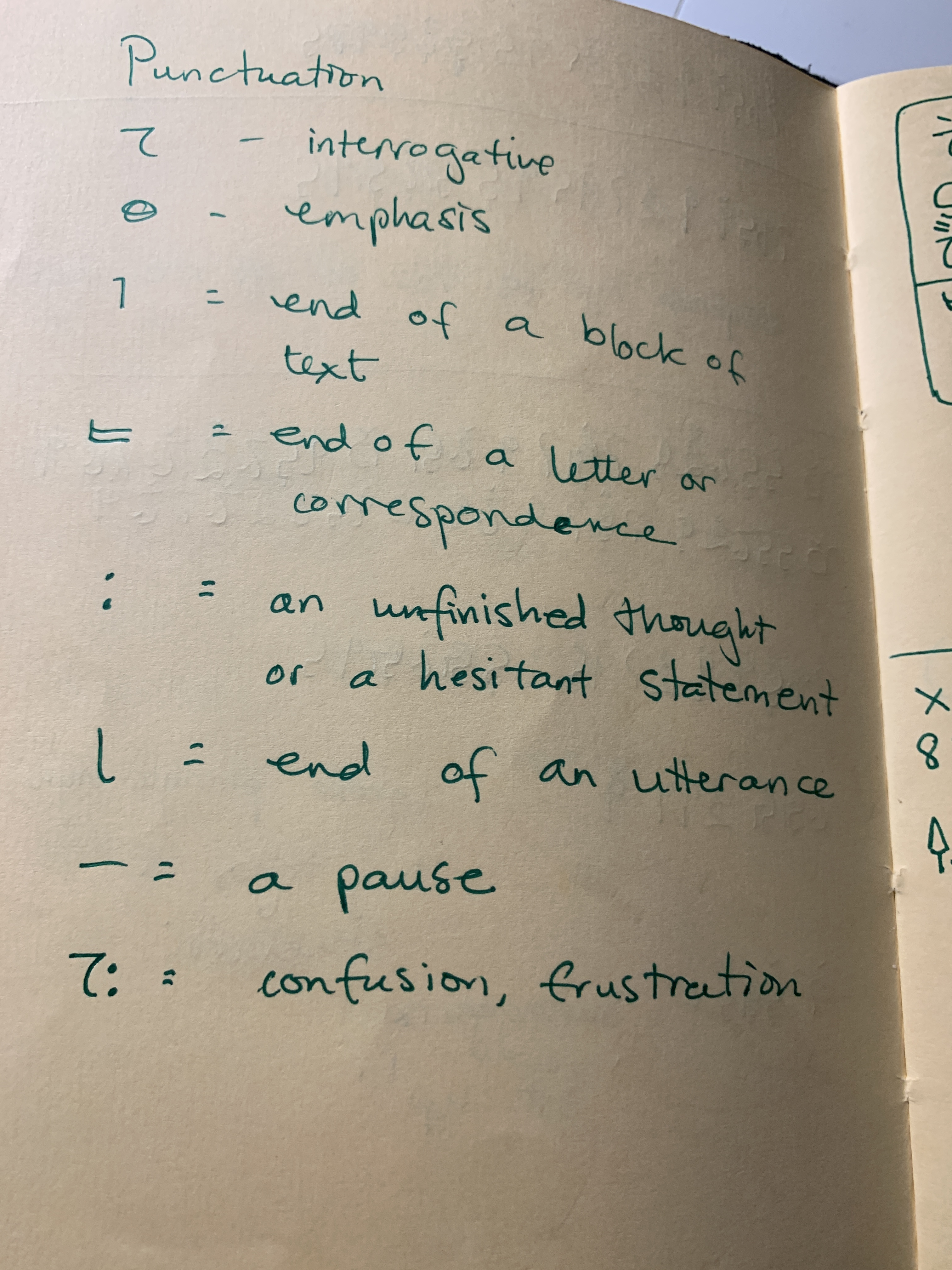
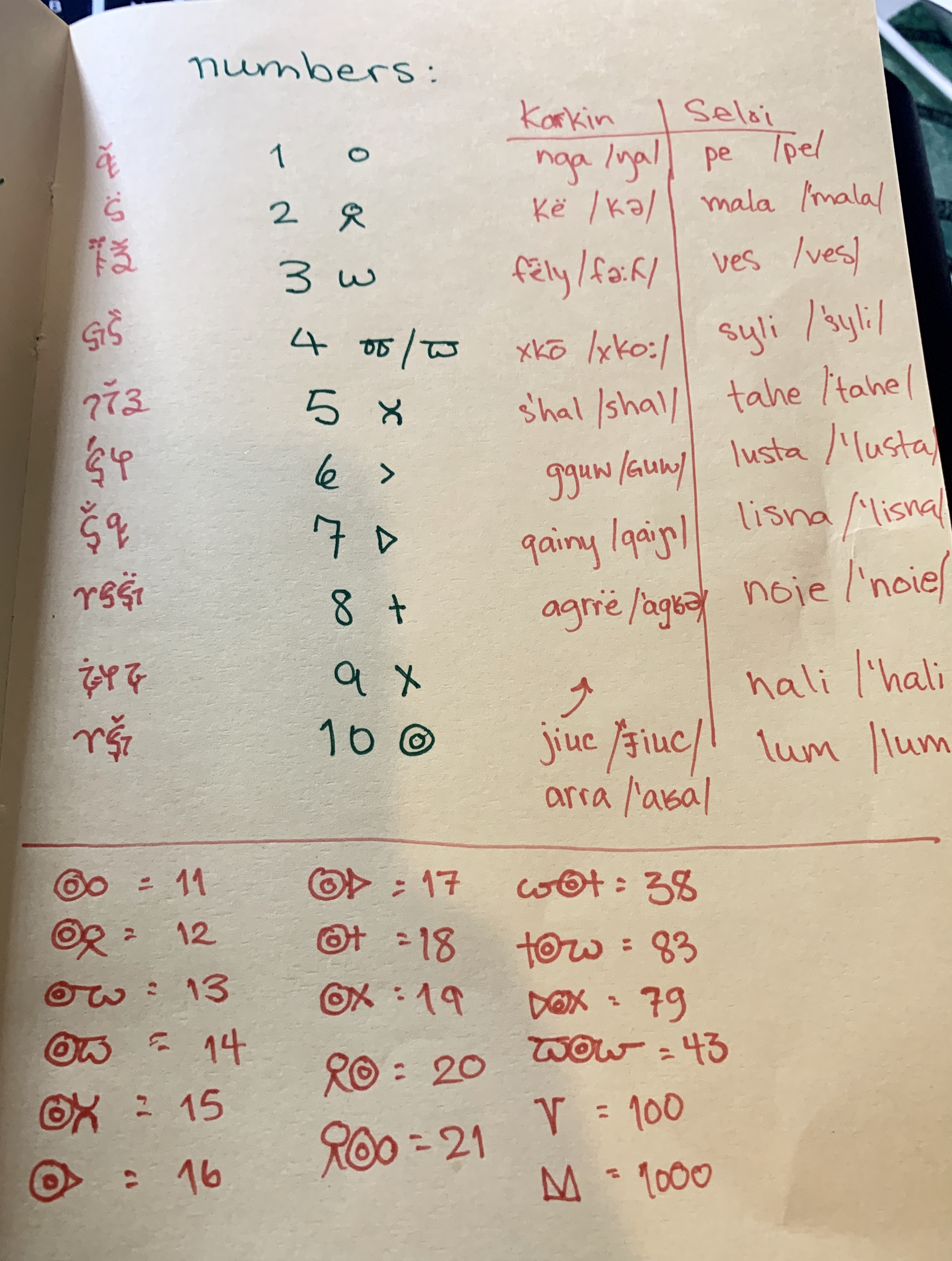
Also the punctuation marks and numerals:
IMG_1497
fullsizeoutput_728

More information will be coming–watch this space!


Margaret

Rílin language: expression of sorrow and sympathy

Well, it’s been a while! I do want to get back in to posting things here, despite my busy workload. Maybe it’s even better for me to do so because of that workload.

Anyway.

In light the recent catastrophe in Paris, I have been thinking about how the Ríli form expressions of sorrow, sympathy, condolences, etc. Languages often have formalized/idiomized or set phrases for these kinds of expressions, so I thought it was important that Rílin did as well. Rílin culture emphasizes harmony, support, respect, and sensitivity to others’ emotions, so I wanted to make their phrases of sorrow and sympathy reflect some of those values too. All of the words and grammar used herein are extant parts of the Rílin language–I am configuring them in ways that seem appropriate.

Note: the variations on the way of saying ‘you’/’your’ are due to traditional Rílin’s (and Lunauli Rílin) way of distinguishing three levels of formality/familiarity for pronouns and persons (lí at the most familiar and zana at the most formal for ‘you sg.’).

Lilaíkim – ‘I am grieving/mourning/crying’ (this word lilaí also means to weep copiously)
lilaí-k-im
/lɪˈlaikɪm/
grieve-pres.prog-1sg

Lilaíkim líu/xyu/zanau – ‘I grieve with thee’
lilaí-k-im lí-u/xy-u/zana-u
/lɪˈlaikɪm ˈliu (ˈxyu) (ˈzanau)/
grieve-pres.prog 2sg-instr

R̂yla límu/xymu/zanamu imi – Lit., ‘I am in/with thy sorrow’
r̂y-la lí-mu/xy-mu zana-mu imi
/ˈʂyla limu (ˈxymu) (ˈzanamu)/
sorrow-instr 2sg-poss

Hestia(tíí)/(tyy)/(taa)ky – Lit. ‘may you recuperate/rest’
hestia-t-íí/t-yy/t-aa-ky
/hɛstɪaˈtiiky (hɛstɪatyyky)(hɛstɪataaky)/
rest-npst-2sg.fut-irr

Bítapky Démas/Ifinŝas líet/xyet/zanat – ‘May Déma/Ifinŝe embrace/aid thee’ (depending on which goddess you would like to reference)
bí-t-ap-ky Déma-s/Ifinŝe-as lí-et/xy-et/zana-et
/biˈtapky ˈdemas(ɪfɪnʃas) ˈliɛt (ˈxyɛt)(ˈzanat)/
embrace/aid-npst-3sg-irr Déma-erg/Ifinŝe-erg 2sg-abs

Rílin script

So you’ve all probably seen at least some of my numerous poems written in Rílin, along with their accompanying script. I wanted to explain how the alphabet for Rílin works.

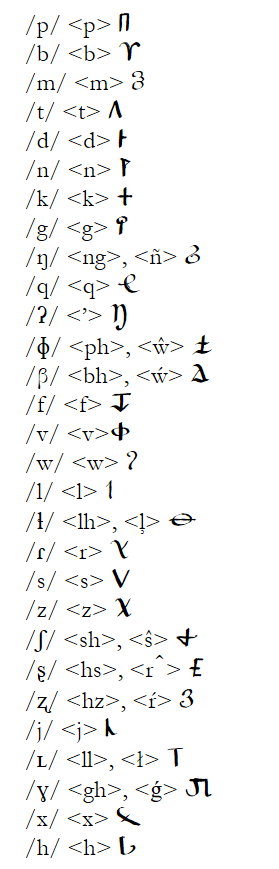
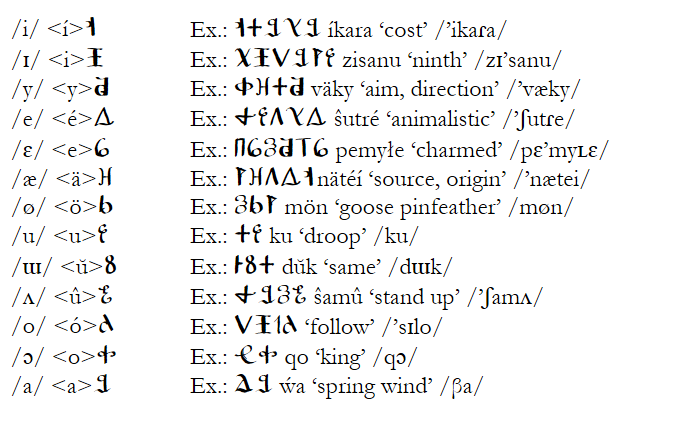
It is pretty simple conceptually. Rílin traditionally uses a phonetic alphabet, where each letter corresponds to a phoneme (distinguished sound) in the language. Rílin has a large phonemic inventory (29 consonants and 13 vowels), so there are as many letters in the alphabet.

In the below image, you can see the IPA symbol for each Rílin phoneme, followed by (in brackets) the Romanized representation (sometimes there are variants available for those times when it is not convenient or possible to use diacritic marks)

rilinletters
Consonants

vowels
Vowels