
Conlang: Ori (interrogative pronouns, deictic adjectives, a few irregular verbs)…

orikrindiaemblem

This is the purple flower of Orikrindia, the nation emblem. Its six petals represent the six provinces of Orikrindia. 

~

Here are a few more pronouns in Ori (non-personal pronons). The base forms of these words is the indeterminate pronouns (something, somewhere, etc.), while adding na- makes the words interrogative (who?, what, etc.). Similarly, adding ca- makes them negative (no one, no way, etc.). See below for the forms and some examples sentences.

alar ‘someone’

nalar? ‘who?’

calar ‘no one’


bel ‘something’

nabel? ‘what?’

cabel ‘nothing’


nye ‘somewhere’

nanye? ‘where?’

canye ‘nowhere’


sya ‘some reason’

nasya? ‘why?’

casya ‘for no reason’


tin ‘in some way’

natin? ‘how?’

catin ‘in no way’


lin ‘some time’

nalin ‘when?’

calin ‘never’


Examples:

Alars tari cyan pye Mirmis cleppat proru cyan ‘Someone said Mirmi ate poison’


Nanye minim ti-trentepya ma? ‘Where can I find the temple?’


Nasya tranye ti ma? ‘Why are you here?’


Calars tin-nelcag iyuru can ‘No one sees the gods’


Tu-porinis tun-porityan tin peli bil ‘The shepherd will probably find the sheep somehow’

~

Deicitc adjectives

Ori has two sets of deictic adjectives. These are adjectives that modify nominals to show relative spatial position–in English we have ‘this’, ‘that’, ‘these’, ‘those’. In Ori, one set of adjectives relates to spaces near and away from the 1st person (the speaker), while the other set is used with references to all other persons (2nd and 3rd).

From 1st person perspective:

ti ‘that’

tra ‘this’


tim ‘those’

tram ‘these’


From 2nd person or 3rd person perspective:

dum ‘that

del ‘this’


dumi ‘those’

deli ‘these’

Plural vs singular is the only morphological distinction, and there is no class agreement on deictic adjectives.


Examples:

dumi porisa ‘those sheep’ (far from you/another)

deli porisa ‘these sheep’ (near you/another)


tim porisa ‘those sheep’ (far from me)

tram porisa ‘these sheep’ (near me)

~

Ori has a few irregular verbs, like all natural languages. Many of them are quite common verbs.

li ‘come’

me ‘go’

te ‘do, make’

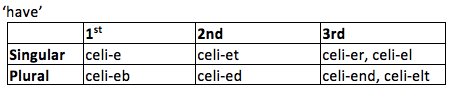
celi ‘have’

syalu ‘use’

tyelu ‘know’

malu ‘be’

maro ‘give’

Examples of conjugations of irregular verbs (where two forms are listed under 3rd person, the first form is for animate/inanimate nouns and the second is for celestial/abstract nouns):
Screen Shot 2018-06-30 at 12.18.15 AM

Screen Shot 2018-06-30 at 12.20.18 AM

Screen Shot 2018-06-30 at 12.22.41 AM

More irregular verbs and other stuff to come!

Mintaka

Conlang: Ori, continued (more verbs, tense/aspect particles)…

Last time we looked at some ways to conjugate verbs in Ori--specifically verbs ending in -i or in alveolar sounds (-t, -d, -n, -s, -l, -r). Some examples of these:

merir ‘he/she/it dances’ (animate, inanimate)

boltimbra ‘we keep’ (boltin- + -bra)

lalta ‘they laugh’ (celestial, abstract) (lar- + -lta)

As you can see from some of the above verbs, sometimes there is variation in stem or ending, as per phonotactic constraints.

Today I want to show the 2nd and 3rd conjugations, which will wrap up all of the regular verbal classes.

The first class, as we saw, includes verbs ending in -i and in alveolars. The second class includes verbs ending in -e, -a, and velar consonants (-c and -g).

cuhe- ‘cleave’

syeg- ‘steal’

ta- ‘speak’

plec- ‘fall’

Note differences in endings in bold

cuhe-ni ‘I cleave’

cuhe-ti ‘you cleave’

cuhe-ri ‘he/she/it cleaves’ (an, inan)

cuhe-li ‘he/she/it cleaves’ (cel, abs)

cuhe-ce ‘we cleave’

cuhe-cya ‘you all cleave’

cuhe-cyo ‘they cleave’ (an, inan)

cuhe-cyon ‘they cleave’ (cel, abs)

ta-ni ‘I speak’

ta-ti ‘you speak’

ta-ri ‘he/she/it speaks’ (an, inan)

ta-li ‘he/she/it peaks’ (cel, abs)

ta-ce ‘we speak’

ta-cya ‘you all speak

ta-cyo ‘they speak’ (an, inan)

ta-cyon ‘they speak’ (cel, abs)

syeg-i ‘I steal’

syeg-it ‘you steal’

syeg-ir ‘he/she/it steals’ (an, inan)

syeg-il ‘he/she/it steals’ (cel, abs)

syeg-‘we steal’

syeg-ya ‘you all steal’

syeg-yo ‘they steal’ (an, inan)

syeg-yon ‘they steal’ (cel, abs)

plec-i ‘I fall’

plec-it ‘you fall’

plec-ir ‘he/she/it falls’ (an, inan)

plec-il ‘he/she/it falls’ (cel, abs)

plec-‘we fall’

plec-ya ‘you all fall’

plec-yo ‘they fall’ (an, inan)

plec-yon ‘they fall’ (cel, abs)

~

The 3rd, and final regular verb conjugation includes verbs ending in -o, -u, and labial consonants (-b, -p, and -m).

pellum- ‘count’

cyep- ‘take, grab’

lyab- ‘lick’

brelo- ‘nuzzle against’

ryesu- ‘sip’

Once again, note changes in stem or ending marked in bold.

ryesu-m ‘I sip

ryesu-tu ‘you sip

ryesu-ru ‘he/she/it sips’ (an, inan)

ryesu-lu ‘he/she/it sips’ (cel, abs)

ryesu-bru ‘we sip’

ryesu-ru ‘you all sip

ryesu-bu ‘they sip’ (an, inan)

ryesu-ltu ‘they sip’ (cel, abs)

(Verbs ending in -o, such as brelo- ‘nuzzle against’ conjugate exactly the same way as those verbs in -u.)

pellum-u ‘I count’

pellun-tu ‘you count’

pellur-ru ‘he/she/it counts’ (an, inan)

pellul-lu ‘he/she/it counts’ (cel, abs)

pellum-bru ‘we count’

pellum-ru ‘you all count’

pellum-bu ‘they count’ (an, inan)

pellultu ‘they count’ (cel, abs)

cyep-u ‘I take’

cyep-pu ‘you take’

cyep-ru ‘he/she/it takes’ (an, inan)

cyep-lu ‘he/she/it takes’ (cel, abs)

cyep-pru ‘we take’

cyep-ru ‘you all take’

cyeb-bu ‘they take’ (an, inan)

cyel-tu ‘they take’ (cel, abs)

lyab-u ‘I lick’

lyab-du ‘you lick’

lyab-ru ‘he/she/it licks’ (an, inan)

lyab-lu ‘he/she/it licks’ (cel, abs)

lyab-bru ‘we lick’

lyab-ru ‘you all lick’

lyab-bu ‘they lick’ (an, inan)

lyal-tu ‘they lick’ (cel, abs)

~*~*~*~*~*~

Ok, so that is it for present conjugation of regular verbs. You may wonder about other tenses. Ori is pretty light on the morphological tense. It uses some different particles that follow the verb to indicate various tenses and aspects, though.

cyan — past perfect 

Ex.: Es lyab-u cyan 

3sg.inan.acc lick-1sg pst.prf

‘I licked it’

Tun-pori-tyan cyep-pru cyan

      def.art.an.pl sheep-acc.an.pl-1pl pst.prf

‘We took the sheep (pl)’

lyes — past imperfective/habitual

This particle also indicates past tense, but the aspect is different. Instead of perfect, like cyanlyes indicates an incompleted action in the past or a habitual action in the past (that happened many times).

Ex.:  Gotebinur-ipya ta-ri lyes 

Gotevian-acc.abs.sg speak-3sg.an pst.hab

‘She used to speak Gotevian’

bil modal

This modal particle indicates a speaker;s uncertainty that the statement is true.

Ex.:  En cyep-ru bil.

3pl.inan.acc take-3sg.an mod

‘He might be taking them’ / ‘Maybe he is taking them’

The modal bil particle can also be combined with the other particles:

Ex.: En cyep-ru cyan bil.

3pl.inan.acc take-3sg.an pst.prf mod

‘He might have taken them’

Ok, that is a lot of info for one post, so I will continue later! Question if anyone cares–do you want to see more linguistic info on Ori, or should I break it up with some cultural info? Shall I stick to Ori for a while or visit some other places/people/languages?

Mintaka