

December is the month that conlangers of all kinds participate in something called Lexember. We create a new word (in the lexicon) for our conlang(s) every day of the month. I’ve been participating and sharing words largely through tumblr (user: aeniith) and twitter (@MintakaGlow). Here are a few from the first days so far.
Rílin
Dec 1:
íha [ˈiha], [v tr/intr] : [1] forgive, pardon; accept, understand; [2] know, acknowledge, recognize; [3] bring attention to, point out, remark on; [4] notice, realize
Etymology: Possibly from iŵ- [iɸ] ‘take in, accept’ and ja ‘know’
Example:
íhazim kasa tañ lönenet naba ŵedínla
íha -z -im kasa tañ lön -en-et naba ŵedí -n-la
forgive-pst.prf-1s already dist woman-pl-abs whatever wrongdoing-pl-instr
“I have already forgiven those women for any wrongdoing’
Karkin
Dec 2:
vkāmēgh [vkɑːˈmeːɣ] [v tr/intr] (ki-verb class) : [1] break out of, escape from within; [2] break down a wall or other barrier; [3] (fig) destroy a boundary, flout a rule, defy expectations
Etymology: From vkā ‘strike, hit’ and mēgh ‘run, run away’.
Example:
Psi nux-ë twë qhrō ki vkāmēgh-ā -yi vuq kuqhkë mi ja wëngi-ā -pa
dist girl-3s.p who early part defy -pst-3s.a all clan gen part speak-pst-1s.a
“I spoke with that girl who had previously broken all the boundaries of her family clan.”
Rílin
Dec 3:
bióŝû [bɪˈoʃʌ] [v intr] : [1] walk precariously, walk on a slippery or icy surface; [2] be in a precarious or unsure state; [3] be in a risky state, ‘walk on thin ice’.
Etymology: From bió ‘slip, slide’ and [jó]ŝû ‘walk’.
Example:
Ŝy-ky sé zaín séfet tû pre-t pato bióŝû -l -í
be-irr prox time now do care-abs because walk.slippery-prs.hab-2s.fam
‘Now is the time to take care because you are in a precious position’
Rílin
Dec 4:
móníhas [moˈnihas] [n, inan] : [1] portent, omen, sign; [2] hint, clue; [3] tell, revealing action.
Etymology: From móní ‘watch, guard’ and has ‘sign, signal’.
Example: Né í-t -íí kuala -n-et ómina-mí, x-óly -t -aap lí-et
if look-npst-2s.fut constellation-pl-abs sky-gen caus-solve-npst-3s.fut 2s-abs the
bí ǵom-et ka-ŝó kalum-mí a oma-mí.
knot-abs two-adv world-gen and soul-gen
“If you look into the constellations in the sky, it will let you untie the knot of both the world and the soul.”
Tosi
tūgh [tuːɣ] [n] : [1] face; [2] front; [3] cover, outside covering, skin; [4] sleeve, sock, outer layer (e.g. of a wrapping, of clothing); [5] protective layer, protection, assurance, aide, help, assistance, back-up, auxiliary force.
Etymology: From Old Tosi tūhuz- “face; scalp”
Example:
Tapi sur ja da chi tūgh i vis rīy.
imp angle vrblz 2s.fem gen face obj to sky
“Turn your face toward the sky”
Tosi
Dec 6:
gungar [ˈɡuŋɡar] [v, tr] : [1] chase, pursue; [2] hunt (e.g. animals); [3] fish, catch fish; [4] seek out, look for, search for.
Etymology: From gar ‘follow’, and gun-, an emphatic prefix (cf. gun ‘great, might’).
Example:
Na gangur na chi xeti gek i, gempe tapi ixari!
1s.f pursue 1s.f gen female.servant drunk obj please imp help
“I’m chasing after my drunken servant, please help me!”
Tosi
Dec 7:
hās [hɑːs] [v, tr] : [1] fill; [2] replenish; [3] add to, increase.
Etymology: From old Tosi hāh-, hāθ- ‘full, plentiful’
Example:
Tapi hās na chi kūn i ge na gō tiv gunāl.
imp fill 3s.f gen cup obj if 3sg.f be punct.fut empty
“Fill her cup if it is empty”
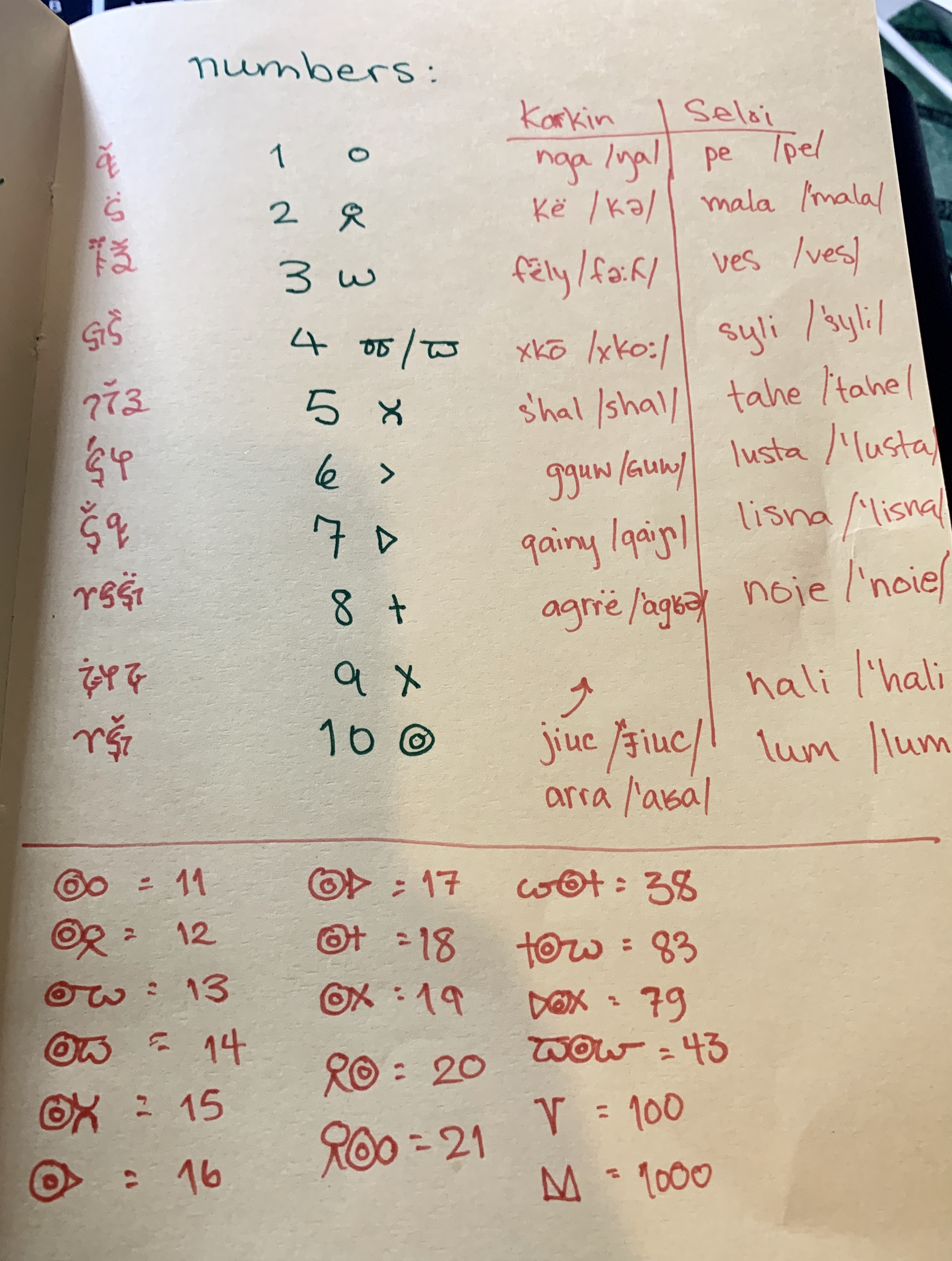
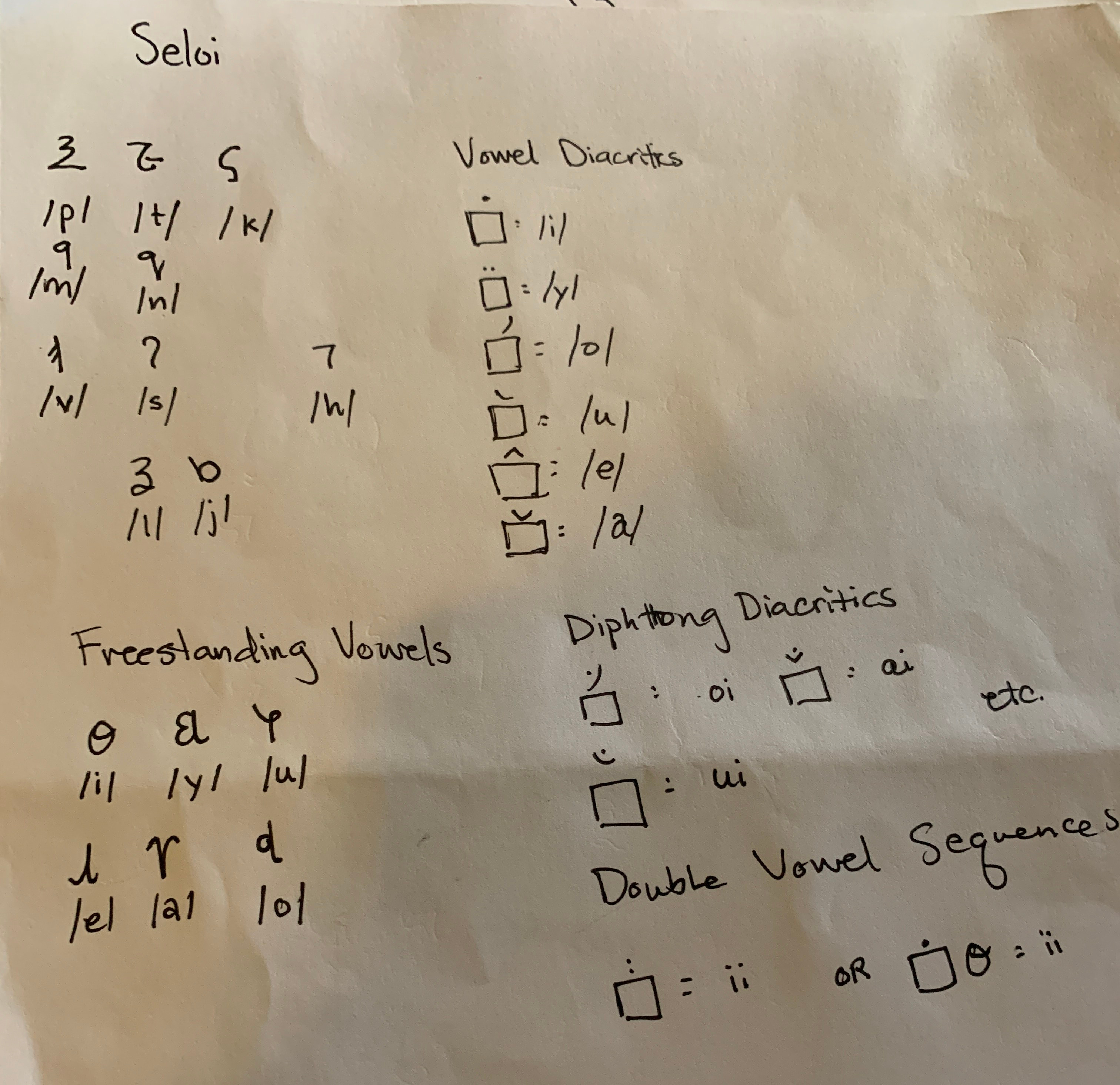 Each consonant is a full letter with the following vowels being marked as diacritics over the consonant. Freestanding vowels are written as full, and diphthongs and double vowels are either combined diacritics or a full vowel symbol plus a diacritic.
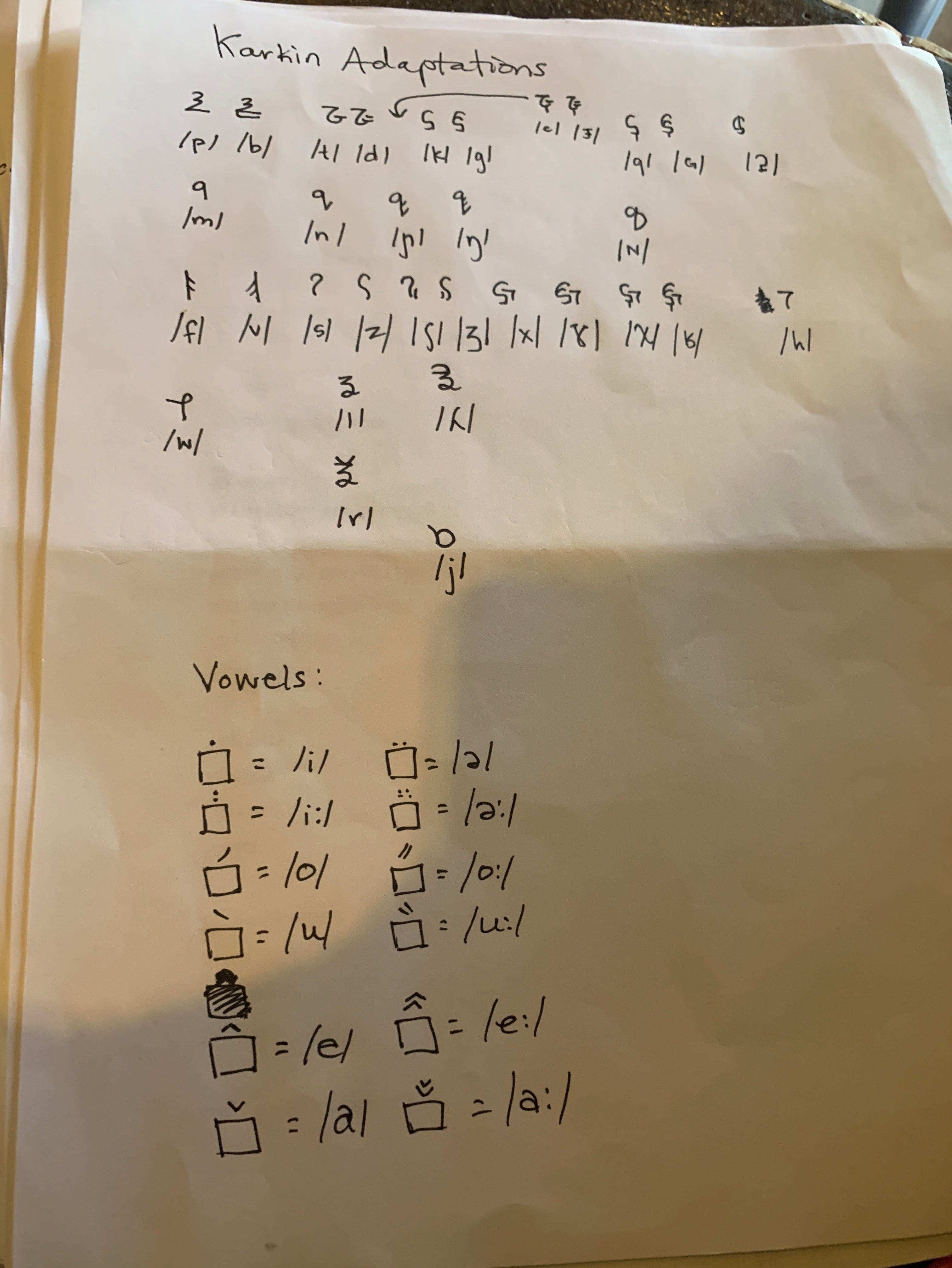 As you can see, many letters are modified to represent the numerous additional sounds that Karkin has. Some consonants have added marks to indicate that voicing (Seloi doesn’t have voiced stops like b, d, g, for example). Some letters have descender marks below them to indicate a change in place of articulation (usually farther back in the mouth). Some fricatives (like the letters for v and s) are reversed to show a change in voicing (f and z). The letter for /l/ is modified to represent /r/ and /ʎ/. Various other changes show sounds that don’t exist in Seloi. Long vowel are represented by double diacritics.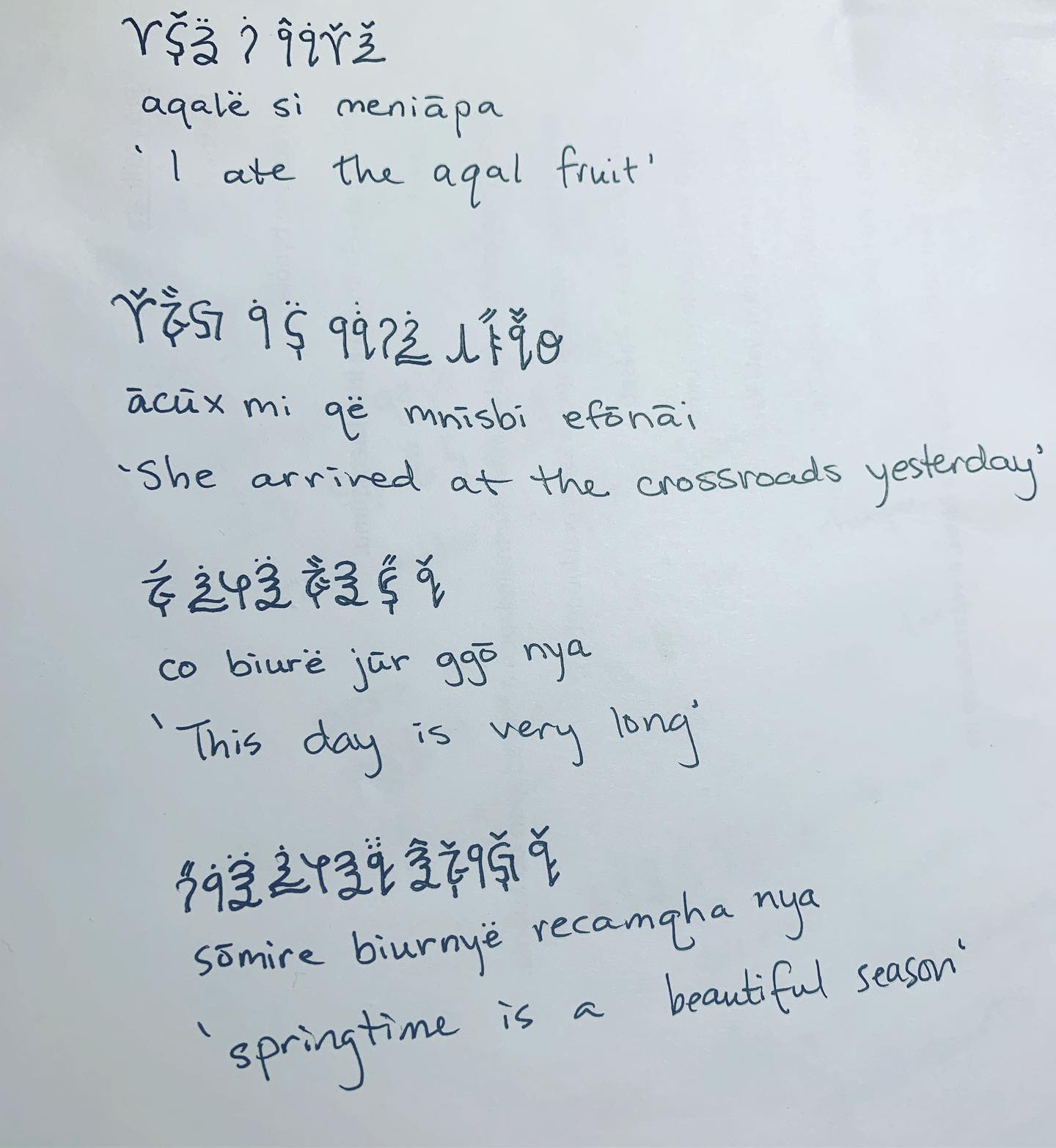

 Aeniith: A Constructed World