Naming conventions in Rílin: names of people

I have been thinking a lot lately about names. In a language, names have a variety of ways they may manifest. Some are derived from older words in the language, some are identical to contemporaneous words, and some need certain morphology to indicate that they are, in fact, names, and not just regular words.

Rílin Given Names

In my various conlangs, I’ve taken different approaches to naming people. In Rílin, for example, there are specific name morphemes that mark a word as a person’s name. Some of these are gender specific, and some are gender neutral. Some have roots are traceable to either Rílin or Old Rílin words, but some do not have even discernable meaning. Below are some examples.

Feminine Names

Some feminine name suffixes include: -tót, -í, -u, -in/-ín, -ló

The following names are all derived from contemporary Rílin words, which become names with a suffix. (You can click on each name to hear it spoken.)

Bishéín [ˈbɪʃein] – from bishé ‘bright’
Esuí [ˈɛsui] – from esu ‘griffin’
Fylûlatót [fyˈlʌlatot] – from fylûla ‘bird’
Ítshaló [iˈtʃalo] – from ítsha ‘luck’
Kisin [ˈkɪsɪn] – from kis ‘honeybee’ or maybe kis ‘slender’
Mímin [ˈmimin] – from mím ‘cute, little’
Nesú [ˈnɛsu] – from nes ‘graceful’

 -tót-in/-ín-ló
bishé ‘bright’   Bishéín 
esu ‘griffin’ Esuí   
fylûla ‘bird’Fylûlatót    
ítsha ‘luck’    Ítshaló
mím ‘cute, little’   Mímín 
kis ‘honeybee’   Kisin 
nes ‘graceful’  Nesú  
Various Rílin word roots paired with naming suffixes can create names. These names are specifically feminine names.

Not all Rílin names have clear or discernible meanings. They may still include some of the typical suffixes, but when detached from the rest of the word, that series of sounds does not necessarily make up a Rílin word.

Änsu [ˈænsu]
Äshtín [ˈæʃtin]
Alaí [ˈalai]
Bûlaísí [bʌˈlaisi]
Nímu [‘nimu]
Silin [ˈsɪlɪn]
Tsilu [ˈtsɪlu]
Tsheló [ˈtʃɛlo]

Masculine Names

Some suffixes are masculine, such as -n, -ó, -a, -ret.

Awun [ˈawun] – from awu ‘upright’
Bynóret [ˈbynoɾɛt] – from bynó ‘morning’
Daghóra [daˈɣoɾa] – from daghóra ‘sacrifice’
Evekaret [ɛˈvɛkaɾɛt] – from eveka ‘streak, brook’
Fífaía -[fiˈfaja] – from fífaí ‘advantage, benefit’
Gómó [ˈgomo] – from góm ‘thought, mind, know’
Kér̂a [ˈkeʂa] – from u ‘step forward, put (oneself) forward’

 Some names may use naming suffixes but have indeterminate root meanings.
Ekhéla [ɛkˈhela]
Feneret [ˈfɛnɛɾɛt]
Gíŕan [ˈgiʐan]
Kedûn [ˈkɛdʌn]
Pirór̂nó [pɪˈɾoʂno]
Shíburet [ˈʃibuɾɛt]
Óŕina [oˈʐɪna]

Gender Neutral Names


Other name suffixes are gender neutral, such as -ja, -bí, and -tos. These could be used for a person of any gender. Some of these names are very old and no longer have clear roots.

Béíntos [ˈbeintɔs] – unknown root
Ískesébí [iskɛˈsebi] – from ískesé ‘high, tall’
Jenja [ˈjɛnja] – probably from jen ‘day’
Kótos [ˈkotɔs] – maybe from ‘intention, meaning’

Other names may not include a suffix at all. Most of these names can be used regardless of gender.

Amlim [ˈamlɪm]
Köle [ˈkølɛ]
Ŕetsŭ [ˈʐɛtsɯ]
Nemne [ˈnɛmnɛ]
Valhén [ˈvaɬen]

Rílin Family Names

Rílin family names come after given names. Names are inherited by children from their parents. Female children inherit their mother’s name, and male children their father’s name (typically, although there are exceptions to this). Therefore, they are somewhat matronymic and patroymic in function, although they also act as family names since there is no other inherited name for most Rílin people.

For example, Silin, a middle-aged Rílin woman, would have her mother’s last name, Bízunla. Her husband, Nósh, would have his father’s name, Ínómí. Their son would take his father’s name too. Family names often concern personal traits, origins, trades, and skills. Bízunla comes from bízun ‘alarm, alert’, with a possible agentive suffix -la. So the original meaning might have been “one who warns or foretells”. Ínómí looks like the word ínó ‘color’ plus a genitive suffix –, so might mean “with color, of color”. This could either have originally referred to a personal trait (some color of the body–hair, eyes, skin, or even clothing) or it could have referred to a colorful place of origin, like a green forest or floral garden, etc.

These are just a few points concerning Rílin naming conventions. In the future, I will write a bit about Rílin nicknames as well as expand on naming conventions of other cultures across Aeniith. Thanks for reading!

I liiiive~

Or should I say: kyílaíkim!

It’s been a while! I have been involved in so many things recently, not least of which was finishing my PhD in December 2022! Now that I am now longer writing my dissertation, I have more time.

What is new in Aeniith?

Well, I began some preliminary work on a non-linear, multi-modal writing system. I also structured a language that it is used for, although only the basics of that are done. The orthography is based on shapes, color, and other features of abstract pictoral representations. Essentially, different morphemes of this rather agglutinative language are represented variously by shapes, colors, etc. featured in what are basically pictures. There is a basic template, onto which different additional shapes in different colors can be added. These add the “flavor” of the verb, which is the inflectional morphology.

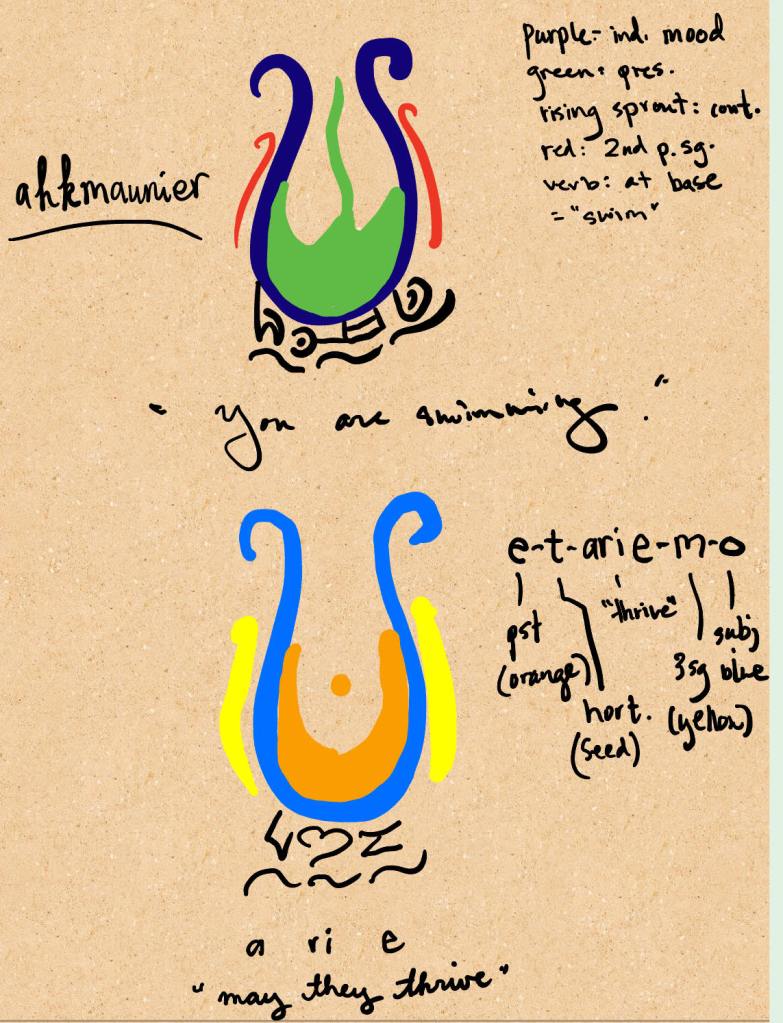
Below, you can see the verb root, which is written in a syllabary, below the “morphological seed pod”–the non-linear portion–which adds morphology to the root. For the first picture, the word written is ahkmaunier ‘you’re swimming’. The root is mauni ‘swim’, which is written in black near the bottom. The purple sides mean ‘indicative mood’, the green is ‘present tense’, the rising sprout shape is ‘continuative aspect’, while the red outer edges indicate the 2nd person singular ‘you’. In terms of the break down of the sounds of the verb, you can find it below:

a-hk-mauni-er-∅
prs-cont-swim-2s-ind

The next picture, just above, represents the verb “may they thrive”. The same basic shape is the same–see the verb root written in black at the bottom. The colors and internal shape are different though. The past tense e- is represented in the orange. The hortative morpheme, -t- is represented by the seed dot in the center. Yellow sides represent the 3rd person singular, while the subjunctive mood –o is indicated by the blue color of the basic “pitcher” shape.

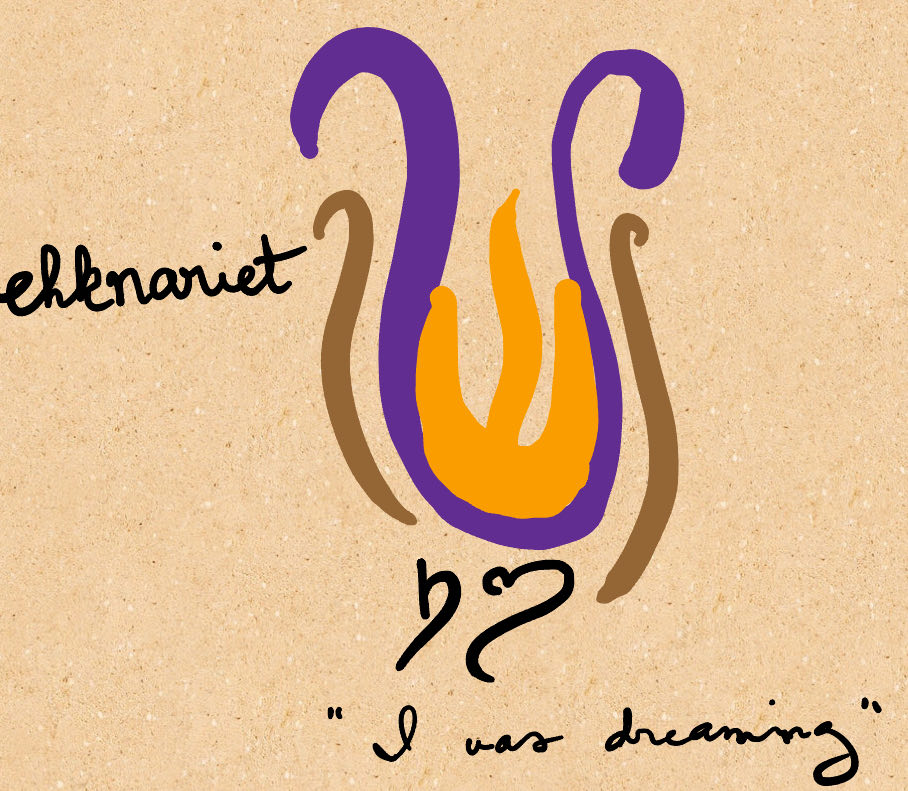
Now above, there is another example. This time, the root is nari- ‘dream’. The basic color purple indicates, again, the indicative mood, which is zero marked in this language. e-, the past tense, is represented by the center orange color. Continuative aspect -hk– is clear from the rising sprout shape. The brown sides indicate 1st person singular -(e)t.

e-hk-nari-et-∅
pst-cont-dream-1s-ind
‘I was dreaming’

Here is another example. This one represents the word ahkrōtaiam ‘he is sowing seeds’, with some additional phonological and phonetic representationss: /aʰkroːˈtaiam/ [aʰkɾoːˈtajəm]

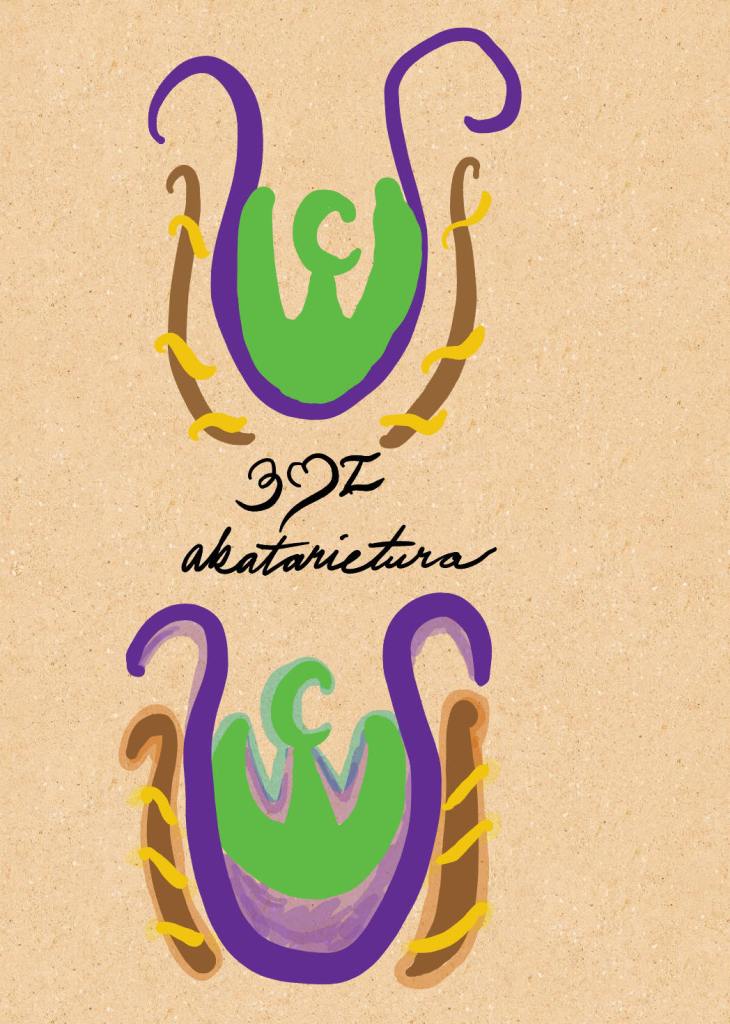
Here is another verb, akatarietura ‘I want to care for you’. This verb incorporates object marking, which is demonstrated by the yellow vines that wrap around the outer brown ‘petals’. The upper version is simpler, while the bottom version is a little fancier.

Above is a breakdown of this same word, with another version of it written/drawn. Also included here are a morphemic gloss of the word, and some examples of verb roots.

prs-vol-A-care.for-1s-2s-A
a-k-(a)-tarie-t-ura-a
akatarietura
‘I want to care for you’

I will likely be expanding this system, as well as the language it was created for, in the next few months. Stay tuned.

~Mintaka

Some Lexember examples: new words in conlangs

December is the month that conlangers of all kinds participate in something called Lexember. We create a new word (in the lexicon) for our conlang(s) every day of the month. I’ve been participating and sharing words largely through tumblr (user: aeniith) and twitter (@MintakaGlow). Here are a few from the first days so far.


Rílin

Dec 1:

íha [ˈiha], [v tr/intr] : [1] forgive, pardon; accept, understand; [2] know, acknowledge, recognize; [3] bring attention to, point out, remark on; [4] notice, realize

Etymology: Possibly from iŵ- [iɸ] ‘take in, accept’ and ja ‘know’

Example:

íhazim kasa tañ lönenet naba ŵedínla
íha      -z        -im kasa       tañ        lön -en-et     naba                  ŵedí -n-la
forgive-pst.prf-1s already dist woman-pl-abs whatever wrongdoing-pl-instr
“I have already forgiven those women for any wrongdoing’

Karkin

Dec 2:

vkāmēgh [vkɑːˈmeːɣ] [v tr/intr] (ki-verb class) : [1] break out of, escape from within; [2] break down a wall or other barrier; [3] (fig) destroy a boundary, flout a rule, defy expectations

Etymology: From vkā ‘strike, hit’ and mēgh ‘run, run away’.

Example:

Psi  nux-ë     twë  qhrō    ki    vkāmēgh-ā  -yi         vuq     kuqhkë mi  ja   wëngi-ā   -pa   
dist girl-3s.p  who early part defy        -pst-3s.a    all       clan      gen part speak-pst-1s.a
“I spoke with that girl who had previously broken all the boundaries of her family clan.”

Rílin

Dec 3:

bióŝû [bɪˈoʃʌ] [v intr] : [1] walk precariously, walk on a slippery or icy surface; [2] be in a precarious or unsure state; [3] be in a risky state, ‘walk on thin ice’.

Etymology: From bió ‘slip, slide’ and [jó]ŝû ‘walk’.

Example:

Ŝy-ky  sé    zaín séfet   tû pre-t       pato        bióŝû -l -í
be-irr prox time now do care-abs because walk.slippery-prs.hab-2s.fam
‘Now is the time to take care because you are in a precious position’

Rílin

Dec 4:

móníhas [moˈnihas] [n, inan] : [1] portent, omen, sign; [2] hint, clue; [3] tell, revealing action.

Etymology: From móní ‘watch, guard’ and has ‘sign, signal’.

Example: Né      í-t     -íí          kuala              -n-et ómina-mí,    x-óly    -t      -aap      lí-et      
      if   look-npst-2s.fut constellation-pl-abs sky-gen  caus-solve-npst-3s.fut 2s-abs the

                 bí ǵom-et ka-ŝó      kalum-mí a       oma-mí.  
                 knot-abs two-adv world-gen and  soul-gen

“If you look into the constellations in the sky, it will let you untie the knot of both the world and the soul.”

Tosi

tūgh [tuːɣ] [n] : [1] face; [2] front; [3] cover, outside covering, skin; [4] sleeve, sock, outer layer (e.g. of a wrapping, of clothing); [5] protective layer, protection, assurance, aide, help, assistance, back-up, auxiliary force.

Etymology: From Old Tosi tūhuz- “face; scalp”

Example:

Tapi sur ja da chi tūgh i vis rīy.
imp angle vrblz 2s.fem gen face obj to sky
“Turn your face toward the sky”

Tosi

Dec 6:

gungar [ˈɡuŋɡar] [v, tr] : [1] chase, pursue; [2] hunt (e.g. animals); [3] fish, catch fish; [4] seek out, look for, search for.

Etymology: From gar ‘follow’, and gun-, an emphatic prefix (cf. gun ‘great, might’).

Example:
Na gangur na chi xeti gek i, gempe tapi ixari!
1s.f pursue 1s.f gen female.servant drunk obj please imp help
“I’m chasing after my drunken servant, please help me!”

Tosi

Dec 7:

hās [hɑːs] [v, tr] : [1] fill; [2] replenish; [3] add to, increase.

Etymology: From old Tosi hāh-, hāθ- ‘full, plentiful’

Example:
Tapi hās na chi kūn i ge na gō tiv gunāl.
imp fill 3s.f gen cup obj if 3sg.f be punct.fut empty
“Fill her cup if it is empty”


Rílin language: expression of sorrow and sympathy

Well, it’s been a while! I do want to get back in to posting things here, despite my busy workload. Maybe it’s even better for me to do so because of that workload.

Anyway.

In light the recent catastrophe in Paris, I have been thinking about how the Ríli form expressions of sorrow, sympathy, condolences, etc. Languages often have formalized/idiomized or set phrases for these kinds of expressions, so I thought it was important that Rílin did as well. Rílin culture emphasizes harmony, support, respect, and sensitivity to others’ emotions, so I wanted to make their phrases of sorrow and sympathy reflect some of those values too. All of the words and grammar used herein are extant parts of the Rílin language–I am configuring them in ways that seem appropriate.

Note: the variations on the way of saying ‘you’/’your’ are due to traditional Rílin’s (and Lunauli Rílin) way of distinguishing three levels of formality/familiarity for pronouns and persons (lí at the most familiar and zana at the most formal for ‘you sg.’).

Lilaíkim – ‘I am grieving/mourning/crying’ (this word lilaí also means to weep copiously)
lilaí-k-im
/lɪˈlaikɪm/
grieve-pres.prog-1sg

Lilaíkim líu/xyu/zanau – ‘I grieve with thee’
lilaí-k-im lí-u/xy-u/zana-u
/lɪˈlaikɪm ˈliu (ˈxyu) (ˈzanau)/
grieve-pres.prog 2sg-instr

R̂yla límu/xymu/zanamu imi – Lit., ‘I am in/with thy sorrow’
r̂y-la lí-mu/xy-mu zana-mu imi
/ˈʂyla limu (ˈxymu) (ˈzanamu)/
sorrow-instr 2sg-poss

Hestia(tíí)/(tyy)/(taa)ky – Lit. ‘may you recuperate/rest’
hestia-t-íí/t-yy/t-aa-ky
/hɛstɪaˈtiiky (hɛstɪatyyky)(hɛstɪataaky)/
rest-npst-2sg.fut-irr

Bítapky Démas/Ifinŝas líet/xyet/zanat – ‘May Déma/Ifinŝe embrace/aid thee’ (depending on which goddess you would like to reference)
bí-t-ap-ky Déma-s/Ifinŝe-as lí-et/xy-et/zana-et
/biˈtapky ˈdemas(ɪfɪnʃas) ˈliɛt (ˈxyɛt)(ˈzanat)/
embrace/aid-npst-3sg-irr Déma-erg/Ifinŝe-erg 2sg-abs

Rílin script

So you’ve all probably seen at least some of my numerous poems written in Rílin, along with their accompanying script. I wanted to explain how the alphabet for Rílin works.

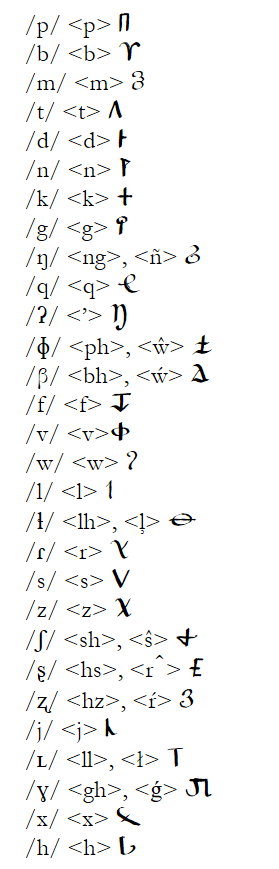
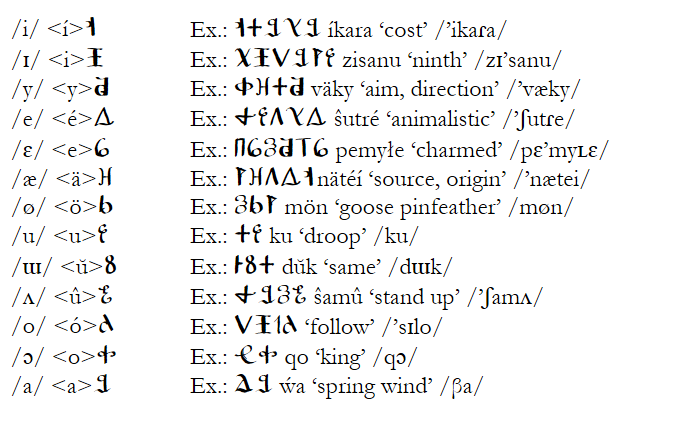
It is pretty simple conceptually. Rílin traditionally uses a phonetic alphabet, where each letter corresponds to a phoneme (distinguished sound) in the language. Rílin has a large phonemic inventory (29 consonants and 13 vowels), so there are as many letters in the alphabet.

In the below image, you can see the IPA symbol for each Rílin phoneme, followed by (in brackets) the Romanized representation (sometimes there are variants available for those times when it is not convenient or possible to use diacritic marks)

rilinletters
Consonants

vowels
Vowels


Ori needed more declensions?

I decided Ori needs more nouns declensions. 😛

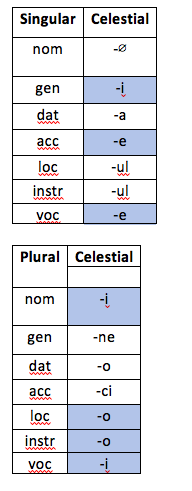
So here are two new celestial class declensions.

2nd declension (celestial)

These nouns often end in -n or -m.

Btw, the -∅ symbol in linguistics means ‘null’ or ‘nothing’. So that means the nom. sg. forms don’t add a suffix.

image

Using Calcurassen’s name as an example (in the singular, of course–there is only one of the God of Justice):

Calcurassen ryintat trulali ‘Calcurassen drinks wine’

Ti-clespes Calcurasseni astere lya. ‘Calcurassen’s jewel is bright’

Murlinis Calcurassene iyuru ‘A raven sees Calcurassen’

Hensapya Calcurassena maroi cyan ‘I gave praise to Calcurassen’

Calcurassenul minim cyan nalemapya peli. ‘By means of Calcurassen, I was able to find justice’

Hestinyal Calcurassenul lya. ‘Hope lies with Calcurassen’

Oa, Calcurassene! Maropye tyeli abarig! ‘Oh, Calcurassen! Give us blessings.’

~

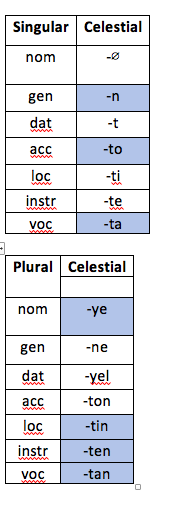
The next declension is also for celestial nouns–most of these ending in vowels.

3rd celestial declension

image

Examples:

Ti-hembe lilya rya. ‘The body of fresh water is small’ (Note that ‘small’ still agrees with embe–it just uses a different celestial (nom sg. suffix, the one from the very first celestial declension I introduced, which is -ya rather than -∅.)

Culleryal caben bellu. ‘The expanse of the world is wide’

Gilupye yalutyin tatyin ti-trahellet ‘Turn your eyes to the meteor shower’

Ok, you get the idea. 🙂

~

Mintaka

Orikrindian lore and legend

I want to do a new segment about Orikrindian lore and legend (which may expand to other cultures), small little blurbs about ideas that have been floating around my head for a while. They don’t really have a home yet so we’ll see what becomes of them.

~

Today’s is about the Song of Esala. The word is not originally Ori, but comes from a nearby language from the mainland of Ei to the west. The word was originally Ashal, but changed over time and to fit Ori phonology a bit more closely.

The Song of Esala is a song that is supposedly divine in nature, or at least somehow supernatural. It is said to be heard in the wilderness when one is completely alone and can neither see, hear, nor sense in any way another person. It is at this time that one may hear the Song of Esala. What Esala is or means is not clear. There are competing etymological theories, variously saying that it is the name of a person, a place, or a concept.

To hear the Song of Esala is a disturbing experience. The listener will think they are going mad and may run even deeper into the wilderness, always avoiding the proximity of any other person. It is thought that this leads them to wander permanently and live like a wild person until a certain, unspecified time before their death, during which they will be released from the hold of the Song and “wake up” from their fervor or delirium. This time is usually months to years after first hearing the Song.

The Song is thought by some in Orikrindia to be a curse of the goddess Moltirin put upon those who have displeased her in some way. Others, however, consider it a kind of intense blessing given by the spirits of animals in the wild that have found a soul that they deem kindred to their own and wish to draw it in amongst themselves. This view is the predominant idea in Behr Gehen (country of the Ei Lands, west of Orikrindia). Those who return from being held by the Song are considered holy and are given special treatment upon their return to society.

Whatever the nature of the Song of Esala, it is a part of folklore that is commonly understood as one of the many risks of venturing into the wilds alone for lengths of time, both across Orikrindia and the Ei Lands.

~

Mintaka

Ori derivational morphology

So this is obviously a work in progress, BUT here are some new Ori derivational morphemes! Yay! I like them.

Derivational Morphemes

-u

This morpheme comes from the word hu‘one’, and it often added to adjectives to create a noun.


lil ‘small’ –> lilu ‘small one’

truma ‘red’ –> trumu ‘red one’


It can also be used with other nouns, however:


cleppa ‘poison’ –> cleppu ‘poisoned one’


-ya


-ya is a gerund marker; it nominalizes a verb (transitive or intransitive):


ta ‘speak’ –> taya ‘speaking’

aste ‘reckon’ –> asteya ‘mathematics’

pra ‘listen’ –> praya ‘listening; educational lecture’

lyeppe ‘enjoy’ –> lyeppeya ‘enjoyment’

clasin ‘become flat’ –> clasinya ‘flattening; (of a person) becoming boring’


-uya


-uya is a suffix that indicates ‘beginning of V/N’, meaning it can attach to either a verb or a noun.


Note that if there is a vowel at the end of the bound morpheme, that first vowel is deleted before -uya.


lyannis ‘make a pilgrimage’ –> lyannisuya ‘beginning of a pilgrimage’

ta ‘speak’ –> tuya ‘beginning of a speech’

syala ‘rule, reign’ –> syaluya ‘beginning of the reign of a king’

becul ‘cave’ –> beculuya ‘antechamber of a cave’

besti ‘earth, ground’ –> bestuya ‘top layer of soil’

cul ‘moon’ –> culuya ‘new moon’

Sometimes the meaning of this suffix implies smallness due to something being “only the beginning of [and no more]” V/N:


lar ‘laugh’ –> laruya ‘a short laugh, a clipped laugh’

lubela ‘secret’ –> lubeluya ‘just a little secret’


-on


-on is an augmentative suffix that applies to nouns.


lyuha ‘dog’ –> lyuhon ‘large dog’

ori ‘man’ –> orion ‘big man’

mil ‘tree’ –> milon ‘large tree’


-li


-li is the opposite of -on, a diminutive suffix for nouns.


lyuha ‘dog’ –> lyuhali ‘puppy’

bistraya ‘flower’ –> bistrayali ‘bud, small blossom’

coru ‘rock’ –> coruli ‘pebble’

bu ‘house’ –> buli ‘room inside a house, chamber’

hesta ‘mountain’ –> hestali ‘hill’


e

-e is a common ending for adjectives (e.g. nale ‘true’, clippe ‘rotten’, balnye ‘great’). It can also function as a derivative morpheme for adjectivization from nouns.


Usually, if there is a final vowel on the base noun, it is replaced by -e.


hustu ‘belief, trust’ –> huste ‘trusting’

cleppa ‘poison’ –> cleppe ‘poisonous’

galacil ‘smoke’ –> galacile ‘smoky’

lubela ‘secret’ –> lubele ‘secret (adj.)’

roru ‘darkness’ –> rore ‘dark’


cli-/clip-

This is a pejorative prefix that usually affixes to nouns. It comes from the adjective clippe‘rotten, sour’. The cli- form precedes consonant-initial words, whereas the clip- form is used with vowel-initial words.


prasta ‘mind, thoughts; behavior, actions’ –> cliprasta ‘betrayal; treason’

olta ‘tomb’ –> clipolta ‘a badly made or ritualistically wrong or unclean burial’

gerum ‘death’ –> cligerum ‘a dishonorable death’

ha-


This prefix can be used as either an augmentative or an ameliorative (“good N”) prefix.


pyelli ‘pain’ –> hapyelli ‘great pain’

selis ‘teacher’ –> haselis ‘a good teacher’

lyuha ‘dog’ –> halyuha ‘a particularly loyal dog’

bela ‘word’ –> habela ‘eloquence’

belta ‘wind’ –> habelta ‘a sudden warm wind in the winter’


Mintaka2

Working on the pantheon of Orikrindia. This is part 1, the first three members.

~

Orikrindian pantheon

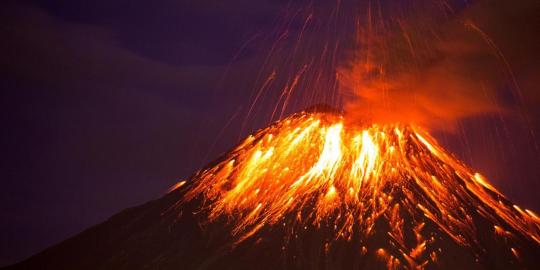
Apyolus– Father God – God of Fire, Lava, Volcanoes, War, Season of Summer, the Sun (Worshipped as Force of Creation, as a Progenitor of all life, a driving mechanism of all living things)

Epithets: Ti-Hasterya Apyasye (The Light of Fire), Ti-Lyaya Iyutreseya (The All-seeing Sun), Yalus (Eye), Tetuya Huseya (First Father), Ti-Hupuse (The Knowing), Yoris (Watcher)

Apyolus is worshipped as a creator of life, a driver of existence. Without Apyolus it is believed all things would be as dead and empty husks, existing the likeness of life but without the crucial spark of consciousness.

The priesthood is Apyolus is all-male and open to those who have fathered at least one child. Their temples tend in be in cities, at the feet of volcanoes, and in the southern most reaches of Orikrindia. In the summer is the Festival of Fire, wherein people make material sacrifices to the fire in hopes of gaining such boons as: fertility/children, health good crops, warmer weather in winter, renewed physical and mental vigor.

Hestaya: Mother Goddess – Goddess of the Mountains, Air, Wind, Cold Weather, Snow, Ice (Worshipped as a stable force in the world, a protector, defender) –

Epithets include: Ti-Nimaya (the Mother), Ti-Nimaya Balnyeya (the Great Mother), Nimaya Coruni (Mother of Stone), Corus Cacalsas (Undying Stone), Crestenya Astersye (Kindler of Light [e.g. lightning via storms])

Prayer to Hestaya:

‘The solidness of the mountain

of stone

of ice

the movement of wind

the forbidding power of storms

the threat of winter

the protective blanket of snow covering the earth,

this our Mother

the Mighty

and the True

the One Who Covers,

The Kindler of Light

The Mother of Stone,

Undying and Eternal

Her light will find you

In the dark

Her stones surround you

Where no enemy can pierce’

Moltirin– Goddess of the Forest:also matron goddess of mysteries, vengeance, the past, memory, rebirth/reawakening, justice, lost things, women who have died in childbirth, dead children, men who have died in battle, storms, and those who have been wronged.

Associated with: birds of prey (especially ravens and vultures and other carrion creatures), wolves, snakes, spiders, vines/plants/trees, the color green/black/grey

Epithets: Ti-Roruya (The Dark), Cyentas Nastas (Wise Aunt), Emas Tin-Mulyurana (Woman of the Forests), Cyeltenalenya (Revenger), Murlinis (Raven)

Moltirin is equally feared and loved. She is the sister of Hestaya, who is married to Apyolus.

She inhabits all forests and is a very mysterious figure, rarely responding to the entreaties of humankind. When she does, though, it is with ferocity and sincerity. Moltirin may take the form of a young or very old woman. Prayers to Moltirin are given by those who have been wronged, those who are lost, who are pariahs, those whose honor has been destroyed (either by themselves or others). She is a protector of women and children, occasionally protecting them via deception or violence. She keeps the souls of those who die within her woods, as well as the souls of the drowned. These spirits are said to wander the places where they died, as it is there that they are with Moltirin.

Devotees to Moltirin often live in forests as hermits or wise women. They, like their goddess, are both feared and respected. Many work as apothecaries as well, specializing in both healing substances and poisons. In Orikrindia, one might visit a Woman of the Woods (as they’re typically called) to procure a less-than-legal concoction for whatever need.

Thoughts on Orikrindian vs Quariosian culture

It’s kind of difficult to me to say what Quariosian culture is, because it’s made up of so many things/people/histories. It is, by nature, multi-faceted. Quarios is, at the time of Elucuna’s arrival, a relatively new state. It was born, politically, of a merger of two countries, Gotêvi and Lomilin. Gotêvi also consisted of several different nations in its southern regions, such as the Teg and Phul peoples. From an early time, then, these two separate nations were not homogenous, but culturally complex. The first rulers to merge the two countries were Queen Inacaporia of Gotêvi annnnd…some other dude whose name I forget, who was the Prince of Lomilin. Anyway, I think they merged the country both via their marriage to each other and also by a mutually agreed upon pact that would combine their states into one. The process, as you could imagine, was not a quick one. It took years to carefully intertwine the countries into one new country, which now covered the whole of the continent. The name Quarios was previously just the name of the continent, but then began to refer to the new country as well.

The port city where Elucuna lands in Quarios, Naeglitan, is a Gotevian city. It is Gotevian in its cultural origins, the language used there is Gotevian (even though Quarios has two official languages, Gotevian and Lomi, only governmental documents, signs, etc. are required to be in both languages). Glohitan is culturally and ethnically Gotevian (the meaning of ethnicity here, is separated from physical identifiers such as skin color, as people in Quarios have differing skin tones/facial features depending on whether their ancestors came from the north or south of the continent–the northerners tend to be darker in tone, but this fact is not as culturally salient for the Gotevians as other factors of their origins may be), but he is multilingual, and speaks to Elucuna in her native Ori. He considers himself a Gotevian, but also a Quariosian. Many inhabitants of Lomilin would likewise say that they are Lomi, but also Quariosian. Members of the other nations of peoples of Gotêvi identify themselves as Teg, or Phul, or whatever, but also Quariosian. Some of these people would also use the word Gotevian to describe themselves, depending on their personal attitude toward the government/majority culture of Gotêvi.

So all of that is what’s behind my thoughts when I think, “What does it mean for Elucuna to be in Quarios? What is this culture she is encountering?” The thing is, her journey is just beginning, and she will come into contact with myriad aspects of Quarios, and will discover how different from each other they can be. She’ll also discover that what she thinks she knows about Quarios may not always hold true–still other elements of her new surroundings will surprise her. For example, I imagine that Elucuna is a skilled knitter and fiber artist. This is a typical kind of skill to teach girls in upper-class Orikrindian homes. She views this activity as deeply feminine and completely hidden from the world of men. In Gotêvi, however, there are artisanal guilds of fiber artists, and many of their members are male. This is something that both surprises and intrigues here. In Orikrindia, men habitually do not devote any thought or attention, and certainly not any admiration, to the private arts of women (when it comes to things like knitting, embroidery, etc., at least). In Gotêvi, I think she would feel almost overly flattered that a man would show interest in her work and her skills, even though to them, it is just a normal amount of respect as one would show to a skilled colleague whose work is interesting or worthy of attention. Perhaps one of these men who compliments her work or shows interest in it is slightly confused as to why she feels so honored that he would talk with her about it, as for him, he talks with his female colleagues all of the time and does not consider it particularly special.

I have all of these scenarios forming in my head about how Elucuna interacts with, and responds to, the differing cultural environments around her. I hope that my writing will hold tight when it comes time to put these ideas into the story.

~

Mintaka